Episode 4
Why don't more people vote?
 Crash Course
 USAFactsCrash CourseUSAFacts
Featured visualization
Voter turnout in the last two midterm elections has been higher compared to midterms in the past four decades.
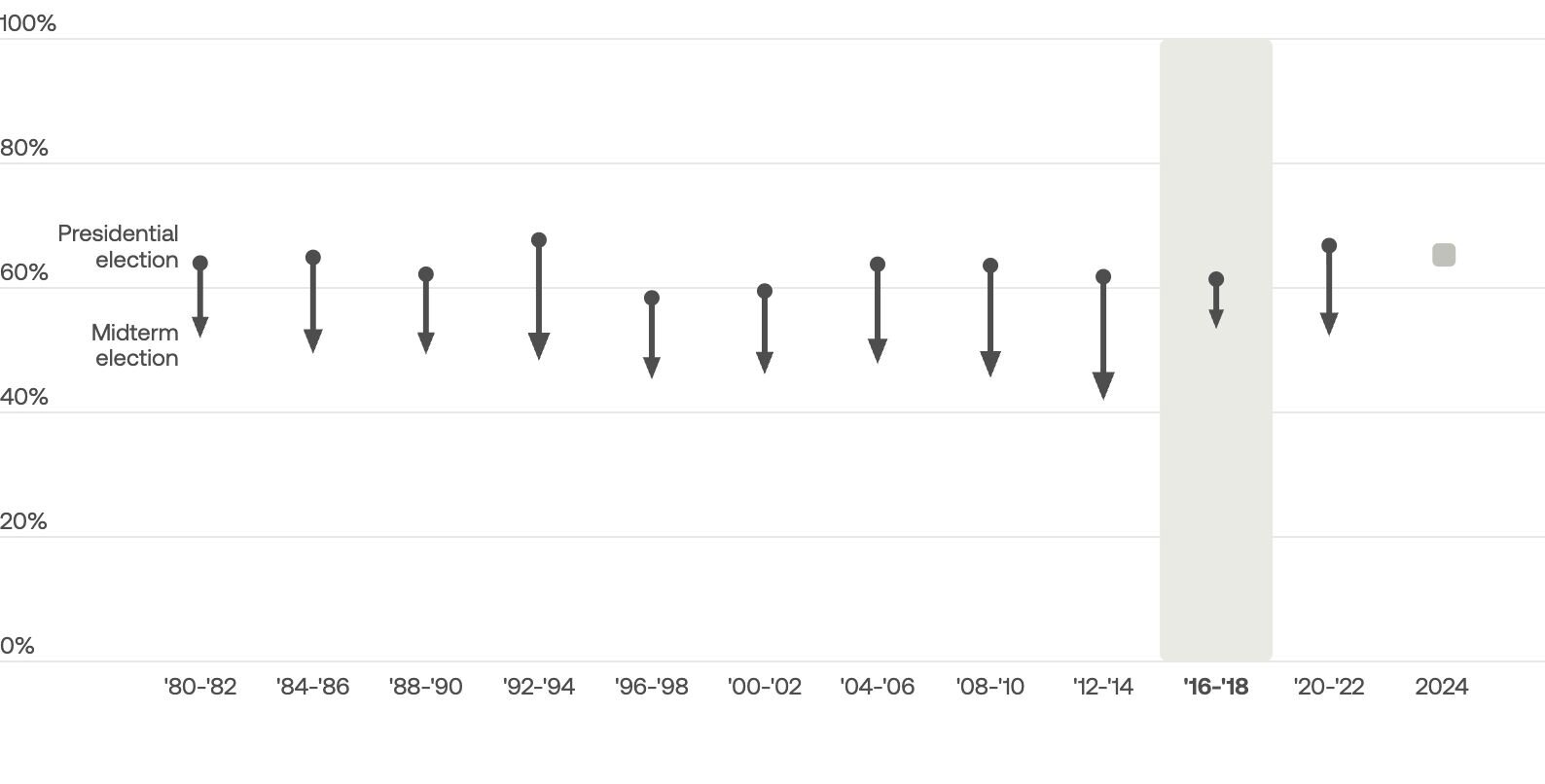
Interpret the graph
Ask yourself
Explore voting visualizations
Class materials
Eligible voters
Everyone who is legally allowed to vote in an election.
Voter turnout
The number of eligible voters that actually vote in an election.
Expressive choice
A theory that claims voting is more emotional than rational.
Rational choice
A theory that claims voting is more rational than emotional.
Disenfranchise
Prevent a person or group of people from voting.
Voter ID laws
Laws requiring voters to show ID at polls.
Voter registration laws
Laws that regulate voter registration.
Description
Why don’t more people in the U.S. vote? In 2024, 90 million U.S. voters made a choice on election day…the choice not to vote. The U.S. has some of the lowest voter turnout of any developed democracy. To find the answer, we have to take a hard look at ourselves, but also at the systems that make us want to vote, or stay home.
Transcript
When it comes to total voter turnout, the last two presidential elections have had more individual people show up to vote than any US election ever.
In 2024 about 75 million people turned up to vote for Kamala Harris, and around 77 million for now-president Donald Trump. But nearly /90/ million eligible voters, more than /either/ of those numbers, made a different choice that day…by not voting at all.
So, what stopped them? Well, that is the 90 million voter question.
Hi! I'm Kousha Navidar, this is Crash Course, and we’re answering Big Questions on U.S. Government.
In any democracy, voting is the /cornerstone/ of the whole system. And it’s one of the most empowering actions everyday people can take to make our voices heard and help shape our political future… theoretically.
I mean, let’s be real. When the political world seems out of control, and your vote is just one of literal /millions/, at times, the whole thing can start to feel a little pointless. It’s like in Star Wars– [BCAM] Don’t groan at me, ok?
[ACAM] It’s like in Star Wars: there’s a whole galactic war going on…and you’re just a single, kind-hearted droid. Beep boop.
So each of us is left with a choice – to vote or not to vote? That is the question.
And the answer says a lot about us…but maybe even more about the systems we’re all living in.
Now, let’s get one important thing out of the way: not everyone living in the US is allowed to vote in the first place. Like, out of the approximately 340 million people living in the US in the 2020s, broadly speaking, the only people who can vote in US federal elections are US citizens, so undocumented people, tourists, green card holders, and fancy foreign diplomats are all out of luck. Voters also have to be at least 18 years old at the time of the election, so kids and younger teens can’t vote, no matter how badly they want to.
Quick story: I became a citizen when I was 16, right before the Kerry-Bush election. /Look/ at that 2004 drip. During my naturalization ceremony, they kept telling me how great it was that I could finally go vote, especially since it was a presidential election year. But they must’ve been talking to everyone else in the room. Because I was 16, and I’d have to wait another 4 years to cast my vote for the president.
Even if you are both a citizen /and/ over 18, some states also prohibit people from voting if they have felony convictions, or certain cognitive disabilities. And folks who live in US territories, like Puerto Rico, aren’t allowed to vote in presidential elections, either (which is a whole other can of worms).
So from that 340 million people who live in the US, if you take out the kids, noncitizens, and anyone else who’s DQed and you add in all the expats who are allowed to vote absentee, you’re left with about 244 million people as of 2024.
These are the country’s eligible voters, everyone who is legally allowed to vote.
But again, not all of us do. The first step to voting is /registering/ to vote. And in 2024, less than 3 in every four people who were eligible to vote managed to make it even that far. And when the election rolled around, only about three out of every five eligible voters, very roughly 60ish%, actually cast their votes.
That’s known as voter turnout, the number or percentage of people who /can/ vote and actually /do/.
That seems really, really low to me. But actually, 60ish% is fairly standard for the US. Voter turnout for presidential elections in the US historically ranges from around 50 to about 80%.
And while it’s definitely not nothing, it does put us behind a bunch of other countries from to Indonesia to Iceland.
So, we can ask why those 90 million people /didn’t/ vote in 2024. But we can just as easily ask why 150 million people /did/– and what /both/ answers say about our system in the US.
To start answering this question, let’s examine humans as emotional beings who love to express themselves. Art kids have oil paintings, musical theater kids have Sondheim, and the rest of us have– voting.
Expressive choice voting says that people vote just to feel like their opinion is being heard, and that the benefits they get are more emotional than rational.
So maybe we have to factor in the value of standing in line with your Anti-Arugula Party t-shirt on. Or the joy of strutting around in your I Voted sticker the rest of the day… [week….year…ok listen you don’t /technically/ need to put sweatshirts in the laundry!]
But what about the voters who are more analytical Droid than warm-and-fuzzy-but-filled-with-violent-emotional- rage Wookie? The rational choice assumes that voters are rational actors who, like all hypothetical rational beings, want the benefits of their actions to outweigh the costs.
It’s basically an equation, where the utility of voting equals the perceived benefit (all the good stuff the person you’re voting for might do) minus the perceived cost ( lost work hours, money spent on transit, time that could have been spent listening to Anakin Skywalker talk about how much he hates sand).
Yeah, it’s another Star Wars joke!
The rational choice can even account for other factors that might influence your decision to vote, like your perception of whether or not that vote will actually influence the election’s outcome. We call that P, and it multiplies that perceived benefit.
Mathematically, that number is /always/ going to be really, really low; especially in state and national elections, where your vote is just one in a sea of thousands if not millions, it can be really hard to imagine it has any power at all. But when elections are really close, a single vote can seem a lot more powerful.
This idea appears to impact voting behavior. It’s why presidential election turnout tends to be way higher in competitive swing states like Michigan than solid red states like , or blue ones like Hawaii.
And it makes sense from a lot of angles. Closer elections get a lot more advertising, money, and media coverage because the candidates are trying hard to win. And from the perspective of expressive choice theory, closer elections feel like they have higher stakes, which gives people big feelings they want to express at the polls.
But here’s the thing. Even in the closest elections, that P term is realistically pretty close to zero. /Your/ vote will probably never decide a national, statewide, or probably even a local election. So, regardless of the costs and benefits of voting, rational voters should basically never vote at all.
But there’s something else at play here: “D”for “civic duty.”
[ACAM]This means that people vote not just because they stand to gain something, but because it feels like their responsibility – a responsibility that makes them a part of the huge, nationwide, collaborative enterprise that is our democracy. Like individual feathers on a majestic bald eagle, when enough people vote, we can soar high above the mountains, gorging on salmon and spreading the wings of democracy. But if too many people (or feathers) fall out, we end up with– whatever this is. No offense.
But personal feelings, be they expressive /or/ rational, are only a tiny piece of the puzzle. The rest depends on…the system.
We’ve talked before about how the US’s two-party system makes it hard for politicians to actually represent their constituents. So maybe some people feel like it’s actually more rational and expressive to not vote at all rather than voting for the lesser of two evils. [B CAM] Though I personally have no issue voting for the lesser of two weevils.
A 2020 poll found that about 20% of nonvoters didn’t vote because they didn’t like either candidate. Another 20% felt like their vote didn’t matter, and 25% simply didn’t engage in politics in general. But that leaves a whole 35% who were engaged, supported a candidate, and genuinely felt their vote was important who still didn’t manage to make it to the polls. And while every voter’s circumstances are different, plenty of roadblocks to voting come straight from our government itself.
Now, the US has a /long/ history of voter suppression, or roadblocks meant to make it /harder/ to vote, even if you were technically eligible. For instance, Black male citizens were /technically/ given the right to vote in 1870 under the 15th amendment, but Southern states used tactics like poll taxes and literacy tests to disenfranchise them, or prevent them from voting.
It was only 95 years later, in 1965, that the Voting Rights Act made these practices illegal.
But while poll taxes and literacy tests have gone the way of the muttonchop, many of the VRA’s protections have been whittled away, making room for plenty of /new/ institutional barriers to voting.
Like voter ID laws, which require voters to show ID at the polls. These are meant to keep our elections safe from voter fraud, but they also have the effect of making it more difficult to cast your vote in an election. 36 states have voter ID laws. And /ten/ of those states require an official /photo/ ID, which means even a social security card or birth certificate won’t cut it. So if you haven’t made it to the DMV lately because you’re too busy working, or taking care of your family, or both, you can’t cast your vote, either.
And it makes a non-insignificant dent in who votes in elections; when Texas Attorney General Greg Abbot enacted new voter ID laws in 2013, it instantly disqualified 600,000 registered voters who didn’t have proper photo ID – disproportionately affecting people of color. And while this particular law was overturned, /plenty/ of others have followed in its footsteps.
But voter ID laws are far from the only structural barrier to voting. There are /plenty/ of state laws that make it harder for people to vote, depending on where you live.
Like, different voter registration laws can make registration smooth and leisurely… or a high-stress gauntlet on the scale of the Aldi checkout line.
About half of states register you to vote automatically when you do certain things, like get a drivers’ license. Some others allow online registration, so you can sign up to vote without ever leaving your laptop. And about twenty of them allow you to register to vote and cast your ballot at the same time, on election day.
But some states make it harder. They require you to register yourself in /advance/ of the election, which serves to lower voter turnout– so no /wonder/ only about 75% of eligible voters are actually registered!
Rules about early, absentee, and mail-in ballots can also make voting harder or easier. Letting people cast their votes /before/ election day, or without physically going to the polls, makes things a heck of a lot easier for voters who are older, or have disabilities, or can’t get off work on a random Tuesday. But states handle those differently too – some let anyone who wants to vote early or absentee, but others require specific excuses.
And while these roadblocks are meant to protect our elections, they also increase the /cost/ of voting, along with those other hurdles like the time, effort, and money it takes to go do the thing. And these all press hardest on people with the least wealth and free time, who we see based on data are more likely to be people of low socioeconomic status, racial minorities, and younger people – groups where we also tend to see the lowest voter turnout.
But to some degree, the hassle impacts all of us. And lots of people think that just making voting /easier/, like making Election Day a federal holiday like they do in South Korea, or moving it to a weekend like Australia, would probably make more people more likely to do it.
So if you choose not to vote, that is a personal decision. But it’s not one you’re making in a vacuum. You’re making it alongside /90 million/ other citizens. And when you look at the big picture, that one decision starts to seem a lot less about you, or me– it’s a lot more about the system as a whole.
So no, frankly, you’re not imagining it: voting in this country isn’t necessarily easy, and it never has been. Inequalities in our system, they’re kinda by design, because as much as people in the US /love/ to spill tea about the wonders of democracy, rules around who gets to vote and who doesn’t have always been hotly contested– and those debates aren’t just about fairness. They’re about power.
The right to vote has been fought for by generations of women, people of color, and other previously disenfranchised groups. When I became a citizen, I became a part of something way bigger. And that right I got that they kept hammering home at my naturalization ceremony—the right to vote— is what makes our democracy, well, a democracy. And it may not be rational, but it /does/ make a difference, if we all do it together.
But even if /every/ eligible voter turned up, US presidential elections would still have another complication– the Electoral College. Ho boy. I have one college degree, one masters degree, and one stint in politics, and this stuff is /still/ confusing. So buckle up, and I’ll see you then on Crash Course: Big Questions on US Government.
[OUTRO]
This episode of Crash Course Big Questions on U.S. Government was produced in partnership with USAFacts, a non-partisan civic tech project that makes government data easier to understand.
Thanks for watching this episode of Crash Course Big Questions on U.S. Government, which was filmed at our studio in Indianapolis, Indiana, and was made with the help of all these nice people. If you want to help keep Crash Course free for everyone, forever, you can join our community on Patreon.

Published Oct. 13, 2026
by Crash Course
Teaching the full Big Questions about US Government series? Get materials for every episode.
Subscribe to get classroom materials new Crash Course episodes, and USAFacts data for teaching civics.

