How big is the US national debt?
In this episode of Just the Facts, Steve Ballmer breaks down the data behind America’s national debt using official U.S. government sources. The US national debt now exceeds $38 trillion, the highest level in history. But that number alone doesn’t explain what the debt is, how it grew, or what it means for the economy.
Up Next

Transcript
I'm Steve Ballmer, former Microsoft CEO and a basketball fanatic. But more than anything, I'm a data guy. That's why I created USAFacts, to bring you unbiased and nonpartisan government data on issues impacting the lives of Americans.
I'll share with you the facts and data, all from our government, you make up your own mind. In this episode of Just the Facts, how much do we owe? The national debt. Imagine if America had a credit card and the balance due was over $38 trillion.
Well, our national debt is 38 trillion, an all-time high. But exactly what does that mean? And how did we get here? It starts with the yearly federal budget. For example, for fiscal year 2024, the government took in 4.9 trillion in taxes, but spent $6.8 trillion.
The difference, $1.8 trillion, is the 2024 deficit. The government spent more than it took in. That was just 2024.

The fact is the US federal government has run a budget deficit in 92 of the last 125 years. To cover the spending that exceeds revenue in these years, the US Treasury borrows money by issuing government securities, like treasury bills, treasury notes, and bonds, which are just differentiated amongst themselves by the time the country has to repay them. These are IOUs.
Investors from banks, businesses, and pension funds to individual citizens and foreign citizens and foreign governments, even our own state and local governments buy them, loaning money to the government in exchange for future repayment with interest. That's right. You personally can buy Treasury securities right now at treasurydirect.gov. Add up all the deficits over time, which includes all the interest from borrowing money and all of our expenses, and subtract any surpluses, which is when we actually take in more money than we spend, and that's the sum total of everything we owe, the national debt.
By the way, an interesting aside, each year the government borrows money to cover the deficit of that year, but that's not all the borrowing. When the older debt, the debt we already borrowed, comes due, the government actually has to then borrow more money just to pay off what it owes on the old debt. That's what happens when you run big deficits year after year after year.
Why does the national debt matter? Well, for starters, paying interest on the debt in 2024 alone is the third largest expenditure by the federal government, bigger than Medicare and National Defense. We'll explore the debt in more detail, but first, some history. The U.S. has had a national debt actually from the beginning.

In 1790, just two years after the Constitution was ratified, Treasury Secretary Alexander
Hamilton reported that the federal government owed about $71 million, mostly from the Revolutionary War and from the federal government assuming the debts of the states. Over the past 230 years, the debt has really grown. The following examples are not adjusted to today's dollars.
They're not inflation-adjusted. During the Civil War, the debt jumped from about $91 million to $2.7 billion. World War I, it went from $3.1 billion to $27.4 billion.
World War II, the debt soared from $49 billion to $259 billion. In the 1980s, it tripled from $908 billion to, for the first time, over a trillion dollars. It tripled to $3.2 trillion because of slow growth in tax revenue and increased defense spending.
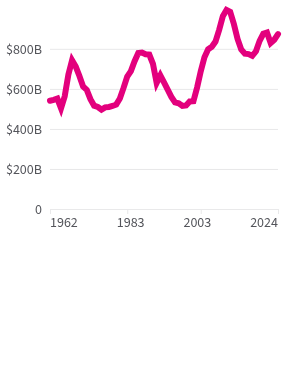
During the Great Recession, it increased from $9 trillion to $13.6 trillion. And with COVID-19, the debt rose from $27 trillion to $33 trillion, more than six trillion growth due to pandemic relief efforts. As of August of 2025, the national debt is over $38 trillion.
Let's break that down. The total national debt includes two major parts, intragovernmental debt and debt held by the public. What is intragovernmental debt? Intragovernmental debt is what the federal government owes to itself.
Huh? How's that possible? Here's an example. Your Social Security taxes go into a trust fund to pay benefits for people on Social Security. And all that money is invested in Treasury securities.
In 2024, intragovernmental debt totals $7.36 trillion. The rest of the debt is called debt held by the public. And that debt is owed to outside entities, to individual citizens, to banks, to investment funds, to state and local governments, to the Federal Reserve Bank even, and of course also foreign countries.
At the end of 2024, it totaled $28.86 trillion. What do you think old Alexander Hamilton would think of that? This public debt is more closely watched by economists because essentially the finance markets never really see or get engaged with the intragovernmental debt. Now exactly who owns the debt? Very glad you asked.
70% of the public debt has been borrowed from Americans. That is our state and local governments, the Federal Reserve Bank, American businesses and pension funds, 401ks, and American citizens. The other 30% is borrowed from foreign investors.
Our biggest foreign buyers of U.S. debt are, well, let's guess. Did you guess China? I bet you did. Close, but the biggest is actually Japan, then China, and then the UK, the United Kingdom.
Together they own 8.8% of all the U.S. debt held by the public. Woof, that means we owe those countries $2.5 trillion. Now let's look at how much the debt costs us.
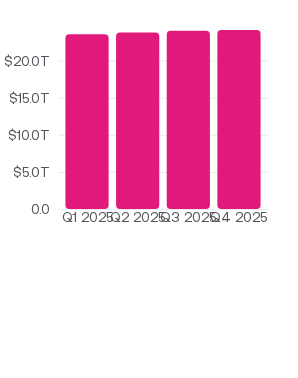
25.2% of US debt is owned by governments, corporations, and people in other countries.
Through June 2025

Our total interest on the debt in 2024 was $880 billion. Of that, nearly $269 billion in interest payments went abroad in 2024, money that left the U.S. economy. The debate about foreign countries, especially China, owning part of the U.S. debt centers around questions like, does this give China too much control? If China or other large holders suddenly reduce their purchases, could it push U.S. interest rates higher, raising borrowing costs and financial risk? So who controls how much debt the U.S. can rack up? That's laid out in our Constitution.
The founding fathers gave Congress control of the purse. One part of that control means the government can't increase its debt without congressional approval. We put in something called a debt ceiling.
The debt ceiling is a legal cap set by Congress on how much total debt the federal government can have. As our debt rises and it approaches the limit, Congress can vote to raise the debt ceiling or not. Congress gets to decide.
If Congress does not act to raise or suspend the ceiling, the government could default on its obligations, on what it owes. Since 1960, Congress has raised or revised the debt ceiling 78 times under both Republican and Democratic administrations. It is often a time when each party blames the other for having to raise the ceiling, and it is often reported in the news.
In 2025, spending and debt were front and center with the debate over the One Big Beautiful Bill Act, which increased the debt ceiling to $41.1 trillion, an increase of about $5 trillion. A default would mean the U.S. fails to pay the money that it owes. While there have been a few small and technical defaults and delays, the United States has never outright defaulted on a loan payment.
The consequences of that aren't known, but my personal view, it would not be pretty. Okay, so now a final question. Is our debt too big? Ah, this one you can ask a group of economists and basically start a big mud fight.
Some facts. Debt to GDP compares the federal government's debt held by the public to the gross domestic product, or GDP, of our economy, which is the total value of goods and services in our economy. It gives a sense of the country's capacity to repay what it owes.
It's a little bit like comparing what you owe on a house to how much your income is. Debt held by the public was approximately 95.9% of GDP in 2024, and that's up from 72.4% 10 years ago. This ratio has increased in all but 15 of the last 50 years.
Right now, the 95.9% is the highest it's been in many years. So overall, is the debt too high? Well, we've survived as a country with these levels of debt so far, but there is a trade-off. The more debt we have, the more we spend on interest payments, so the less money we may have to invest in programs or lower taxes, or else we will continue to increase the deficit and the debt.
If debt gets so large that it crowds out spending we may need or tax reductions we may like, the question is, one day, will we be unable to pay our lenders what we owe them? Will there be a day when they won't lend to us anymore? My belief is that it's a danger. It's a danger. But like a good horror movie, you have no idea how scary it might be or when it might happen.
Now you have a foundation of facts from USA Facts. So the next time the debt debate unfolds, you can make up your own mind on what's best for you and for America.
Page sources and methodology
All of the data on the page was sourced directly from government agencies. The analysis and final review was performed by USAFacts.
Department of the Treasury
Congressional Budget Office

