What does the Secret Service (USSS) do?
The US Secret Service (USSS) is a subdivision of the Department of Homeland Security responsible for safeguarding the nation's financial infrastructure and payment systems, as well as protecting national leaders, visiting heads of state and government, designated sites, and National Special Security Events. The agency's dual mission includes investigating and preventing financial crimes such as counterfeiting, credit card fraud, and cybercrime, while also ensuring the security of the President, Vice President, their families, and other high-profile officials. It was established in 1865.
$3.57B
3.1%
How much does the Secret Service spend?
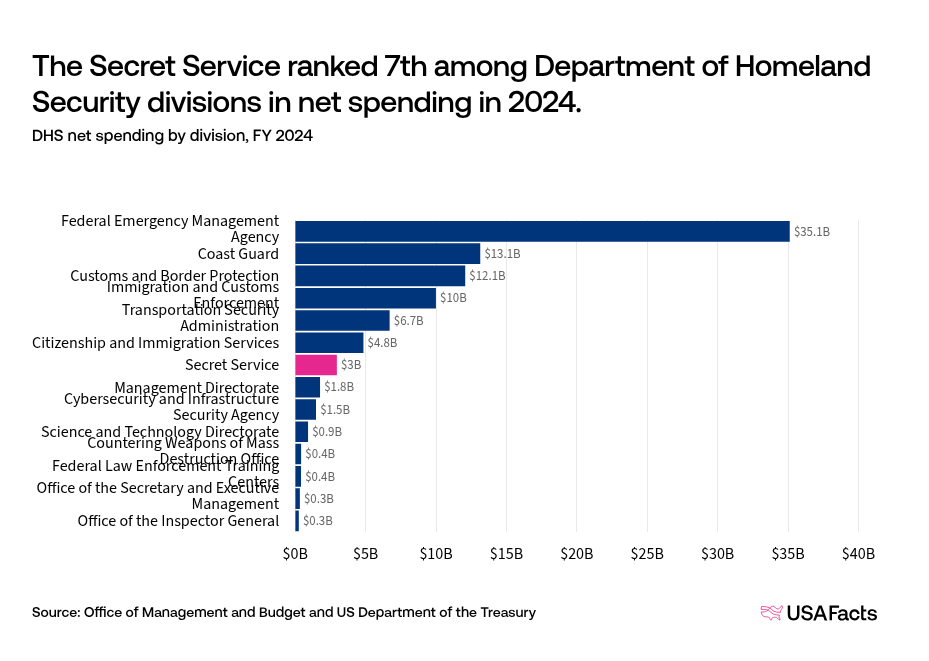
The Secret Service ranked 7th among Department of Homeland Security divisions in net spending in 2025.
DHS net spending by division, FY 2025
Get weekly insights
Subscribe for data-driven insights. No spin, just the facts.
The Secret Service’s federal spending in FY 2025 was higher than in FY 1980.
Yearly federal net spending by USSS, adjusted for inflation (2025 dollars), FYs 1980–2025

The Secret Service’s share of federal spending in FY 2025 was higher than in FY 1980.
Net spending by USSS as a share of federal spending, FYs 1980–2025

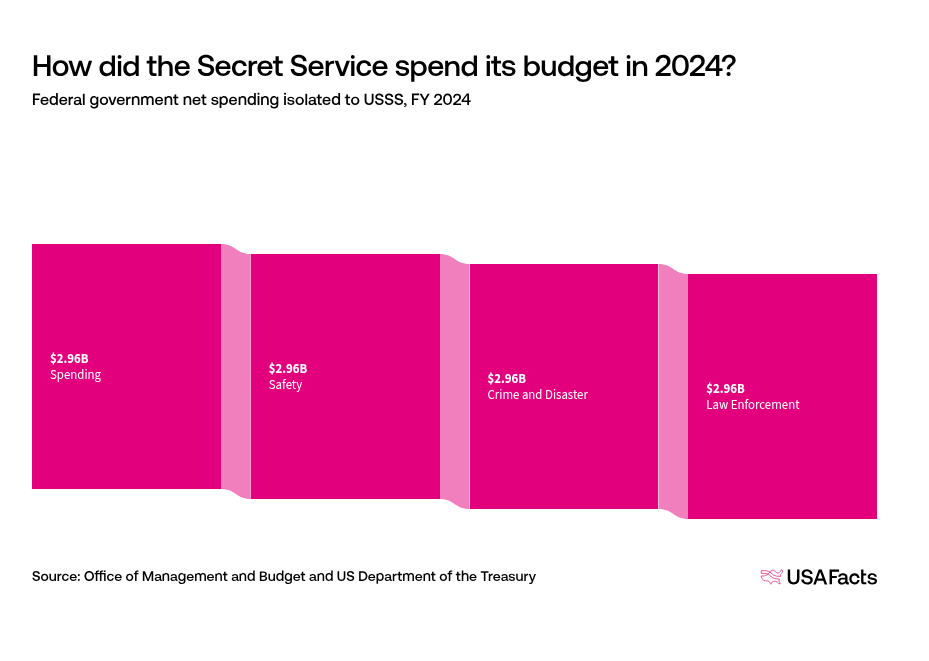
How did the Secret Service spend its budget in 2025?
Federal government net spending isolated to USSS, FY 2025
How many people work for the Secret Service?
The number of federal employees working for the Secret Service has increased 22.8% since 2012.
Number of federal employees working for USSS, May 2012–2026

Who leads the US Secret Service?
The US Secret Service is led by a director. This individual is appointed by the president of the United States and requires confirmation by the Senate. The director reports to the Secretary of Homeland Security. There is no fixed term for this position.
Keep exploring

Methodology
USAFacts standardizes data, in areas such as time and demographics, to make it easier to understand and compare.
Page sources
USAFacts endeavors to share the most up-to-date information available. We sourced the data on this page directly from government agencies; however, the intervals at which agencies publish updated data vary.

