How much federal money goes toward state and local governments?

Updated May. 12, 2026Refreshed annually
The federal government provided $1.22 trillion to state and local governments in fiscal year (FY) 2025. This total includes money transferred to states, tribal governments, and local governments, such as cities and counties. Federal funding helps state and local governments pay for things like infrastructure, education, and health care for low-income people. In FY 2025, these transfers made up 17% of all federal spending.
In FY 2025

$1.22T

was provided by the federal government to state and local governments
In FY 2025

17%

of federal spending was transferred to state and local governments
Federal transfers to state and local governments may be awarded through a competitive application process, or given based on formulas that consider things like the size of a population, number of highway miles, or income of an area. Sometimes the money goes directly to local governments. Other times, the federal government gives “pass-through” grants to states, which then decide how to distribute the funds to local governments within their state.
Federal transfers trended upward during the 1990s and early 2000s, spiking at $896 billion (inflation-adjusted to FY 2025 dollars) in FY 2010 mostly due to the American Recovery and Reinvestment Act of 2009 which provided funding to state and local governments to support recovery from the Great Recession. After settling near FY 2010 levels, transfers increased from $911.8 billion in FY 2019 to $1.22 trillion in FY 2020 and $1.5 trillion in FY 2021. This 64% increase from FY 2019 to FY 2021 was largely driven by the federal government’s response to the COVID-19 pandemic. Legislation like the American Rescue Plan of 2021 sent money to state, local, and tribal governments for pandemic response and recovery.

Federal transfers to state and local governments increased 4% from FY 2024 to FY 2025.

Federal government transfers to state and local governments, inflation adjusted (FY 2025 dollars)
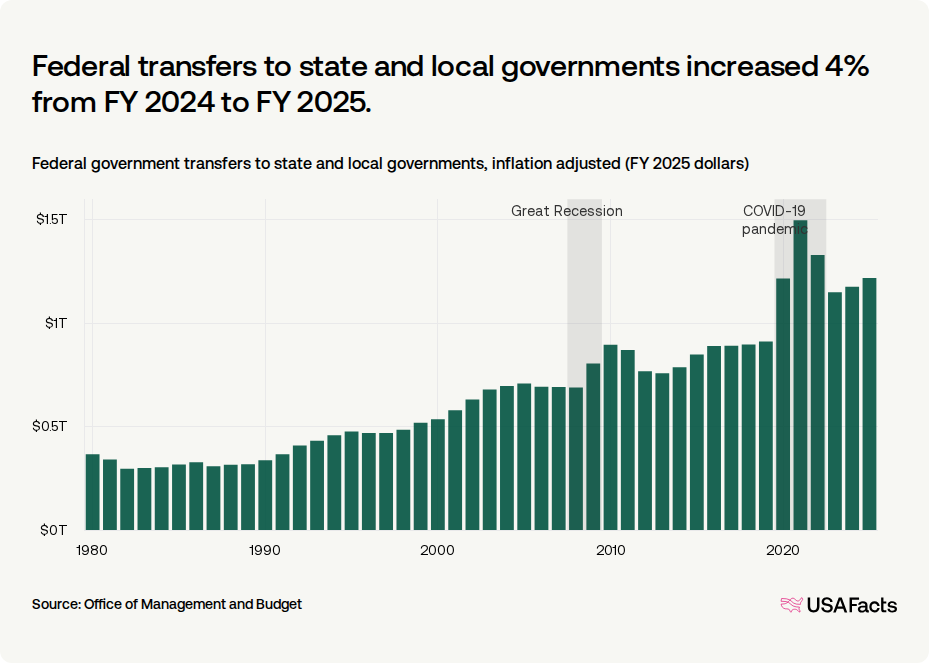
At $1.22 trillion, federal transfers in FY 2025 were up 4% from FY 2024. After adjusting for inflation, funding for state and local governments has increased 44% in the last 10 years, and remained unchanged over the last five.
Ask the data
Beta

We use AI to summarize the data, charts, and analysis we have on USAFacts

What percent of all federal spending goes to state and local governments?

One way to understand trends in federal funding for state and local governments is to look at how big a chunk of the federal budget those transfers are. For example, transfers increased in FY 2020 in response to the pandemic, and because federal spending also increased, the percentage dedicated to state and local governments fell from 16.2% of federal spending to 14.9%.

Get weekly insights

Subscribe for data-driven insights. No spin, just the facts.

Transfers peaked at 19% of federal spending in FY 2022.

Federal transfers to state and local governments as a percent of federal spending, FY 1980–FY 2025
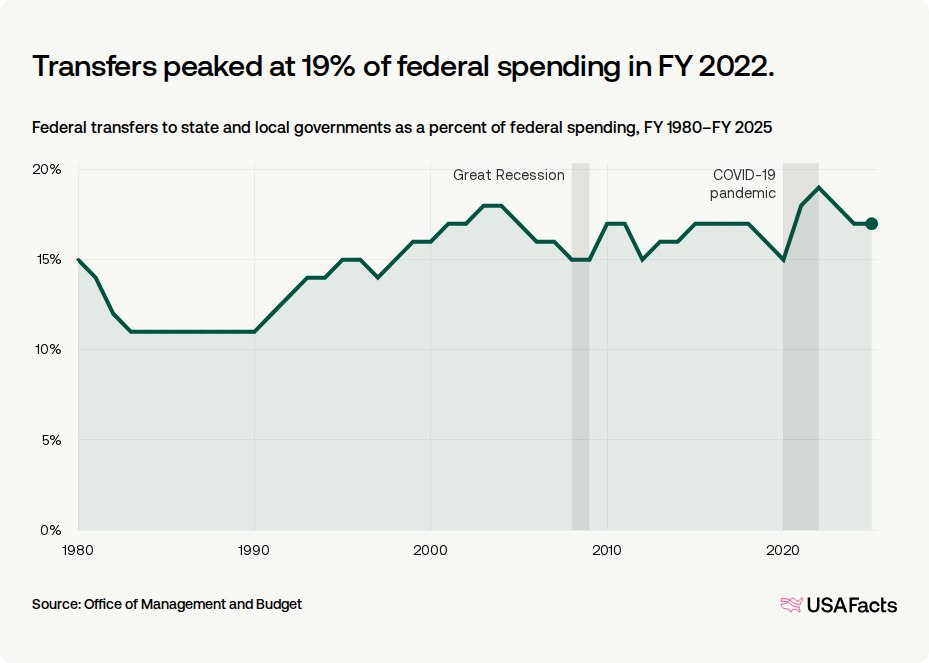
In FY 2025, the federal government spent 17% of its budget on transfers. This was the same as FY 2024 when transfers were 17% of the budget.

What are federal dollars transferred to state and local governments spent on?

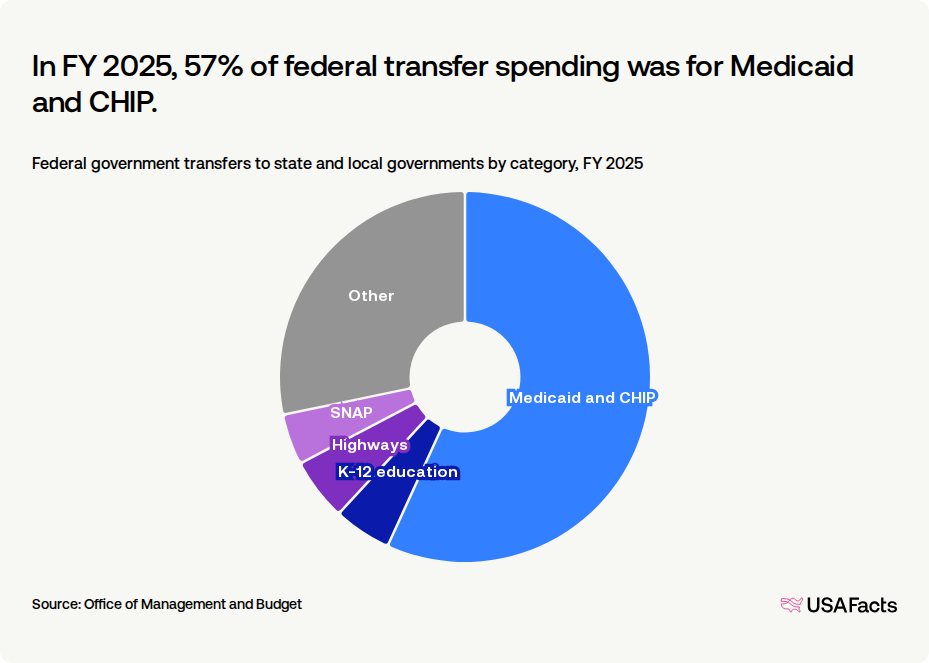
Federal funding finances a broad range of programs and services, including education, nutritional programs, and infrastructure. In FY 2025, $692 billion, 57% of the total transferred, funded Medicaid and the Children's Health Insurance Program (CHIP). These two programs provide free or low-cost health insurance to eligible individuals, such as some low-income people, pregnant people, and the elderly.

In FY 2025, 57% of federal transfer spending was for Medicaid and CHIP.

Federal government transfers to state and local governments by category, FY 2025
Which states have the highest and lowest share of revenues from federal funding?

Data summarizing total federal transfers is made available within six months of the end of the fiscal year by the federal government, but it does not provide details about how much goes to each state. To collect this information, the Census Bureau conducts the Annual Survey of State and Local Government Finances. It captures the details of how much states and local governments receive via federal transfers. The results of this survey are delayed by roughly two years, with data from FY 2023 being the most recent. Although the data it provides is older than the aggregate data from the federal government, the survey can still provide insights into which states’ budgets rely most on federal government money.
Because funding levels are often determined based on population, which varies from state to state, directly comparing the amounts sent to governments within each state doesn’t provide much insight. A better way to compare federal transfers across states is to look at the share of state and local revenues that come from federal money.

Federal transfers made up 20% to 39% of government revenues within states.

Federal government transfers as a share of state and local revenues, FY 2023

Across the US, the share of total state and local government revenues that came from federal transfers in FY 2023 was 25.5%. At the state level, this percentage was lowest in Kansas (19.7%), Hawaii (20.9%), and Utah (20.9%) and highest in Arizona (35.6%), Arkansas (35.7%), and Louisiana (36.4%). (Washington, DC, is a federal district rather than a state and it received 39.2% of its total revenue from the federal government.) Federal transfers to state and local governments can vary for many different reasons including the characteristics of the population, strength of the economy, and policy choices made by the recipient governments.

Federal transfers to state and local governments, by state (FY 2023)

Federal transfers to state and local governments, by state (FY 2023)
1.

District of Columbia

39.2%
2.

Louisiana 

36.4%
3.

Arkansas 

35.7%
4.

Arizona 

35.6%
5.

Montana 

35.5%
6.

West Virginia

35.1%
7.

Kentucky 

34.9%
8.

Alaska 

34.8%
9.

Rhode Island

33.7%
10.

Mississippi 

33%

Keep exploring

Methodology

USAFacts standardizes data, in areas such as time and demographics, to make it easier to understand and compare.

The analysis was generated with the help of AI and reviewed by USAFacts for accuracy.

Page sources

USAFacts endeavors to share the most up-to-date information available. We sourced the data on this page directly from government agencies; however, the intervals at which agencies publish updated data vary.