What does the do?

Refreshed annually

The Selective Service System (SSS) is an independent federal agency responsible for maintaining information on individuals who could be called to military service in the event of a national emergency. It ensures the federal government has a fair and efficient process in place for conducting a draft if needed. It was established in 1940.

In FY 2025,

$33M

was spent by the Selective Service System
In FY 2025,

<0.1%

of federal spending was by the Selective Service System

How much does the Selective Service System spend?

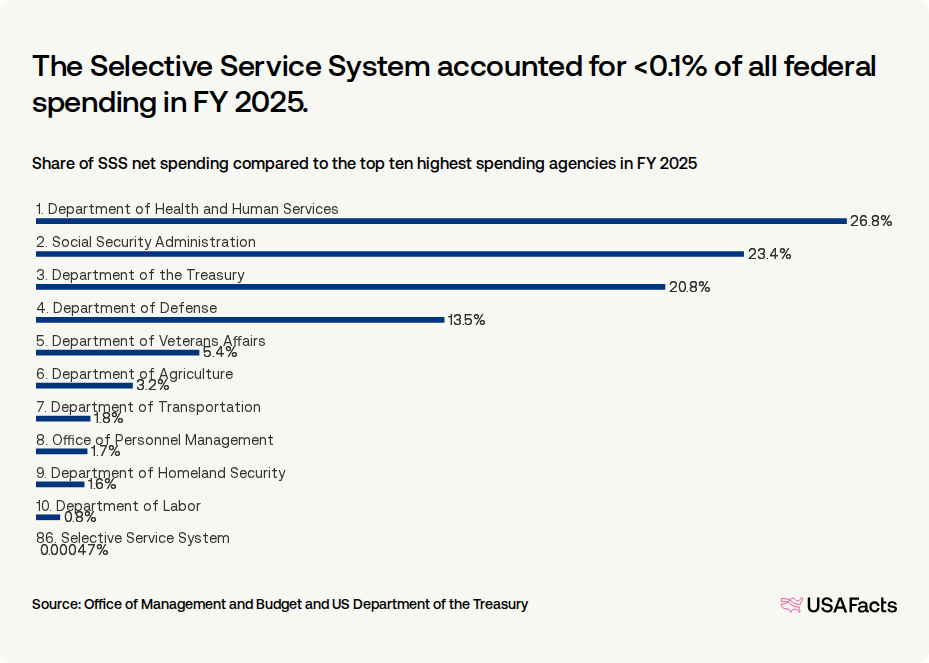
Selective Service System spent $33 million in fiscal year (FY) 2025. This was 0.00047% of the $7.04 trillion in overall federal spending. The department ranked 21st among federal agencies in total spending.

The Selective Service System accounted for <0.1% of all federal spending in FY 2025.

Share of SSS net spending compared to the top ten highest spending agencies in FY 2025
Federal spending may shift over time due to population growth, changes in policy and programs, and emerging problems to address. Adjusting for inflation, the Selective Service System’s federal spending has decreased from $37.8 million in 1980 to $33 million in 2025.

Get weekly insights

Subscribe for data-driven insights. No spin, just the facts.

The Selective Service System’s federal spending in FY 2025 was lower than in FY 1980.

Yearly federal net spending by SSS, adjusted for inflation (2025 dollars), FYs 1980–2025
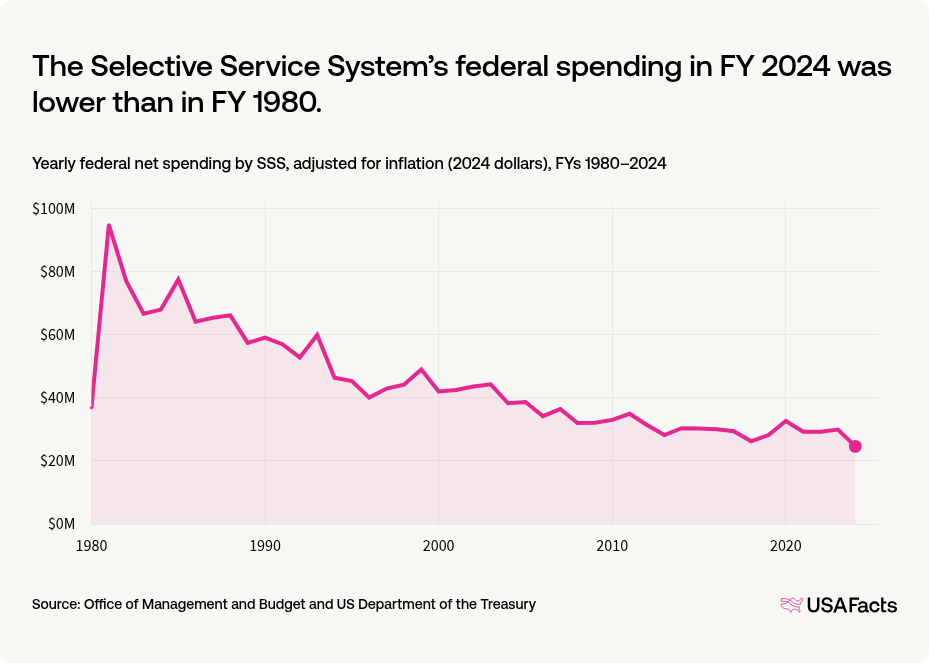
Since 1980, the Selective Service System's spending has decreased 12.7%, while overall spending has increased 196.9%.
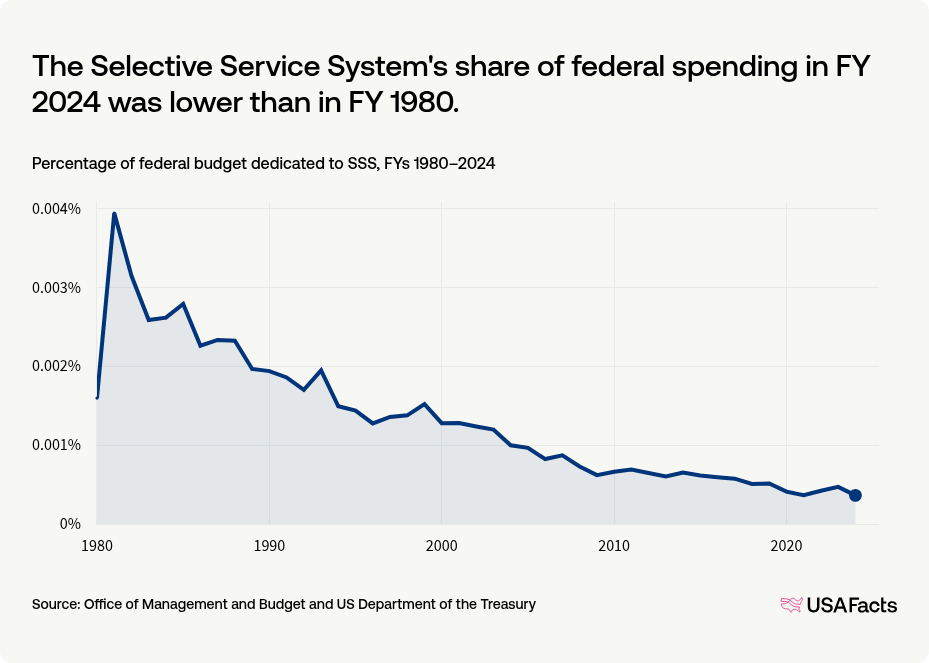
The department’s spending grew less than overall spending, which means that the department’s share of the federal budget decreased. In 2025, SSS accounted for 0.00047% of all federal spending. That’s 0.00015 percentage points lower than in 2015 and 0.0011 percentage points lower than in 1980.
Major legislation, internal or global economic conditions, and acute events like the COVID-19 pandemic can affect spending year to year. For example, the federal budget fluctuated during the pandemic, rising from $5.3 trillion (in 2023 dollars) in 2019 to $7.7 trillion in 2020 and $7.8 trillion in 2021.

The Selective Service System's share of federal spending in FY 2025 was lower than in FY 1980.

Percentage of federal budget dedicated to SSS, FYs 1980–2025
Most federal spending can be categorized as direct or indirect. Direct spending refers to money the federal government spends on budget items such as federal programs, employee salaries, and debt interest. Indirect spending refers to federal transfers to state and local governments.
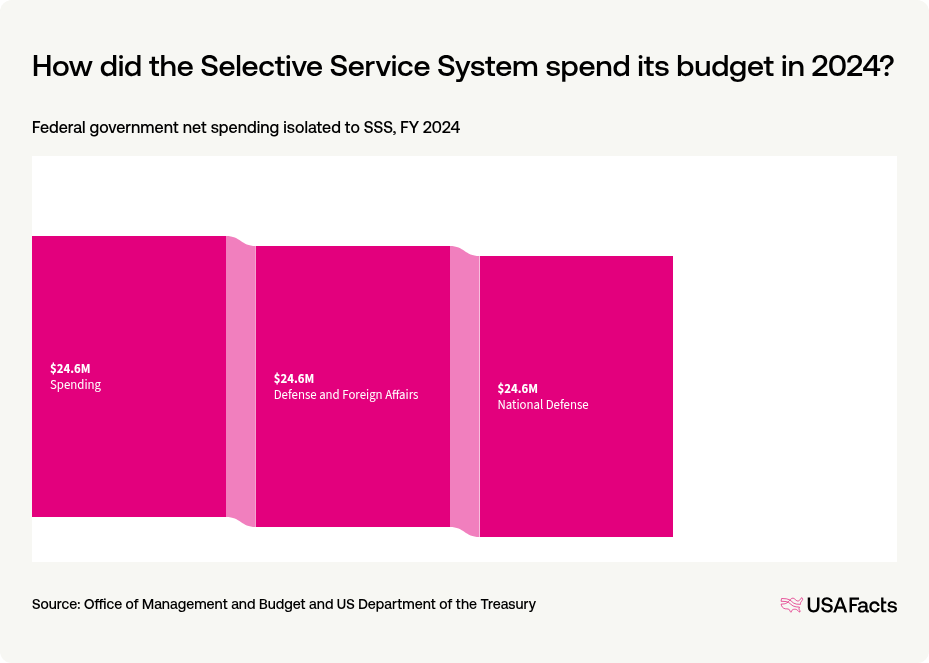
In FY 2025, all of the Selective Service System's spending was direct.
The chart below outlines all net SSS spending.

How did the Selective Service System spend its budget in 2025?

Federal government net spending isolated to SSS, FY 2025
How many people work for the Selective Service System?

Some 132 of the 2.02 million total civilian federal employees work for the Selective Service System as of May 2026. This is 23.3% fewer people than the department staffed in 2012.

The number of federal employees working for the Selective Service System has decreased 23.3% since 2012.

Number of federal employees working for SSS, May 2012–2026

SSS accounts for 0.0065% of the overall federal workforce. As the number of federal employees has changed, so too has the way the workforce is organized, with resources allocated to agencies depending on government priorities. SSS constituted a smaller share of the overall federal workforce in May 2026 than in 2012 (0.0082%).
While the number of employees on an agency’s payroll contributes to that agency’s expenditures, some agencies have relatively few employees compared to their budget or vice versa, giving them an outsized share of either the budget or the workforce. According to the most recent data, the Selective Service System’s share of the workforce (0.0065%) is larger than its share of the budget (0.00047%).

Who leads the Selective Service System?

The SSS is led by a Director, who is appointed by the president and confirmed by the Senate. The Director is not a cabinet-level official and serves at the discretion of the president, typically remaining in the role until they resign, are replaced, or a successor is appointed.

Keep exploring

Methodology

USAFacts standardizes data, in areas such as time and demographics, to make it easier to understand and compare.

Page sources

USAFacts endeavors to share the most up-to-date information available. We sourced the data on this page directly from government agencies; however, the intervals at which agencies publish updated data vary.