Episode 2
Why does the US only have two major parties?
 Crash Course
 USAFactsCrash CourseUSAFacts
Featured visualization
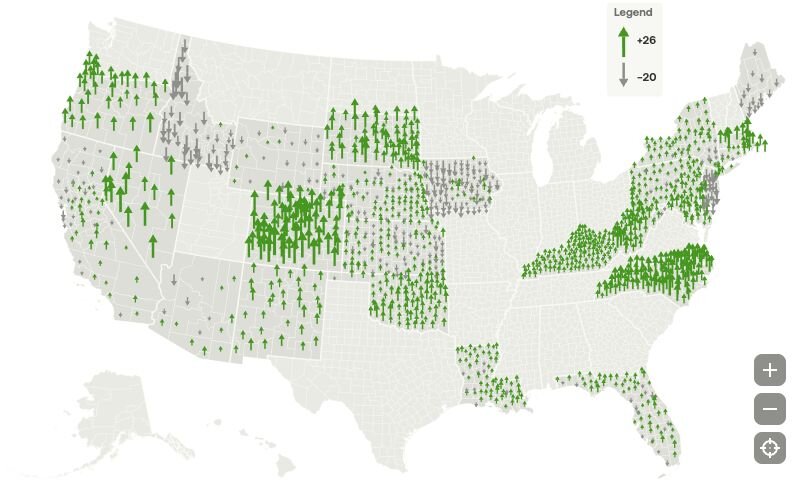
The episode discusses the role of the two-party system in American politics. But the share of voters registered either with a minor party — or no party at all — has risen over the past decade. This map show the percentage point change in the share of voters registered outside either major party between 2016 and 2026
Interpret the graph
Ask yourself
Two-party system
Voters mostly choose between two major-party candidates for national elections.
Multiparty democracies
Systems in which multiple political parties compete in national elections.
First-past-the-post system
An election that requires a plurality rather than a majority.
Minority rule
When voters are represented by someone that only a small fraction actually supported.
Single-member districts
Geographic areas that are each represented by a single elected official.
Description
Does the US need a competitive third party? And would anyone even vote for one? In this episode of Crash Course Big Questions on U.S. Government we’ll investigate why it feels like the U.S. is trapped in a two-party system. The answer comes down to two things – our systems and ourselves.
Transcript
Are you tired of politics as usual? Democrat /or/ Republican. Left /or/ Right. Conservative /or/ Liberal. Are you looking for something…new? Well, you’re not alone. As of 2025, more US voters identified as unaffiliated political “Independents” than as specifically Democrats or Republicans.
Are you tired of politics as usual? Democrat /or/ Republican. Left /or/ Right. Conservative /or/ Liberal. Are you looking for something…new? Well, you’re not alone. As of 2025, more US voters identified as unaffiliated political “Independents” than as specifically Democrats or Republicans.
But wait, there’s more! Consider how many presidential elections a third party has won in the last 175 years! Wait…none? What do you mean /none/? As it turns out, nobody but a Democrat or a Republican has won a US presidential election since the mid-19th century, and even before that, even though the party names were different, the two party system was largely the same.
But with /so many/ people who don’t identify with Democrats /or/ Republicans, why do they still feel like the only two options? Hi, I’m Kousha Navidar, this Crash Course, and we’re answering Big Questions on U.S. Government.
See, even though we /have/ other parties, the US is effectively a two-party system, where voters mostly choose between just two major-party candidates for national elections.
And that…is actually kind of weird. Most other democracies don’t work like that. All over the world, from Sweden to Uruguay, multiparty democracies are set up to allow multiple political parties to actually compete in national elections. Heck, Kenya has /92/ registered parties. So in terms of global democracy, we are actually the odd ones out.
But it seems like we’d rather not be. In 2025, 62% of people in the US thought the country /needed/ a viable third party to represent the people’s interests. But – and here’s where it gets even weirder – the number of people who said they’d be “very likely” to /vote/ for a third-party candidate? It’s not 62%-- it’s only 15 %.
I guess they just haven’t heard of the Anti-Arugula Party? We’re pro spinach! Down with Spicy Lettuce! So what’s up? Why is the US trapped in this two-party system when over half the country wants out?
That dissonance is really interesting. And to really unpack it, we can start by thinking about what the point of having “Democrats” and “Republicans” is supposed to be in the first place.
The United States is a representative democracy, which means it’s supposed to be ruled by, and reflect the interests of, the people who live here. It’s /also/ a country of over 340 million/different/ people, who presumably have over 340 million /different/ interests. And we can’t all make the laws together. [BCAM] Imagine that Zoom call.
[ACAM] And we can’t get much accomplished by ourselves either. So instead, we organize into political parties that share some /basic/ interests, and elect representatives who promise to more or less represent those interests.
We can understand political parties based on what kinds of interests and ideologies they fight for. Sometimes political scientists put all those parties on a big chart, where one axis runs from “economic liberal” to “economic conservative,” or “more government involvement in the economic spending” to “less government involvement in the economy,” and the other axis runs from “social liberal” to “social conservative,” or “push to make changes for the common good” to “protect the status quo”.
So, mainstream Republicans would fall somewhere in the upper right quadrant, for “small government spending, big traditional values.” And mainstream Democrats would go somewhere in the lower left quadrant, for “more public funding and cultural progress.” Those two dots sit in opposing quadrants.
In multiparty democracies, other political parties might fill in the gaps between, and even extend out on either side. Like, Sweden has eight major political parties across the social and economic axes, with the ultra-conservative Sweden Democrats way over here, and the socialist Left Party way over here, and the Social Democrats, Moderates, and Center Party filling in the middle.
But here in the US, we just have the two /major/ parties. Everyone else is a bit player. Like, sure, we’ve got the Green Party, who are big on sustainability and social justice and would land even deeper in the lower left, and Libertarians who land in the lower /right/ quadrant for economic conservatism and social liberalism.
We’ve also got some centrist options, like the Forward Party, who land closer to the, you guessed it, center. Or even more niche parties, like the United States Pirate Party, whose platform, among other things, seeks to abolish patent rights. They’re socially liberal, since their platform includes things like anti-bigotry and police reform. While their economics are closer to the center.
So really, the US /does/ have more than two parties to represent all our 340 million interests. They just can’t seem to ever win an election.
Okay, that’s not /totally/ true. /Sometimes/ they can get ahead in local and state elections, and /once/ in a while even snag a seat in Congress. But even that is tricky – in the US it’s usually easier to just glom onto one of the two major parties.
Like, Zohran Mamdani, who was elected mayor of New York City in 2025, is a Democratic Socialist…but ran as a Democrat. Or Justin Amash, a Libertarian who was a Michigan House rep for 10 years… ran as a Republican. And of course, a third party hasn’t won the presidency – or even come close – in over two centuries.
So we’re still left with a big question: why not?
Well, according to political scientists, there are two explanations.
Explanation One: the institutional explanation. It basically comes down to our elections: the way we choose political representatives in the US boxes out third parties and makes it /very/ hard for anyone but a Democrat or Republican to win. This explanation lays the blame at the feet of the system. And there are a couple different facets of said system that support it.
Like, consider the fact that most US elections require just a /plurality/, rather than a /majority/, of votes to win. So say nine out of ten candidates all get around 10 percent of the vote, but the tenth one gets 11 percent, they win the whole thing.
This is known as a first-past-the-post system, where whoever has the most votes wins, even if the majority of people didn’t vote for them.
Like, in this ten candidate scenario, the winner barely came out on top, leaving 89 percent of voters represented by someone they didn’t choose– an example of minority rule, where suddenly /all/ voters are being represented by someone only a small fraction actually supported.
And pair this with the fact that the US, unlike Sweden and a lot of the countries we mentioned earlier, mostly votes in single-member districts, where the country is broken up into different geographic areas that are each represented by a single elected official.
This leads to a winner-takes-all situation, where the person who gets the most votes wins /everything/. There’s no prize for coming in second.
Now, this doesn’t immediately disqualify a third party candidate, but it does make things a lot harder for them, because of something called Duverger’s law.
I did not know I had that in me.
Like, say you’re a voter in that ten-candidate election, throwing your hat in the ring for the Pirate Party candidate.
But one year, that candidate doesn’t do so hot. Instead of the usual 10-ish percent of the vote, he only gets 7%, and it doesn’t look like he’s going to do much better next time.
You want the Pirate Party to win. But what you want even /more/ is to make sure the /Copyright Party/ doesn’t win.
So instead of wasting your vote on a party that’s looking less and less competitive, you decide to give it to someone a little more mainstream, like the Net Neutrality Party. They might not align with /all/ of your values, but they do on some big issues.
And on the other side of the spectrum, discouraged members of the Hunt Copyright Violators for Sport Party are doing the same thing – jumping ship to a more popular, more moderate candidate to keep Net Neutrality /out/ of office. Until all of a sudden, that diverse political field is dominated by just two big parties – and voting for anyone else doesn’t really make any sense.
And while there’s no such thing as the Hunt Copyright Violators for Sport Party [BCAM] unfortunately [ACAM] this kind of thing actually happens in the real world, like when Green Party supporters vote Democratic, or Libertarians vote Republican.
Duverger’s law helps explain how single-member districts and winner-takes-all elections tend to weed out third-party candidates. When US politics are /so/ polarized, and every election is a bloody 1-v-1 knockout, voting your conscience can feel less important than keeping the wrong guy out of office.
This is called the spoiler effect, where voting for a third party just seems too risky. We’d rather vote for the major-party candidate we /kind of/ like, than risk “spoiling” the race, and handing it over to the other major party we really /don’t/ like. Which leaves a lot of us feeling forced to vote for the “lesser of two evils.”
[BCAM] [Not to be confused with the lesser of two weevils– check out SciShow or Bizarre Beasts for your insect content needs.]
Chapter 4: The voter explanation
Those institutional factors help explain why less-popular third party candidates can’t get a foothold in most of our elections. But they don’t explain why the 45 percent of /unaffiliated/ independents don’t just band together and make an /actually/ competitive third party.
Remember I said we had two explanations? Here’s where the second explanation comes in: the voter explanation. See, the thing about independents is they’re, well, independent.
They hold a /wide/ variety of political beliefs all across those ideological axes, and just because they’re all “independent” doesn’t mean they align with each other.
Like, lots of independents call themselves “centrists,” but seem to actually lean toward one major party over another– and by “lots” I mean “literally 78 percent”. So in the voting booth, all these self-proclaimed independents are basically /indistinguishable/ from those folks who call themselves Democrats or Republicans out loud.
And others might even be /more/ liberal or conservative than the major parties, but choose to align with them anyway when they cast votes in elections. Like the ultra-conservative Tea Party movement of the late 2000s, and today’s MAGA movement – both of which have done their business from within the Republican Party.
Then, of course, you have the folks who hold values and ideals that are /totally/ outside of the ideological axes we’re working with,
[BCAM] Like my neighbor, who believes the only money the US government should spend is on soundproofing his apartment so he doesn’t have to hear a /very/ promising trumpet player practicing at 3 AM. Excuse me for trying to keep the arts alive in this country, /Robert/.
[ACAM] And the true /neutral/ “independents?” They typically don’t have much interest in politics at all. Nothing like being oblivious to give you some peace of mind in this country
So in the end, trying to lump all those independents together in one party makes…even a little less sense than trying to lump them into two competitive parties we already have.
Chapter 5: Review and credits
All that to say, it's not ideal, but for now, it's the system we've got. Partly because the system isn't really set up to be able to represent everyone's individual interests, and partly because people are worried that their interests wouldn't be represented even if they did vote for another party.
I don’t blame you if you feel like we’re stuck. But there's nothing to say it has to be this way forever. Other democracies do things differently, and with some reforms to our systems, like swapping away from single member districts or adopting ranked choice voting, we could conceivably get some pretty competitive third party action going.
But for now, politics in the US remains a zero-sum game between the Democrats and the Republicans. When Republicans win, Democrats lose. When Democrats win, Republicans lose.
And every time it seems, Independents end up picking the lesser of two weevils.
Speaking of things that are grubby, in our next episode we’ll talk about campaign spending. I’ll see ya then. [Kousha plays trumpet]
[Do eagles eat weevils?]
ALT: In our next episode we’ll talk about campaign spending. I’ll see ya then. This one’s for you, Robert!
[OUTRO]
This episode of Crash Course Big Questions on U.S. Government was produced in partnership with USAFacts, a non-partisan civic tech project that makes government data easier to understand.
Thanks for watching this episode of Crash Course Big Questions on U.S. Government, which was filmed at our studio in Indianapolis, Indiana and was made with the help of all these nice people. If you want to help keep Crash Course free for everyone, forever, you can join our community on Patreon.

Published Sep. 29, 2026
by Crash Course
Teaching the full Big Questions about US Government series? Get materials for every episode.
Subscribe to get classroom materials new Crash Course episodes, and USAFacts data for teaching civics.

