EPISODE 1
Why Are US Politics Today So Divisive?
 Crash Course
 USAFactsCrash CourseUSAFacts
Featured visualization
The episode makes the case that American politics has become super polarized. The size of congressional majorities shows it too, and both chambers now sit near an even split.
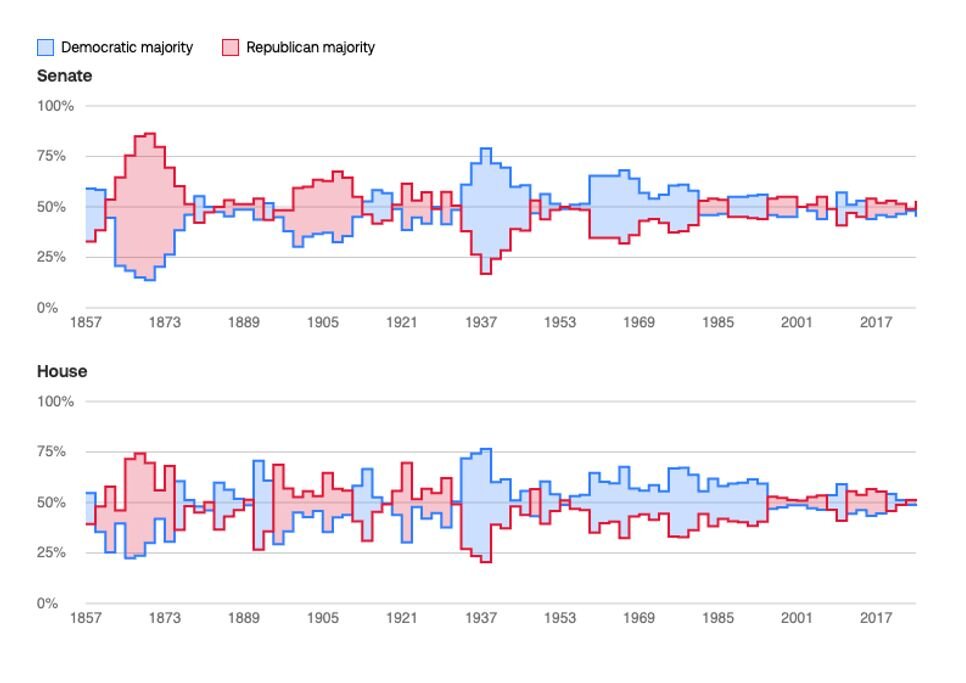
Interpret the graph
Ask yourself
Political ideology
A spectrum of beliefs about how society should work.
Ideological sorting
The process by which people align their party identity based on liberal or conservative ideology.
Social sorting
The process by which certain identities have become increasingly tied to one party over another.
Affective polarization
When partisan polarization leads to distrust, animosity, and contempt.
Political nationalization
When national political identify affects voting habits on a local level.

Published Sep. 22, 2026
by Crash Course
Description
How did U.S. politics get so divisive? In this episode of Crash Course Big Questions: U.S. Government and Politics, we’ll pull back the curtain on how Republican and Democrat became synonymous with “conservative” and “liberal,” and why politics today has gotten so polarized and personal.
Transcript
Maybe you’ve noticed: The echo chambers are loud. The divisions, wide. Our Fox News dads and our MSNBC moms may as well be living in different dimensions. And our majestic eagle friend is looking…way less majestic than when we last saw him. You okay there, Baldy? Stop picking at your feathers, you’re only gonna make it worse.
You okay there, Baldy? Stop picking at your feathers, you’re only gonna make it worse.
So, how did we get here, screaming at each other across an ever-growing cavernous divide? And what does that mean for the fate of this country?
Hi! I’m Kousha Navidar, this is Crash Course, and we’re answering Big Questions on U.S. Government.
While it’s true that the media we consume contributes greatly to our super-polarized political culture, it’s not actually the main cause. And some of you may disagree, I know. But to understand the full scope of what’s going on, we have to take an even wider view, because this thing we’ve got going on goes back a long time.
For decades, there’s been a widening divide between the two major political parties in terms of political ideology: where people fall on the spectrum of beliefs about how society should work. Very simply, from left to right, liberal to conservative.
And when we say liberal and conservative, we’re not actually talking about Democrats and Republicans. At least, not yet.
Liberal really just means falling on the left side of our political spectrum. These folks tend to support more government involvement in people’s lives.
Conservatives, on the right side of the spectrum, want the government to conserve the status quo, which usually means less intervention both socially and economically. So, for example, a liberal person would probably support government-funded healthcare, while a conservative person might think that’s something better left to private companies.
In a centrist political culture, most voters hold moderate views, falling somewhere between liberal and conservative. Sure, you’ve got your fair share of leftists and right-wingers, but the largest cluster of voters are hanging out in the middle. And in an election, they could swing either way. But in a culture of political polarization, like ours, voters are camped out farther away from each other in their views.
These days, we tend to think of the political spectrum as falling along party lines, with “liberal” meaning the same thing as “Democrat” and “conservative” meaning the same thing as “Republican,” with a vast, seemingly uncrossable canyon between them.
But the left-right divide between the parties wasn’t always this clear-cut. So what happened?
To help explain things, let’s head over to my colleague, historian Buff. Just Buff. That’s his whole name.
Hi there, Kousha.
You are not what I was expecting.
What do you mean?
Don’t worry about it, Buff. Go ahead, friend.
You got it, Kousha.
Well, back in the day, political parties didn’t really mean the same thing they do now. There were liberals and conservatives sprinkled throughout both parties.
I’ll give you an example. In the wake of the Civil War, in the period known as Reconstruction, who do you think led the charge to expand voting and civil rights for Black Americans? It was liberal Republicans from New England. And who do you think instituted Jim Crow laws that made it harder for Black Americans to exercise those rights? It was conservative Southern Democrats.
In fact, the voting records of Southern Democrats in Congress skewed significantly more conservative than their Northern Republican brethren until well into the 20th century!
And here’s an interesting way that shows up: In 1964, President Lyndon B. Johnson, himself a Democrat, signed the Civil Rights Act into law. The act made it illegal to discriminate and segregate by race in public spaces, and it generally enjoyed pretty bipartisan support in Congress.
But the folks who didn’t support it? Most weren’t Republicans; they were Dems from Johnson’s own party.
When white, conservative Southern Democrats saw Democratic presidents like LBJ and his predecessor, JFK, embracing civil rights legislation, it sent a message: Democrats became the party more associated with the civil rights movement.
So those conservative Democrats steadily left the party for the Republican party (or died out; Congress was pretty old, even back in the ’60s). Meanwhile, those liberal Republicans decided to fully align themselves with the party of civil rights, and made the swap over to the Dems. Back to you, Kousha.
Thanks, Buff. That is just one example of how party alignment shifted during the mid-20th century, giving us the system we know today, with Democrats being pretty universally liberal, or left-leaning, and Republicans being pretty universally conservative, or right-leaning, with a, you guessed it, ever-widening gap between them.
These days, when Congress does manage to get legislation passed, it’s often not with the same bipartisan support of the days of yore; like, 2025’s One Big Beautiful Bill Act passed through the House with support from 218 out of 220 total House Republicans, and, count it! Zero Democrats.
The 1960s set us off on a journey where “conservative” and “liberal” have become more and more synonymous with “Republican” and “Democrat.” And things have started to turn into kind of a self-perpetuating spiral of polarized intensity.
As the parties become more associated with specific values, like liberal support for LGBTQ+ rights or conservative support for the Second Amendment, they attract people with those same values, which then enforce those “conservative” or “liberal” associations.
All of this makes it a lot easier for people to fit neatly into slots along the left-right continuum, a process known as ideological sorting. Essentially, it’s become a lot easier to guess which party somebody supports just by their stance on individual things like abortion, taxes, gun control, foreign policy, the environment, or, importantly, their go-to news network, and a lot harder for voters to hang out in the center.
But it’s not just that Democrats and Republicans have grown apart in terms of how they think about issues. They’ve also grown apart in terms of who they are as people.
Until recently, you couldn’t reliably predict someone’s political party based on their gender, or race, or anything like that. But thanks to what’s known as social sorting, for the past two decades or so, certain identities have become increasingly tied to one party over another.
Take gender, for example. Across the entire U.S. population, men today are more likely to identify as Republican, and women more likely to identify as Democrats. To be clear, that doesn’t mean there aren’t men or women who buck the trend, there definitely are; it’s just that gender is becoming a stronger predictor.
And so is race. White voters are more likely than any other racial or ethnic group to identify as Republican, while Black voters are more likely than any other group to identify as Democrats.
So even though women in general more often vote Democrat, if we look at exit poll data on votes cast by white women in the 2024 election, the Republican candidate Donald Trump comes out 4 percentage points higher than his opponent, Kamala Harris.
On top of all these other factors, there is a growing geographic divide, too. People in rural areas increasingly identify as Republican, while people in urban areas increasingly identify as Democrats.
So, thanks to the combined effects of ideological sorting and social sorting, our politics aren’t just something we believe; they’re becoming who we are.
So, it didn’t take just one ingredient to cook up our current situation; it was decades of shifting party ideology, calcifying identities, and increasing partisanship from both sides. And as the gap between us widens, it’s harder and harder to find common ground.
What do we have left: gardening? The Bachelor? Bachelor in Paradise?!
Of course, political polarization has way bigger consequences than, like, “it’s hard to know what to talk about at family dinner.” As political affiliation becomes more closely linked to other core parts of who people are, it stops being just a political identity and becomes something new: a mega-identity, or one identity and set of values to rule all others.
The term “mega-identity” was coined by political scientist Liliana Mason in the 2010s. It describes a pattern where someone’s partisan identity, whether they define themselves as Republican or Democrat, affects how they see and interact with people that identify the other way.
And as a result, we’re more likely to think bad stuff about the “other side,” or even view them as a threat. Research has shown a rise in what’s known as affective polarization: a kind of polarization that goes way beyond whether or not the two sides disagree on policy issues, dipping into big emotions like distrust, animosity, and contempt.
In other words, the more polarized we get, the less we recognize each other as 3-D human beings, and the more we cast each other as 2-D bad guys.
And that has direct consequences on election day. Voters are increasingly motivated less by what they like about their own party’s platform, and more by negative partisanship, or their hatred for the other party.
This isn’t new, by any means; negative campaign ads were swaying your grandpappy’s vote before you were born. But as Republicans and Democrats have gotten more polarized, negative partisanship has become increasingly powerful. More and more, we’re out there voting against someone instead of for someone, to the point where we might start to ignore candidates’ actual political platforms.
And I know we’ve been talking about national stuff, but the inability to divorce politics and partisanship can also affect voting habits at the more local level, leading to nationalization. Basically, as the parties have divided into these two big, at-odds camps, voters increasingly cast ballots based on what they know about the national party they identify with (or identify against), not necessarily what’s happening in their own town.
And, unfortunately for us, our country, and our little eagle friend Baldy, all these effects of increasing partisanship feed back into the causes. It’s a vicious cycle, creating a feedback loop that’s really shi- bad.
Because not only is it seeping into how we, the citizens, interact with each other, but how the people running our government work together to actually get stuff done.
Just because something’s hard doesn’t mean it’s not possible. Our government, and our country as a whole, has weathered plenty of challenges and come out on the other side with a desire to be better. And today there are plenty of people, both in the government and on the street, willing to reach across the aisle to work together for a better future.
Today’s super-polarized politics have been brewing for decades. But it’s not the end. And there are plenty of people thinking there must be a better way.
So, next time, that’s exactly what we’re asking: “Why does the U.S. only have two major political parties?”
This episode of Crash Course Big Questions on U.S. Government was produced in partnership with USAFacts, a non-partisan civic tech project that makes government data easier to understand. For more resources that go along with these videos, go to usafacts.org/crashcourse.
Thanks for watching this episode of Crash Course Big Questions on U.S. Government, which was filmed at our studio in Indianapolis, Indiana, and was made with the help of all these nice people. If you want to help keep Crash Course free for everyone, forever, you can join our community on Patreon.
Published Sep. 22, 2026
by Crash Course
Teaching the full Big Questions about US Government series? Get materials for every episode
Subscribe to get classroom materials new Crash Course episodes, and USAFacts data for teaching civics.
