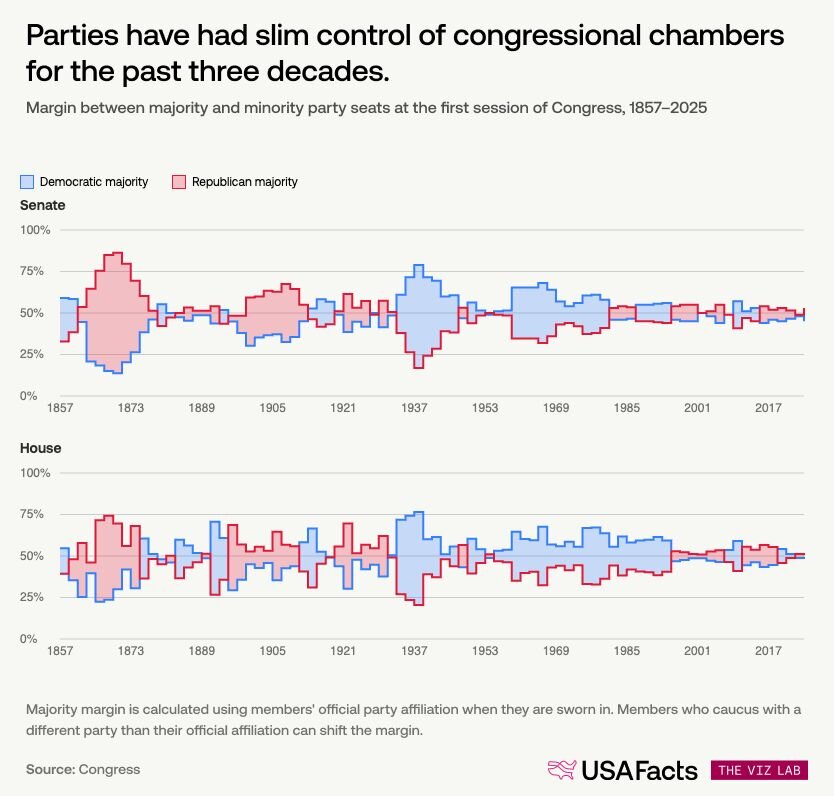
In 2025, when the Senate convened, Republicans held a majority of seats. Counting only party affiliation, it would have taken five seats changing hands to flip that majority. A flip in the House would have taken only three. In 1869, it would have taken 25 Senate seats and 43 House seats to do the same.
Congress used to swing between wide and slim margins. Not anymore. Since 1995, neither party has held more than 59% of either chamber at the beginning of Congress every other January. Margins are so thin that a handful of seats, not dozens, determines which party holds more seats.
Parties have had slim control of congressional chambers for the past three decades.
Margin between majority and minority party seats at the first session of Congress, 1857–2025
Why did we use party affiliation?
Why did we use party affiliation?
Seats are counted using party affiliation, not caucus alignment, so that Congresses can be compared consistently back to 1857. Caucus alignment is not officially recorded. The margins shown can differ slightly from how control was organized in practice.
Why do slim margins matter?
Slim margins matter because they reduce the number of votes a party can afford to lose when passing legislation. A large majority provides wiggle room if some members oppose a bill while still reaching the votes needed for passage. A narrow majority means a few defections, absences, or opposition from within the party can prevent a bill from passing.
In the House, most bills can pass with a simple majority, meaning more than 50% of members vote in favor. In the Senate, passing a bill takes two steps: 60 votes to end debate, then a simple majority to pass it. Short of those 60 votes, a senator can filibuster to hold the floor indefinitely. The smaller the margin, the easier it is for a few of the majority’s members to sink a bill by voting against it, skipping the vote, or crossing party lines — or for the minority to block it outright. Unless a party in the Senate has at least 60 members, it needs help from outside the party to bring a bill to a vote.
A smaller majority also raises the odds that a simple majority vote ends in a tie — and the two chambers handle a tie very differently. The Senate has a built-in tiebreaker: According to the Constitution, the vice president casts the deciding vote whenever the chamber is split 50-50. The House has no equivalent; a tied vote simply fails and the bill can’t move forward without being reintroduced.
A bill must pass both the House and Senate before it moves to the president.
Get weekly insights
Subscribe for data-driven insights. No spin, just the facts.
Not everyone who was elected made it to Congress
Between 1793 and 1933, Congress was elected in November, began its term the following March, and due to farming schedules and extended travel (quick flights across the country were not an option), didn’t formally convene until December — 13 months after the election. Just as they can today, presidents could convene a special session of the Senate to handle urgent business; this most frequently happened at the start of a new president’s term so the Senate could confirm the incoming administration’s cabinet and other key executive nominations.
During the months between the election and Congress’s first regular session, some elected officials died, became incapacitated by illness, lost when their election was contested, were deemed unqualified, or encountered other disqualifying circumstances. Sometimes, the winners of the special elections to fill these seats were of a different party than the candidate who'd won in the general.
Since 1995, neither party has held more than 59% of either chamber at the beginning of Congress every other January.
Even after the passage of the 20th Amendment, which shortened the gap between election time and first formal convening, the same problem still occurred.
In some cases what happened during this gap was dramatic enough to flip control of a chamber: in the 72nd Congress (1931–1933), Republicans won a narrow 218–216 House majority in the November 1930 elections, but by the time the first session convened 13 months later in December 1931, 14 Representatives-elect had died. The resulting special elections flipped control to the Democrats, who took the House with 219 seats to the Republicans' 213.
Although the congressional calendar differed from today’s, Congress's overall meeting schedule was not substantially different. Like modern Congresses, each Congress generally met in two regular sessions, with the first typically lasting more than 100 days.
Unified control doesn’t last like it used to
A unified Congress is when the House and Senate share the same majority party. Unification makes it easier to align committee agendas and legislative priorities across both chambers. However, it does not guarantee that a bill will pass both chambers. For example, in 2017, the House passed the American Healthcare Act, but the Senate’s version failed by two votes, even though Republicans controlled the House, Senate, and presidency at the time.
Since 1857, 76.5% of Congresses have started unified. The Democratic party held the longest unified stretch, beginning in 1955 and lasting until 1981 — a run spanning 13 consecutive Congresses. Before that, the longest runs had lasted seven and eight Congresses.
That hasn’t come close to happening in the 21st century. There have been four stretches of unification at the beginning of Congress since 2001. Each has lasted no more than two Congresses — four years.
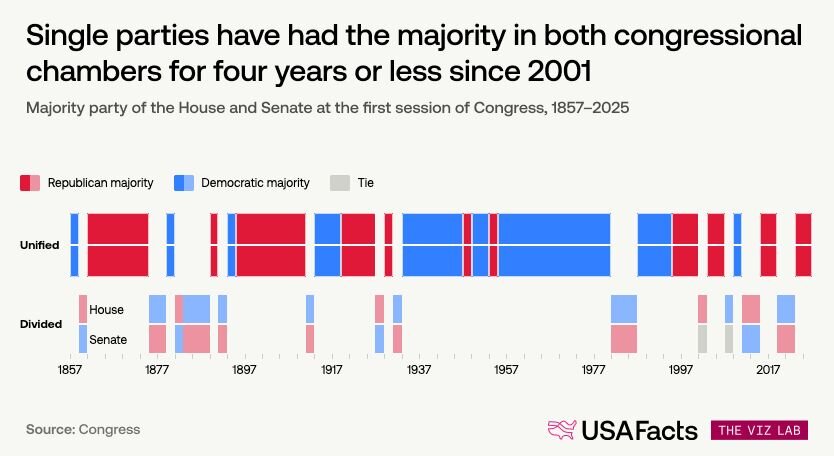
Shorter stretches mean a majority party has less time to act with unified control before it’s gone. The most recent stretch began in 2023 and has run two Congresses so far.
Explore historical party control
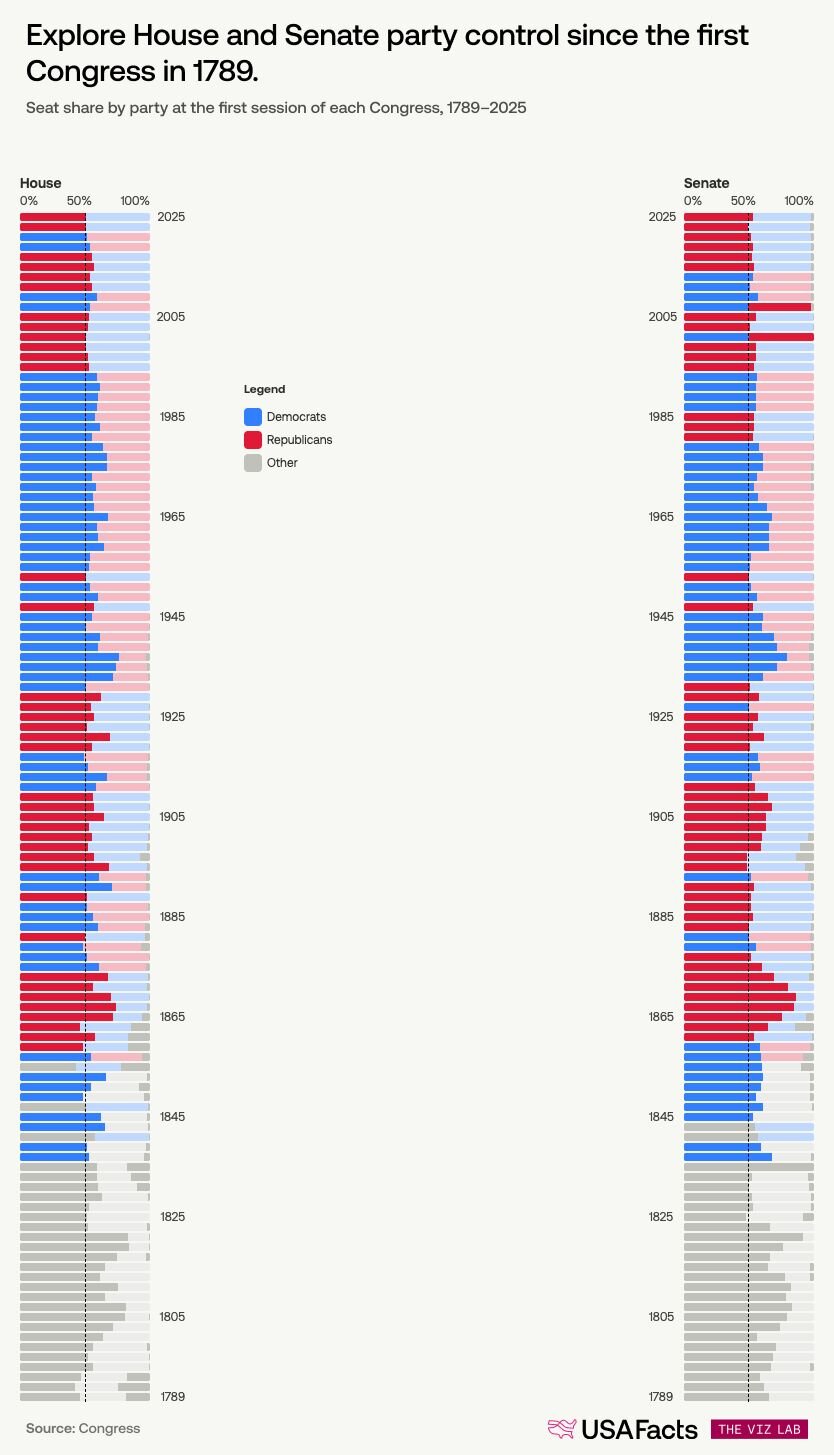
Democrats and Republicans have shared Congress since 1857 — but for six decades before that, other parties held the seats.
The interactive chart below breaks down over 250 years of party control in the House and Senate.