Episode 5 coming soon
What's the deal with the Electoral College?
 Crash Course
 USAFactsCrash CourseUSAFacts
Featured visualization
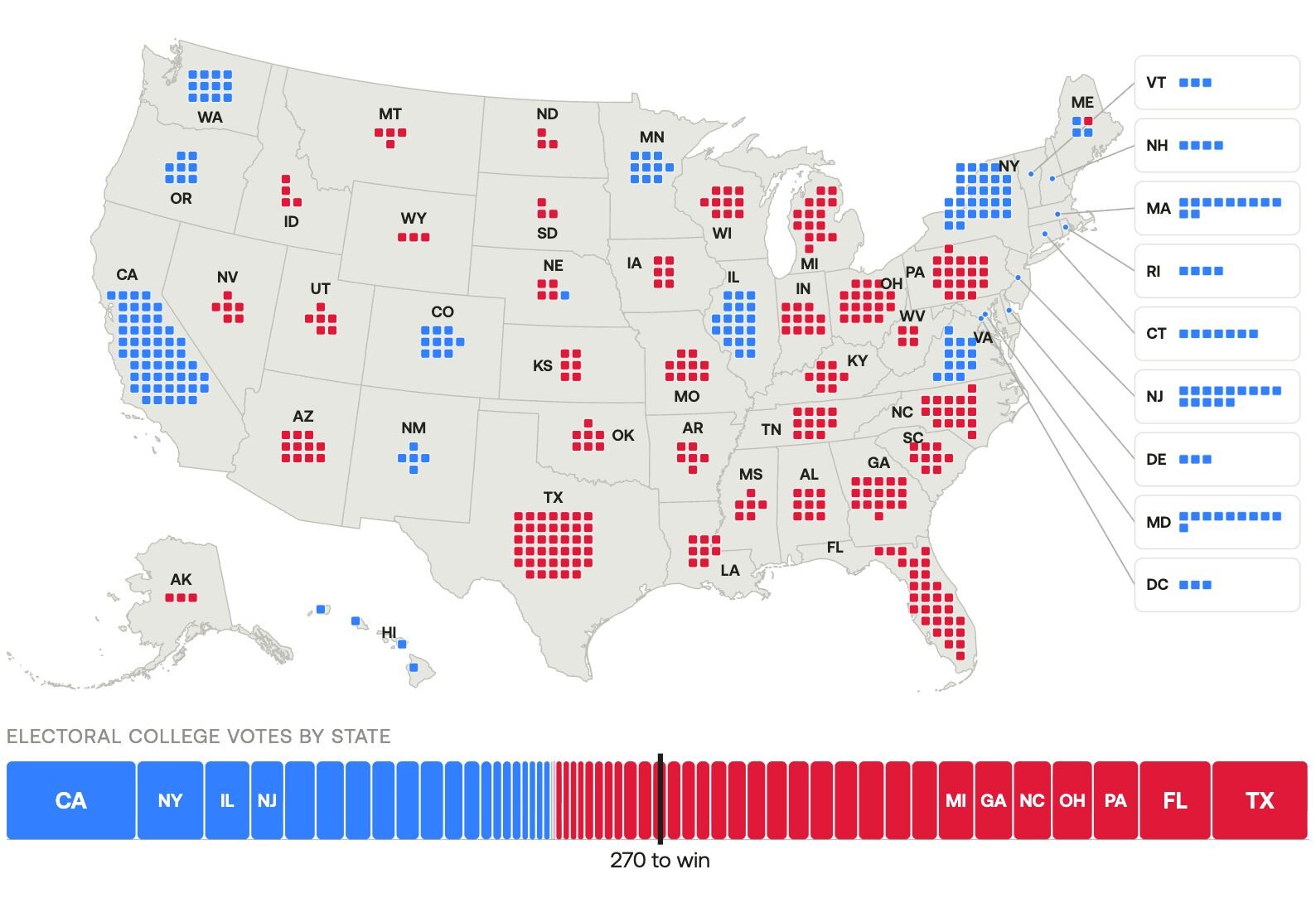
The Electoral College has been part of every presidential election since 1789, but the number of electors and the balance of voting power among states have changed over time.
Interpret the graph
Ask yourself
Electoral College
The group of people who actually cast their votes for president.
Popular vote
Where the people directly decide the winner of an election.
Slate of electors
Group of electors a state gets in the electoral college.
Winner-takes-all
When the party that gets the popular votes in a state receives all the state's electors.
Faithless elector
An elector that votes against the candidate they are pledged to support.
Battleground states
States that have a decent shot of swinging one way or another in an election.
National Popular Vote Interstate Compact
An agreement between states to automatically give all their electoral votes to the winner of the national popular vote.
Description
Coming soon
Transcript
Coming soon
In the year 2000, George W. Bush won the presidency, even though over half a million /fewer/ people voted for him than for Al Gore. The same thing happened in 2016, when Donald Trump won—even though 2.9 million /fewer/ people voted for him than for Hillary Clinton.
In fact, in five different presidential elections in U.S. history, the winner of the most votes lost the election as a whole. It sounds like upside-down math, but it’s actually caused by something that goes all the way back to the constitution: the Electoral College.
So, what’s the deal? Is the Electoral College broken? Or could it be that it’s actually working /exactly/ how the Founding Fathers intended it to? Hi! I'm Kousha Navidar, this is Crash Course, and we’re answering Big Questions on U.S. Government.
In the year 2000, George W. Bush won the presidency, even though over half a million /fewer/ people voted for him than for Al Gore.
The same thing happened in 2016, when Donald Trump won—even though 2.9 million /fewer/ people voted for him than for Hillary Clinton.
In fact, in five different presidential elections in U.S. history, the winner of the most votes lost the election as a whole.
It sounds like upside-down math, but it’s actually caused by something that goes all the way back to the constitution: the Electoral College.
So, what’s the deal? Is the Electoral College broken? Or could it be that it’s actually working /exactly/ how the Founding Fathers intended it to?
Hi! I'm Kousha Navidar, this is Crash Course, and we’re answering Big Questions on U.S. Government.
We love to debate about the Electoral College, but what actually is it in the first place? In simplest terms, the Electoral College is the group of people who /actually/ cast their votes for president. They represent the will of their given state’s voters. And while the U.S. isn’t the /only/ country where people elect their leader indirectly, no one else does it /quite/ like us.
And the Electoral College isn’t a recent invention. Let’s check in with Buff, our resident historian, who’s almost as handsome as me, for how this started.[BEGIN TANGENT]
[BUFF] Hi, Kousha! You’re glowing. Alright. Let’s get into it and stop history from being a mystery.
So, the year was 1787. The drafters were writing the Constitution, and they found themselves with a pretty heavy question: How do you pick a president fairly??
They agreed citizens should have a say– citizens at the time of course meaning White land owning men. But running a national election by popular vote, where the people directly decide the winner, sounded like a logistical nightmare — even with only 13 states at the time.
Another concern among the southern states was their large population of enslaved people. While the populations between the northern and southern states were roughly equal, around a third of the southern population were enslaved, and thus nonvoting, giving the South less power under a popular vote system.
Another idea was to give Congress members or governors the task of picking the president. But some worried that would give the legislative branch too much power, and pave the way for an election process more secretive and cutthroat than a tribal council meeting on Survivor. [Kousha does a Survivor yell]
So, somewhere between “everybody chooses the president” and “only elected leaders do”, the founders struck a last-minute compromise: each state gets a slate of electors, based on how many Senators they’ve got (which is always two) and how many representatives in the House they’ve got (which varies, depending on the state’s population). Then /those/ electors actually cast votes for the next President.
And thus, the Electoral College was born. Back to you, Kousha. [END TANGENT]
Wow, Buff, I had no idea you liked Survivor! You know, Jeff Probst is like a founding father of reality TV.
Okay, back to business. The Constitution doesn’t actually dictate /how/ states pick electors, but it lays down some ground rules—like, electors can’t be current members of Congress. But electors also aren’t just randos off the street. Today, what generally happens is each party picks their slate of electors at their state conventions. Typically, they’re local leaders or campaign ride-or-dies with deep party loyalties.
Then, when regular people like you and me vote, we’re not /actually/ voting for our favored presidential candidate. We’re voting for the slate of electors who’ve pledged to vote for that candidate.
Most states, plus Washington, D.C., go for a system that’s winner-takes-all, where the party that wins the popular vote gets all the electors, too.
Take Colorado. In 2024, 54 percent of regular voters cast their ballots for Kamala Harris. 43 percent voted for Trump. Since Harris won the popular vote, she got all 10 of Colorado’s electoral votes.
But two states—Maine and Nebraska—do things a little differently. They give two of their electoral votes to whoever wins the popular vote in their state overall, and the rest to the favorite in each individual congressional district.
Nationwide, there are 538 total electoral votes up for grabs, and a candidate needs a majority of those to win— 270, to be exact. But when it’s election night and you’re watching the news on your phone, and those fancy state maps on your screen light up red and blue, they’re really /projecting/ what the electoral vote will be.
The real electoral vote happens after Election Day—on the Tuesday following the second Wednesday of December. And it’s only officially done on January 6th, when the electoral votes get counted in Congress under the Vice President’s eye.
And most of the time, that’s how the Electoral College works. But rarely, a faithless elector rocks the boat, and votes for someone /other/ than who they pledged to.
It happened in 2016, when /seven/ members of the Electoral College voted against their pledge—causing Trump to lose two electoral votes, and Clinton to lose five.
And actually, there’s nothing in the Constitution that says faithless electors /can’t be faithless/. But after all the /drama/ in 2016, the Supreme Court ruled in 2020 that states are allowed to punish their own faithless electors with fines or by invalidating their ballots.
It’s all pretty complex. But the main reason people grumble about the Electoral College is that oddity I mentioned before: it makes it completely possible for a candidate to win the popular vote, but still lose the election.
There’s a few reasons why this happens, the first being that a citizen’s vote in a smaller state actually /counts/ more than in a big one.
That sounds like even more fake math, but remember, the number of electors for each state is calculated by how many seats in Congress it has. And while the number of House seats is calculated based on population, /every/ state gets two electoral votes for the Senate, no matter how many people live there.
I’ll give you an example. Wyoming, a low population state, gets 3 total electors for their two Senators and one House Rep. That breaks down to about one elector for every 200,000 people. Meanwhile, California, with a famously massive population, gets 54 electors total– about one elector for every /700,000 people/. That means a voter in Wyoming has almost 4 times more influence on the Electoral College than a voter in California!
But there’s a second reason there’s sometimes a difference between who wins the popular vote and the electoral vote: it’s that “winner takes all” thing that most states have going on.
Again, looking at California’s helpful here. Harris won the state in 2024, taking home all 54 electoral votes. But only 58 percent of Californian voters actually cast their ballots for her. That’s how winner-takes-all works, though. Even if she’d only won California by a /single/ popular vote, she /still/ would have swept /all/ 54 of the state’s electoral votes.
That means millions of popular votes essentially have no influence on the outcome of the actual election. In 2024, Trump won /millions/ of votes in blue states that did nothing to help clinch his win, just like Harris earned millions of votes in red states that made no difference in preventing her defeat. In fact, about the same number of people voted for Trump in California /alone/ as in /twelve/ of the lower population states that actually won him electoral votes.
This puts a /lot/ of pressure on states where the popular vote comes really close. Battleground states have a decent shot of swinging one way or the other, and all it takes is a small cadre of folks to change their mind. If that happens in enough battleground states, a candidate can get a /motherlode/ of electoral votes—even if they only won a /babyfull?/ more popular votes in those states. Which is why we hear about Wisconsin /a lot/ every four years.
[B CAM] I mean, that and their cheese curds. I’m lactose intolerant.
That’s exactly what happened in 2016. You look at the electoral map, and it looks like Trump won by a landslide—306 to 232. But if less than 100,000 voters /total/ across Pennsylvania, Michigan, and Wisconsin had voted for Clinton instead, she would’ve taken those electoral votes and won 278 to 260.
In the end, Clinton came out with nearly /three million/ more popular votes nationwide than Trump. But because of the Electoral College, it was /Trump/ who was elected president.
[broken computer gag: Kousha fights with computer, cut to color bars]
That disconnect between the popular vote and electoral vote can be enough to make you wonder—um, are we really just /down/ to live like this?
Some argue it’s actually /not/ such a bad thing for the Electoral College and the popular vote to get out of sync sometimes, for reasons not so different from the one put forth in 1787. What about the little guys?
Defenders of the Electoral College argue that if elections were decided by popular vote alone, candidates would naturally focus on the most densely populated states. And that would leave rural areas and their specific, important, needs behind.
[B Cam] Let’s be real, I feel like the candidates would still hit up the Iowa State Fair for the butter cow alone, but maybe that’s just me. I’m still lactose intolerant.
But while that’s a super valid concern, the math doesn’t actually math. Even if candidates put all their energy into winning over voters in the 100 biggest cities and they got /all/ of the popular votes there, they'd still only have 26 percent of the popular vote total. You literally couldn’t win without paying attention to the little guys, and the medium-sized guys too.
Still, it’s one thing to be like, “hey, maybe this system isn’t really serving us well.” It is another to fix it. To actually do away with the Electoral College, we’d need to pass a constitutional amendment —and that is legitimately like a 535-person tribal council, except even more fighting.
The workaround that’s made the most headway so far is the National Popular Vote Interstate Compact. That’s an agreement between states to automatically give all their electoral votes to the winner of the /national/ popular vote. So, if you lose Colorado but win the popular vote overall? You still get all of Colorado’s electoral votes. This wouldn’t get /rid/ of the Electoral College, but it would essentially de-fang it.
So far, 18 states and Washington DC have agreed to the compact, but the compact only goes into effect if enough states get on board for the total electoral votes to add up to 270. But it’s a little dubious how constitutional the NPVIC actually is, and there aren’t signs of enough other states planning to join anytime soon.
Since the Electoral College seems here to stay, at least for now, there are bipartisan efforts to help prevent it from being used for any funny business. Like, the 2022 Electoral Count Reform Act, or ECRA, was created in response to the attack on the U.S. Capitol on January 6th, 2021.
January 6th, if you remember, is the day when electors’ votes are formally tallied while observed by the sitting Vice President. After losing both the popular vote and the Electoral College in 2020, outgoing President Trump and a group of supporters moved to create an /alternate/ slate of Republican electors in certain battleground states he lost. The plan was to convince his Vice President, Mike Pence, to count /those/ votes instead of the official ones, via armed riot—so Trump would be declared the winner.
Spoiler alert: the plan failed. But it was a wake-up call for lots of people who wanted to make sure that, while imperfect, the Electoral College couldn’t be used to overthrow the results of an election. /Now,/ the ECRA clarifies the Vice President's role in counting the votes as purely ceremonial– so even if the rioters /had/ succeeded in wrestling their new electors in after the fact, Trump /still/ would have lost the presidency.
Whenever we think about how our government works (or doesn’t), we have to think about where it came from: a bunch of land-owning white guys locked in a hot, swampy conference room over 200 years ago. These guys created the Electoral College to solve what they saw as a problem: that maybe it wasn’t such a great idea to give /all/ the power to /all/ the people, logistically /or/ politically.
So is the Electoral college broken? Well, actually no. It's working more or less exactly as the founders intended it to. The question is: is it working for us here, today, now, for you and me? And if it’s not, what might we build instead?
Next time, we’ll keep thinking about the idea of one person, one vote– we’re talking voter fraud, people. I’ll see you then!
[OUTRO]
This episode of Crash Course Big Questions on U.S. Government was produced in partnership with USAFacts, a non-partisan civic tech project that makes government data easier to understand.
Thanks for watching this episode of Crash Course Big Questions on U.S. Government, which was filmed at our studio in Indianapolis, Indiana, and was made with the help of all these nice people. If you want to help keep Crash Course free for everyone, forever, you can join our community on Patreon.

Coming Oct. 20, 2026
by Crash Course
Teaching the full Big Questions about US Government series? Get materials for every episode.
Subscribe to get classroom materials new Crash Course episodes, and USAFacts data for teaching civics.

