Episode 6 coming soon
Can American elections be stolen?
 Crash Course
 USAFactsCrash CourseUSAFacts
Featured visualization
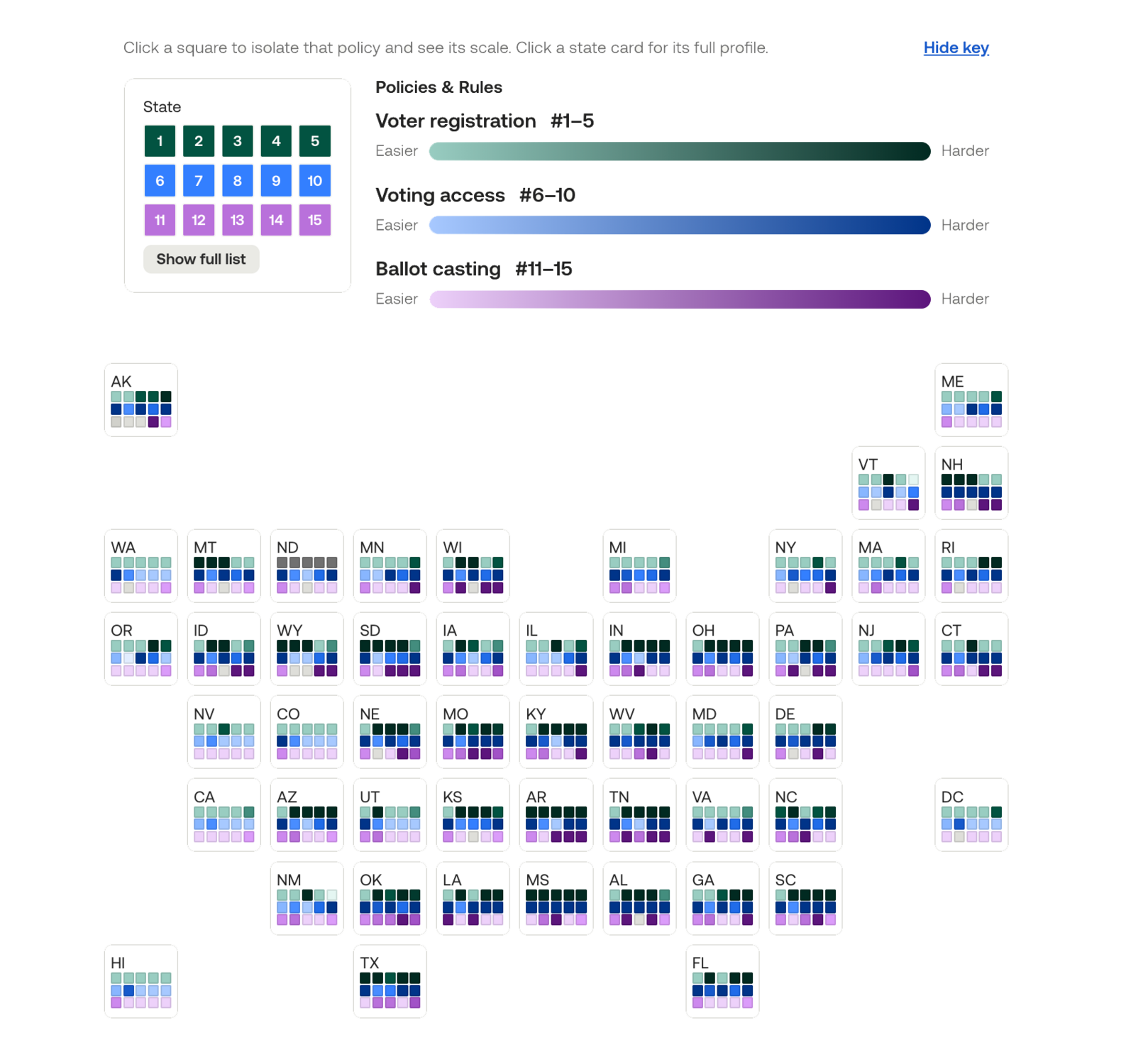
Compare several election policies between states, from registering to vote through post-election procedures.
Interpret the graph
Ask yourself
Voter fraud
When people manage to manipulate the vote count in ways they shouldn't be able to.
Provisional ballots
A ballot provided if a voter's name doesn't appear on a registry.
Risk-limiting audit
A state-level postelection audit that ensures an election yielded the correct outcome.
Mandatory recounts
Recounts that are automatically triggered if results are within a certain margin.
Description
Coming soon
Transcript
Coming soon
In 2021, over 2,000 people stormed the US capitol building. They destroyed property, pepper sprayed police, and terrified the congresspeople inside.
Why? They thought the presidential election had been stolen through widespread voter fraud.
So, what’s the deal with voter fraud, really? And could it actually sway a presidential election?
Hi! I'm Kousha Navidar, this is Crash Course, and we’re answering Big Questions on U.S. Government.
[THEME MUSIC]
We have to get one thing out of the way: the 2020 election /wasn’t/ stolen. Both our court system and bipartisan organizations all across the country have looked /deep/ into things and confirmed that everything went exactly as it was supposed to—at least, until, you know, rioters stormed the Capitol.
But in a democracy like ours, free and fair elections are a /big/ deal. So if the integrity of an election ever /were/ in jeopardy, it /would/ make sense to defend it.
Which does raise a big question. How concerned should we /actually/ be over mass voter fraud?
Basically, voter fraud happens when people manage to manipulate the vote count in ways they shouldn’t be able to.
Like, voting in a jurisdiction where you don’t actually live, or voting multiple times in different jurisdictions, or impersonating someone else and voting in their name, or somehow altering the vote count after the election, or even intimidating /other/ voters to change their vote.
/Tons/ and /tons/ of voter fraud would be a huge problem for elections. But is it actually happening? To find out, we need to look at how our elections really work.
The US is a /huge/ country, and its voting system is so complicated that people literally go to graduate school to study how it works. Trust me, I had the student loans to prove it.
In 2020, over 150 million people voted in the presidential election, in over a hundred thousand different precincts and polling places. So really, even our biggest elections are made up of tons of smaller ones.
Those elections are usually controlled by county or municipal officials, like a county clerk, or a board of election commissioners. Those are the folks in charge of registering the voters, operating the polling places, and verifying the vote count – it’s not the federal government.
That’s why we say the system is decentralized – there’s no one national agency or official that’s in charge of our presidential elections. Congress can make nationwide laws about how federal elections have to operate generally, but the nuts and bolts of how election day goes down in your area …that’s up to local officials.
The whole thing can feel a little sprawling and scattered– and frankly, that might make it natural to worry about voter fraud.
And the system definitely does have flaws. Having different rules and guidelines at the state, county, or even local level can make counting the votes slow, which is why it can take a little while for big elections to get officially called.
Decentralization can also make things pretty confusing for voters who have recently moved and are trying to navigate a totally different process than they’re used to, not to mention different policies when it comes to things like your registration date, what kind of ID you need, and how to cast an absentee ballot.
But decentralized voting also has a /huge/ benefit. Even if some voter fraud were to occur…there’s not actually a single election to steal. Instead of having all our eggs (or votes) in one basket (or government agency), we’ve spread them out in their own teeny tiny nests (or precincts) all over the country. So anybody trying to snatch enough of them to manage to steal a national election would have a /lot/ of work to do.
And frankly, in this economy, who’s got the time?
So decentralization is our first huge safeguard against anyone stealing an election via voter fraud. But it’s not the /only/ one. In fact, there are a ton of other safeguards to make our elections safe and reliable. But are they /really/ enough to stop voter fraud? Let’s check in with a real-life voter about his experience.
[BEGIN TANGENT]
Hi, I’m a really enthusiastic US citizen who is definitely /not/ Kousha Navidar in a hat, although, wow, I am /so/ flattered you think I look like him! That man is a national treasure!
One thing you should know about me is I /love/ to vote. It’s, like, my favorite thing! It’s better than ice cream! It’s better than the Westminster Dog Show! It’s better than the aquamarine waters of Jones Beach on Long Island lapping at your toes while you drink a pina colada! The sense of civic duty! The /stickers/! I’d vote all the time if I could!
But, thanks to our government’s protections against voter fraud, I can only vote /once/ per election– and only in my locality. So each election, I know I have to make it count.
In the lead-up to my very favorite day, Election Day, duh, I prepared by /registering/. To do that, I needed to provide /tons/ of documents to verify my identity and where I live, like a government ID plus a piece of very official mail like a utility bill or a bank statement with my address on it.
If I wanted to cast my vote using a mail-in ballot, I’d have to provide a bunch of stuff that perfectly matches the information I already provided when registering, like my verified address, birthday, ID, and my signature. But if I voted by mail, I knew I’d get turned away if I tried to vote again in person, so I decided to hold off.
When Election Day /finally/ came around I was happier than a kid on Christmas morning. It was tempting to try to show up to a bunch of different polling places, but, just like with mail-in voting, I knew I’d still have to provide information that matched my official registration. Even if I tried to cast a bunch of votes on /provisional/ ballots, which can be provided if a voter’s name doesn’t appear on a registry, I know they check those things really carefully against the voter rolls afterward too, and if they don’t match up, they toss your ballot.
I didn’t want to waste anyone’s time, and I definitely didn’t want to waste all those paper ballots! So after getting my red, white, and blue yogurt parfait for patriotic breakfast, I headed straight over to where I’m /actually/ registered, the middle school gym that doubles as my local polling place.
After saying hello to the local congressional election observer, who was put in charge by the state to make sure nobody was doing anything shady, I high fived all the local election officials, followed the security protocol, and savored the bittersweet high of casting my one singular vote. Ah, Democracy!
I of course would /never/ jeopardize the integrity of our beautiful electoral system by trying to vote multiple times, as much as I’d love to. But if I hadn’t been able to control myself, my extra votes definitely would have been caught after the fact in a risk-limiting audit, where state-level election officials look back over an election to make sure nothing seems out of place.
Risk-limiting audits check the election equipment, the procedures, and the data to make sure every vote matched a record on the voter rolls, all the votes got counted, and nobody casts multiple votes for the love of the sticker…those little clicky pens…the smell of the middle school gym…the gentle smile of the poll worker….the siren song of democracy… ahhhh!
[END TANGENT]
Thanks, enthusiastic citizen! So, it turns out election fraud is actually pretty hard. At least, according to that guy, who I’ve never seen before in my life. He was handsome though, right? Like a…Persian Michael B. Jordan.
/Anyway/, all those safeguards we have in place make it really difficult for people like that to cast votes they’re not allowed to cast. A lot of these measures are thanks to the Help America Vote Act of 2002. It tried to standardize some of the voting process between individual localities in order to make sure voting is secure, reliable, and easy.
[HAVE-uh] HAVA addressed a lot of security concerns that came in the wake of the 2000 election by tightening some of the rules around mail-in ballots and requiring accommodations so people with disabilities could vote privately. It also required states to make centralized voter registries and standardize their counting policies, and made precincts without same-day voter registration offer people provisional ballots so their vote would be counted once their registration was formally verified. It also tried to just make life easier for everyone, by doing stuff like standardizing the information that appears on ballots. HAVA also encouraged polling places to update their voting machines.
You know, because of the chads. Not those chads, these chads. The SEXY chads!
Instead of the punch-card systems that had everyone ripping their feathers out, most precincts today use optical scan paper ballots. Voters fill in a bubble to mark their choice and then a machine scans them to tally up the votes.
On top of all that, if you take a step back and really think about it, voter fraud just isn’t that effective. A few, or even a few /hundred/ extra votes isn’t super likely to change the outcome of an election, even in an individual region. And, when races are close, many states have mandatory recounts that would put a magnifying glass on the voting process, help uncover election fraud and set the record straight.
So knowing /all/ that, maybe you won’t be surprised to find out that voter fraud in the US is /incredibly/ rare.
An independent report by the Brennan Center for Justice screened tons of US elections for incidents of voter fraud, and found that it only happened between 0.0003 and 0.0025% of the time. That’s somewhere between 3 and 25 in every /million/ votes.
That’s true for the 2020 election too. Researchers looked into it /hard/. And what they found lines up with everything we just learned: /no/ evidence of systemic voter fraud.
Which is why a lot of political scientists think all this talk about voter fraud is kind of just fearmongering, and that further efforts to prevent voter fraud, like stricter voter ID laws or higher barriers to voter registration, might actually do more harm than good.
It’s like if I told you that a pack of wild boars was coming to ransack the neighborhood, you’d probably want to see at least a /couple/ boars as proof before I lined the sidewalk with spring traps that could just as easily catch your dog or your 3 year old neighbor.
And when we look for fraudsters coming to ransack our elections, we simply do not find them.
But that’s where professional and public opinion differ. It can be hard for the average citizen to decipher all the ins and outs of decentralization, leaving room for people to start to get kind of anxious about the whole thing.
And all across the country, voters /have/ lost trust in our elections – in a big part because political leaders have cast so much doubt on the whole process. In 2020, Donald Trump claimed without evidence that the presidential election had been stolen through voter fraud. And a Congressional committee assigned to investigate the January 6th insurrection linked it directly to claims like this.
And here in 2026, Trump is president again, and he’s doubling down on his mission against voter fraud and continuing to stoke false ideas about the security of our election systems. He’s even talked of “nationalizing” our election process, which, while /not/ constitutional, has the potential to give the federal government unprecedented power over the election outcome.
So far, measures that require /big/ changes, like requiring prospective voters to provide passports or birth certificates in addition to those other forms of ID, haven’t made it into law. But the fight over who gets to vote, and who gets to decide, is far from over.
Our election system is /complicated/. We’ve got hundreds of millions of voters, hundreds of thousands of precincts, and hyper-specific rules that vary from place to place. But that’s /by design./ Distributing the responsibility for election security in presidential elections keeps any one department or agency from having too much power. And, at least in terms of limiting voter fraud: it’s working.
But, in order for free and fair elections to /truly work/, the results have to be trustworthy /and/ people have to be able to trust them. And if there’s one thing more complicated than the government? It’s people.
Next time, we’ll talk about something that influences election outcomes way more than fraud does – gerrymandering. I’ll see you then.
[OUTRO]
This episode of Crash Course Big Questions on U.S. Government was produced in partnership with USAFacts, a non-partisan civic tech project that makes government data easier to understand.
Thanks for watching this episode of Crash Course Big Questions on U.S. Government, which was filmed at our studio in Indianapolis, Indiana, and was made with the help of all these nice people. If you want to help keep Crash Course free for everyone, forever, you can join our community on Patreon.

Coming Oct. 27, 2026
by Crash Course
Teaching the full Big Questions about US Government series? Get materials for every episode.
Subscribe to get classroom materials new Crash Course episodes, and USAFacts data for teaching civics.

