US trade with Asia: a snapshot
Trump's in Southeast Asia and China this week talking trade. Let's take a look at the state of US trade in the region.
President Trump traveled to Asia this week to join a conference of Southeast Asian leaders in the Philippines and to meet with China's Xi Jinping and Russia's Vladimir Putin in China. The visit included new developments in a trade deal with Thailand.
When the US president travels to East Asia, trade is often driving the conversation. Here's a look at the current state of international trade relations with Trump's hosts this week.
The state of US–China trade
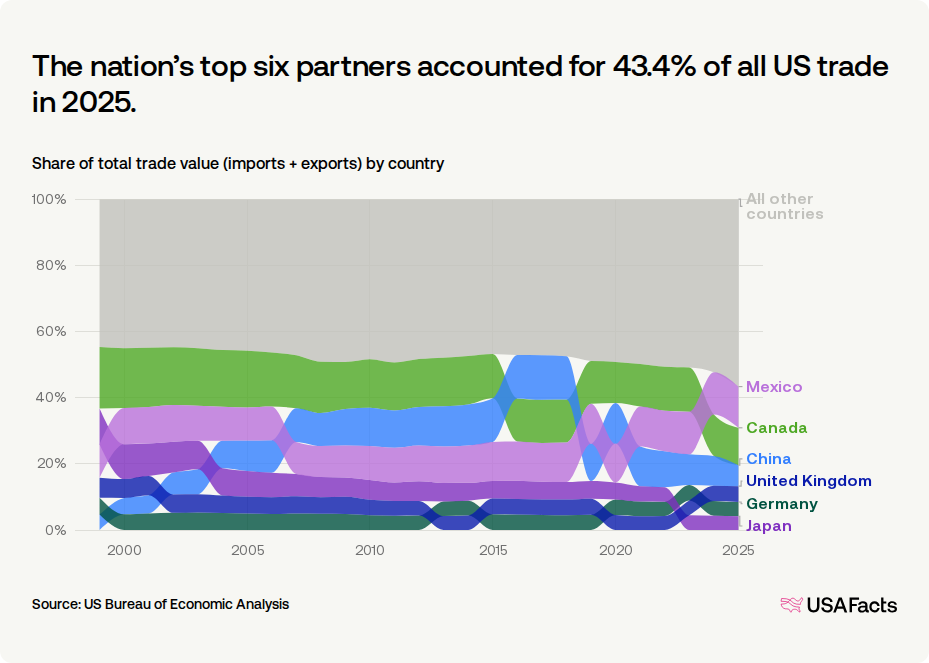
China has been a top five trade partner of the US by total trade volume since 2000, accounting for 6.4% of total US trade volume and ranking third in 2025.
The nation’s top six partners accounted for 43.4% of all US trade in 2025.
Share of total trade value (imports + exports) by country
Last year, the US imported $331.8 billion in goods and services from China and exported $164.2 billion, amounting to the US's third-largest trade deficit at $167.6 billion. This is down from $377.1 billion in 2018, when the US trade deficit with China was its largest, before adjusting for inflation.
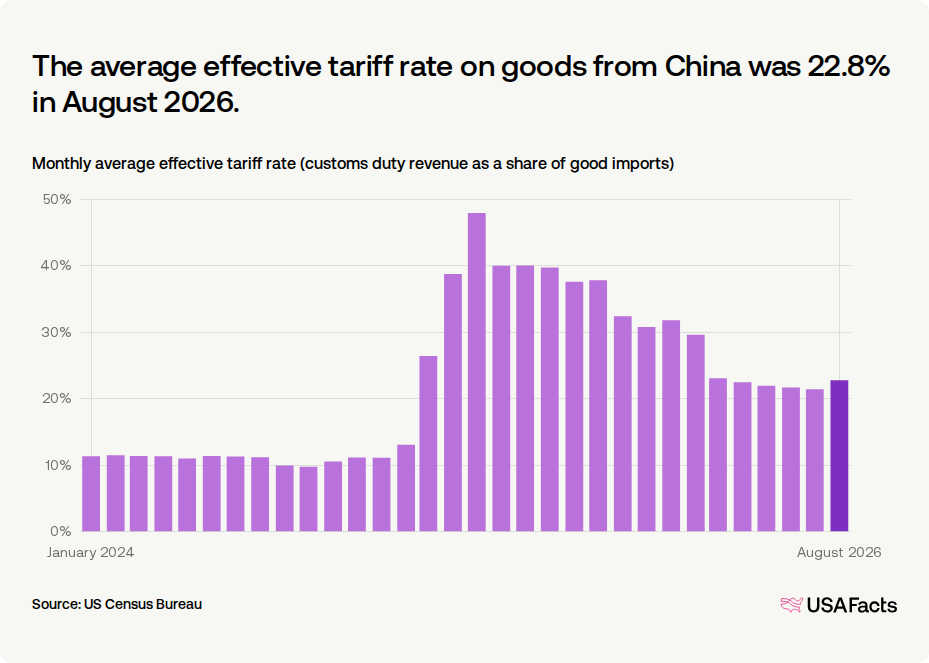
The US raised tariffs in early 2025, driving the effective tariff rate on China from 11.1% in January 2025 to a high of 47.9% in May of that year. The rate has since eased to 22.8% as of August 2026, though that's still more than twice the rate from 19 months prior.
The average effective tariff rate on goods from China was 22.8% in August 2026.
Monthly average effective tariff rate (customs duty revenue as a share of good imports)
How much does the US trade with Southeast Asia?
US trade with Southeast Asia has grown in the 21st century, with Vietnam and Thailand rising into the country's top 20 trade partners by total volume.
As recently as 2011, Thailand ranked 28th among US trade partners with a total of $39.3 billion in volume. By 2025, the country ranked 18th at $118.3 billion (not adjusted for inflation).
Vietnam's growth in US trade has been even more pronounced. Twenty years ago in 2006, it ranked 43rd among trade partners with a relatively modest $10.7 billion volume. Last year it ranked 12th, leading all Southeast Asian nations, with $215.3 billion.
Singapore ($145.7 billion) and Malaysia ($94.6 billion) also ranked in the top 20 in 2025, at 16th and 20th.
Vietnam leads Southeast Asian countries in trade volume with the US.
Total trade volume with the US by country, not adjusted for inflation, 1999–2025

With most countries in the region, the US imports more than it exports. In 2025, the US trade deficit with Vietnam was $177.1 billion, larger than the deficit with China. The US and Vietnam reached an agreement on a trade framework in 2025.
The lone exceptions in the region are Singapore, with which the US had a $33.1 billion surplus in 2025, and Brunei.
The US carries trade deficits with 5 of 7 Southeast Asian trade partners.
Total trade balance with the US by country, not adjusted for inflation, 1999–2025

As trade talks with Thailand advance, the effective tariff rate on Thai imports is 5.8% as of August 2026, below the US average on all trade partners but more than four times the rate in January of 2025.
Continue reading about trade and get the data directly to your inbox with our weekly newsletter.

Keep exploring
- Who are the US’ top trade partners? - Over 50% of 2023 US trade involved one of five partners: Mexico, Canada, China, Germany, and Japan.
- What does it mean for the US to have a half a trillion dollar trade deficit? - The trade balance says more about trade patterns than the health of the US economy.
- What are tariffs and how do they work? - Tariffs are taxes paid by firms importing goods internationally. They are used as a tool to control global trade.
- US-Canada trade history in six charts - Tariff increases by the US and Canada in 2026 have intensified trade tensions between two of North America's largest trading partners.
