Long-term care: How expensive is it, and who does the work?
Long-term care is pricey, and many families end up doing most of the work themselves.
Healthcare doesn't always mean doctors, emergency rooms, and surgeries. For some people, it's assistance with daily activities — eating, bathing, and taking medicine. Help with tasks like these is called long-term services and supports (LTSS), and more than 17.6 million adults in the US rely on it; 51% of them age 65+.
Most US residents who live to become elderly (an estimated 56%) will need this help at some point. Just over one in five will require care for more than five years. (People of all ages need LTSS, but most of the available data is about older folks).
This care isn't free. For older people who need LTSS, a mix of Medicaid, other public programs, private insurance, and out-of-pocket expenses covers the cost, which the Department of Health and Human Services (HHS) projects will average $245,400 per person.
Many people, faced with the costs, choose to rely on family and friends. Roughly 38.2 million people aged 15 and up engaged in unpaid elder care from 2023 to 2024.
Get weekly insights
Subscribe for data-driven insights. No spin, just the facts.
How much does long-term care cost?
Long-term care is broken into two categories: institutional care and home and community-based services (HCBS). Institutional care is round-the-clock care in nursing homes. HCBS provides long-term care where a person lives, with personal care and home health aides helping with daily tasks.
The median annual price for a nursing home in 2024 was $111,300 for a semi-private room and $127,800 for private.
HCBS costs clock in at the mid-$70s: assuming 44 hours of care a week, the industry standard, the national median cost for home health aide services in 2024 was $77,800 in 2024. For assisted living facilities, it was $70,800. Assisted living facilities differ from nursing homes in that the care recipient does not require around-the-clock care.
Total 2023 spending on LTSS, private and public, totaled $563.7 billion — a significant cost.
How does the government pay for long-term care?
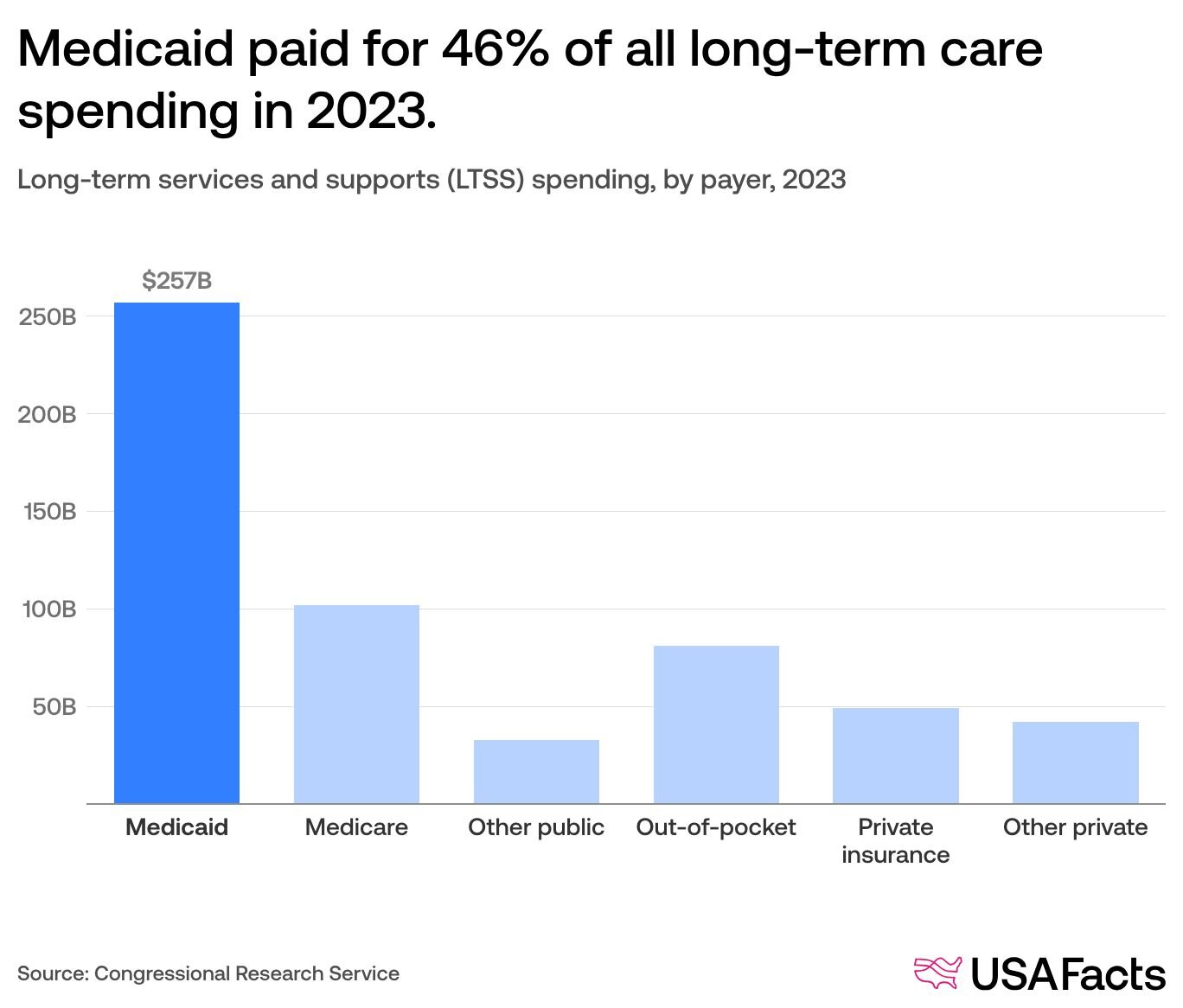
Of all payers of that $563.7 billion, the government contributed the most: $391.3 billion. The largest single payer was Medicaid (which supports people with low income and limited assets) at $257 billion, followed by Medicare (healthcare for people 65+) with $101.7 billion.
Medicaid and Medicare both fund long-term care, although Medicare primarily provides short-term, recovery-oriented services, not the ongoing daily supports of LTSS.
Medicaid paid for 46% of all long-term care spending in 2023.
Long-term services and supports (LTSS) spending, by payer, 2023
What does Medicaid long-term care cover?
If someone is eligible for Medicaid institutional care, the government pays for a nursing facility, room, board, skilled nursing, and daily living assistance. Around 1.5 million people used Medicaid institutional care in 2023.
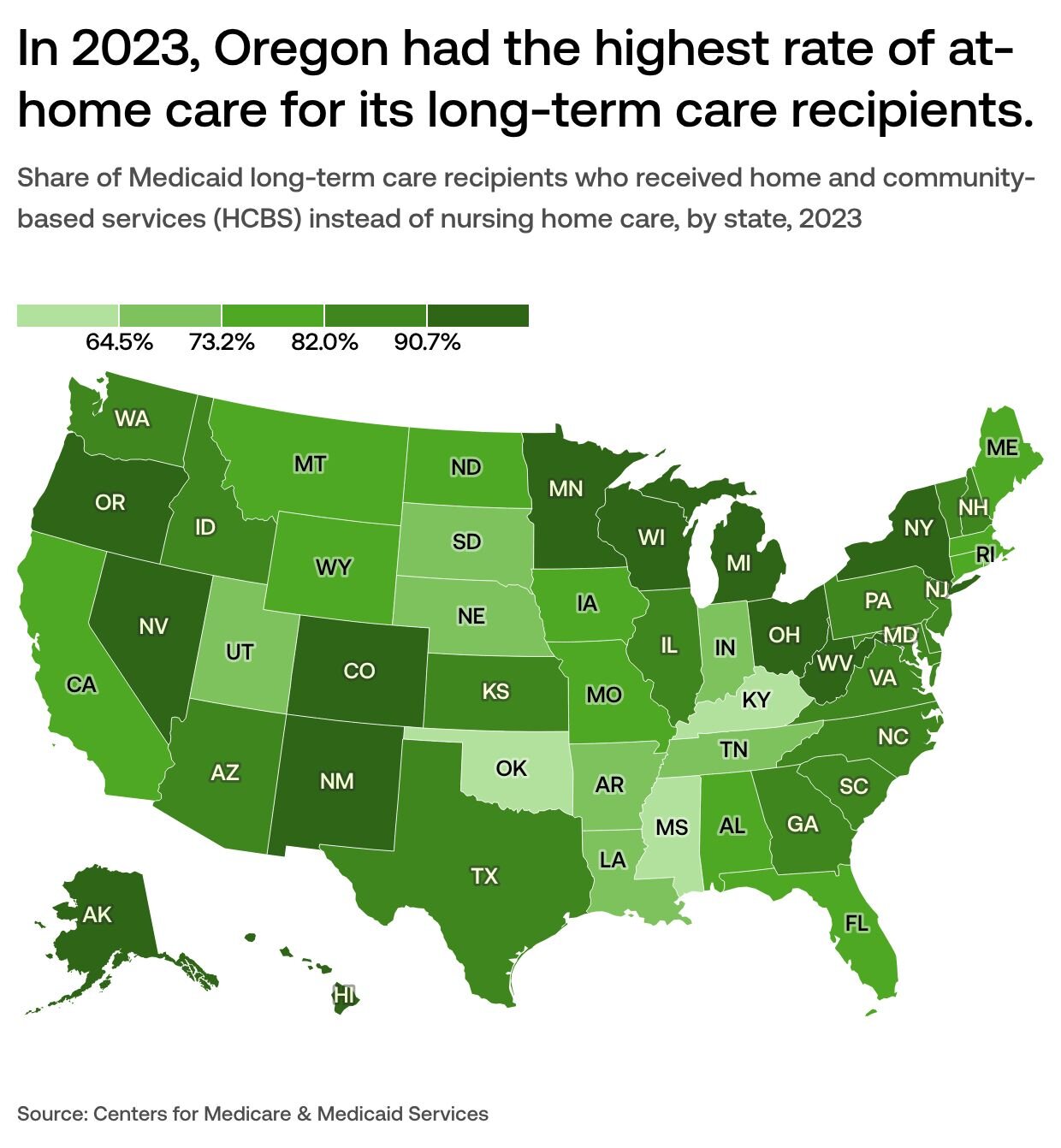
For those eligible for HCBS, Medicaid covers personal care, home health aides, adult day services, respite care, and home modifications. Roughly 8.4 million people used Medicaid HCBS in 2023, and the percentage of eligible recipients receiving home services ranged from 55.8% in Kentucky to 99.4% in Oregon. (States can choose whether to offer most of these services and can cap enrollment, which affects the number of recipients.)
In 2023, Oregon had the highest rate of at-home care for its long-term care recipients.
Share of Medicaid long-term care recipients who received home and community-based services (HCBS) instead of nursing home care, by state, 2023
Medicaid participants can also apply to self-direct their HCBS care, setting personalized budgets and training and paying their own caregivers (who can be family members rather than agency-employed workers). But self-directed care is under the HCBS umbrella, so reimbursed family care isn't guaranteed — hence the 38.2 million Americans who provided unpaid elder care from 2023 to 2024.
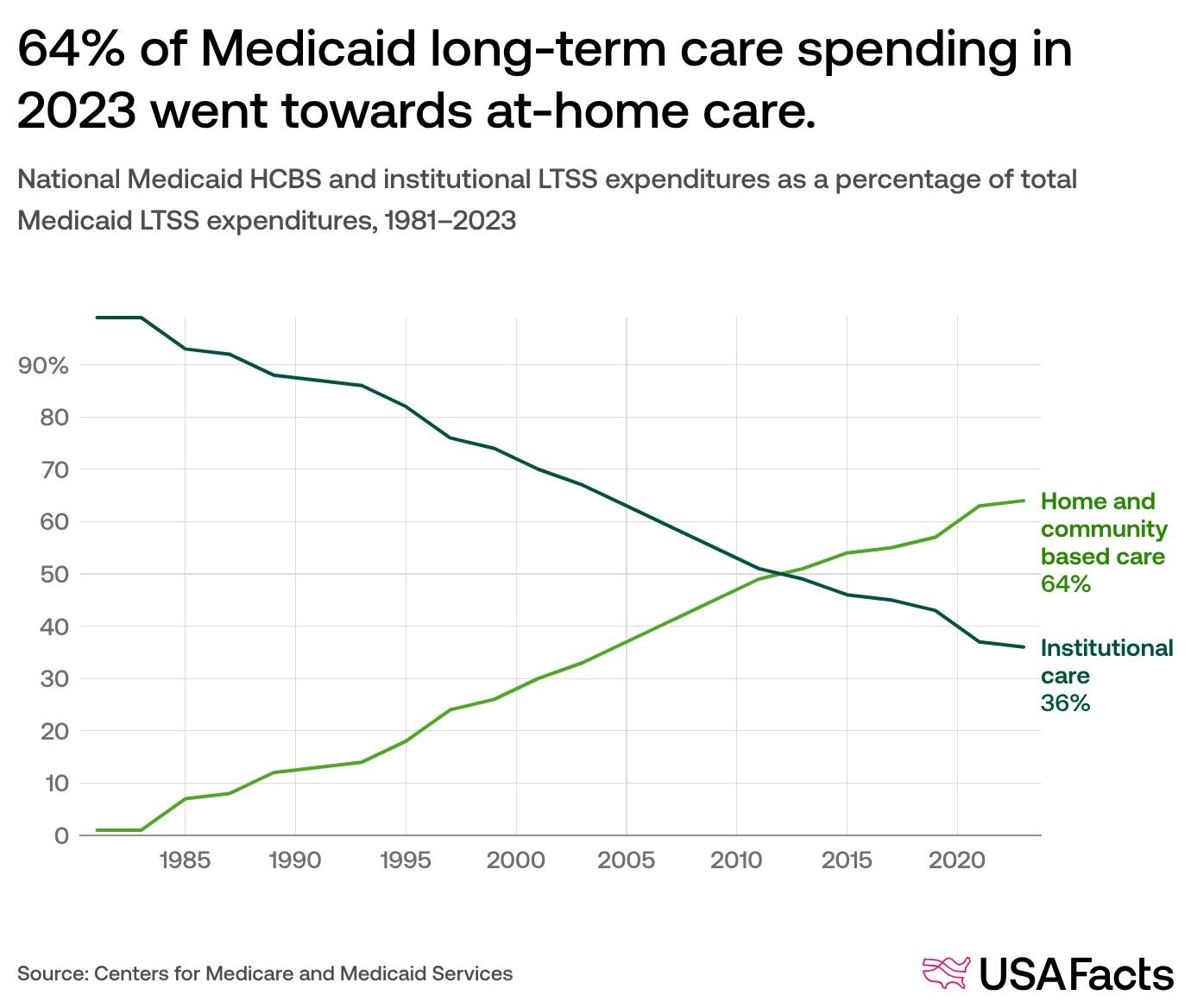
Medicaid long-term care spending has been shifting toward HCBS and away from institutional care. In 1981, 1.1% of Medicaid long-term care spending went to HCBS. In 2013, more went to HCBS than to institutional, and by 2023, it was 63.8%. That's despite HCBS costing far less per person: $54,462 per person in an institution vs. $17,298 for HCBS.
64% of Medicaid long-term care spending in 2023 went towards at-home care.
National Medicaid HCBS and institutional LTSS expenditures as a percentage of total Medicaid LTSS expenditures, 1981-2023
The Medicaid and CHIP Payment and Access Commission credits part of this change to Olmstead v. L.C., in which the Supreme Court held that states couldn't keep people with disabilities in institutions if they could otherwise live in their communities.
The unpaid care economy
In 2025, roughly 4.7 million paid aides worked in home health and personal care, serving people of all ages, but from 2023 to 2024, 38.2 million Americans provided unpaid care to elderly adults. That's about eight times as many — and doesn't count those caring for younger people with disabilities.
In 2022, HHS estimated that unpaid family care for older adults with significant disabilities is worth $204,000 on average over a lifetime. That's a lot saved, but free care has a cost for the caregiver.
Sixty-five percent of working parental caregivers said that it affected their ability to do their jobs. They may get to work late, leave early, or take extra time off. For people paid hourly, that can mean lost wages on top of the unpaid caregiving.
What's the future of care?
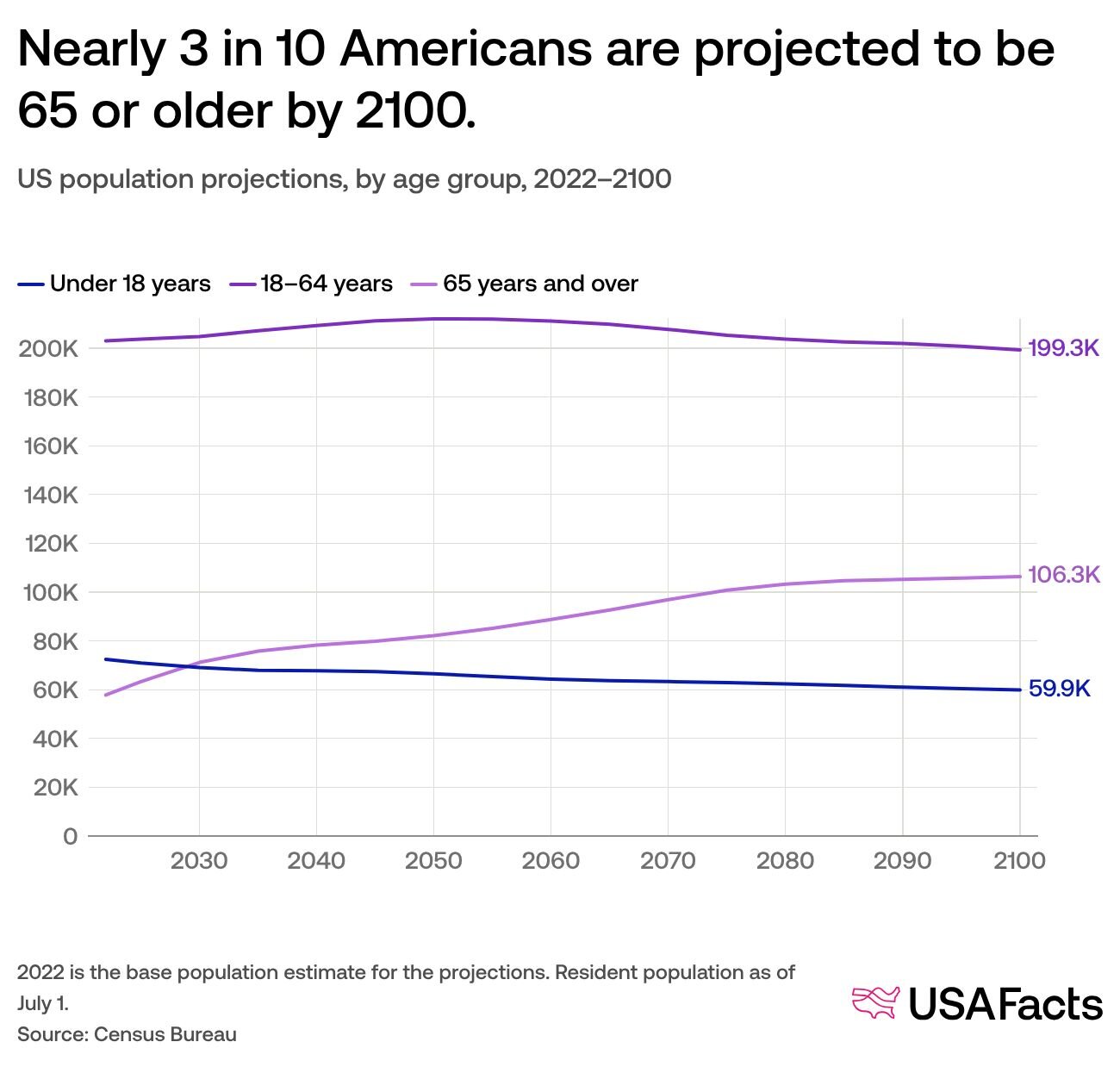
Most US residents who need long-term care are elderly, and their share of the population is growing. Census Bureau projections, which run to 2100, have the number of elderly people per 100 adults aged 18 to 64 nearly doubling: from 28.5 elderly per 100 in 2022 to 53.3 per 2100. Demand for long-term care workers is projected to grow between 2023 and 2038.
Nearly 3 in 10 Americans are projected to be 65 or older by 2100.
US population projections, by age group, 2022–2100
The labor market is responding. The Bureau of Labor Statistics (BLS) projects 18% growth in home health and personal care aide jobs from 2025 to 2035, with 847,300 positions gained, faster than the average across all occupations. Long-term care is expensive, and the cost is spread across several payers.
In 2023, government programs paid more than two-thirds of total spending. But that ignores both unpaid family carers, who outnumber paid carers, and the work of getting reimbursed for that work — meeting income limits and getting through paperwork and waiting lists.
Explore more data about the cost of healthcare and get data delivered to your inbox weekly by signing up for our newsletter.
Steve Ballmer Explains: The American Healthcare System

Keep exploring
- How will the One Big Beautiful Bill Act impact Medicaid? - Work requirements and changes to state funding mechanisms are expected to impact federal Medicaid spending the most.
- California and Medicaid: What the data says - The federal government is deferring $1 billion in Medicaid payments to California and Minnesota. Here's a look at the numbers.
- Who has health insurance? Are rates going up? - Young adults ages 19 to 25 are the most likely to be uninsured of any age group: 14.3% of them were uninsured in 2024.
- How many people receive government assistance? - In 2022, around one in three Americans was enrolled in at least one government assistance program.

