America's public data has a trust problem. Now what?
Americans are calling for better data and better discourse. How can we answer that call?
It is often said of trust that it takes years to build and seconds to destroy. Is America’s federal data infrastructure experiencing those destructive seconds?
Americans are losing trust in the government as a source of information, according to the State of the Facts poll released today by USAFacts and AP/NORC. The percentage of people who said they trust information from federal agencies dropped from 18% in 2024 to 11% in 2026. The seven-point drop was the largest among 15 information sources.
How much do you trust information from these sources about the government?
Change in share responding "a great deal" or "quite a bit" from 2024 to 2026
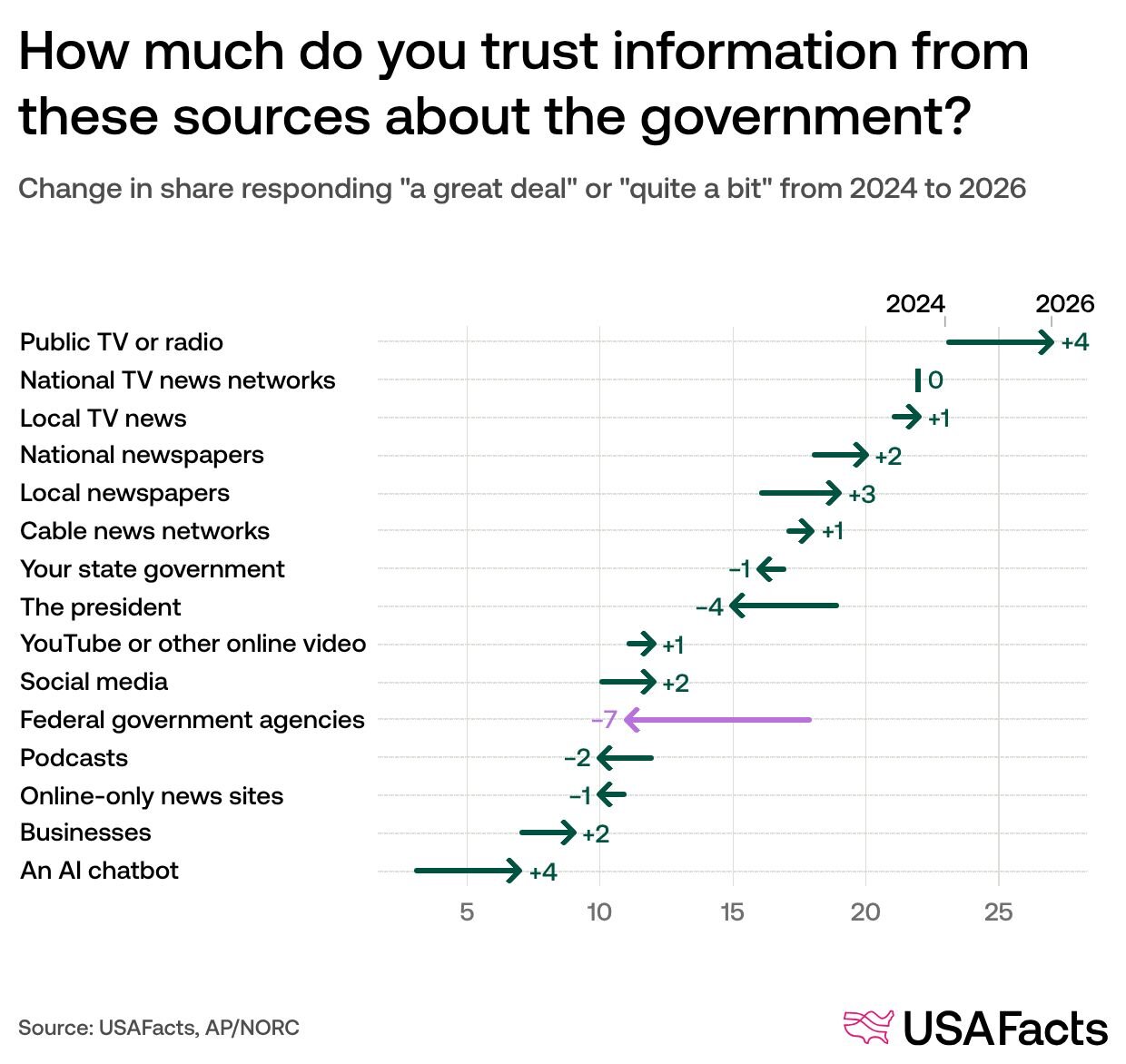
In 2024, people reported trusting federal agencies about as much as national newspapers or cable news networks. Today, fewer people report “a great deal” or “quite a bit” of trust in federal agencies than in YouTube and social media.
The same poll illustrates just why we need that information. A 43% share of respondents attribute our country’s political division to “relying on different facts” about major problems as opposed to having different beliefs. Consider that — nearly half of Americans don’t actually think we disagree ideologically on certain political issues, just that we have different information.
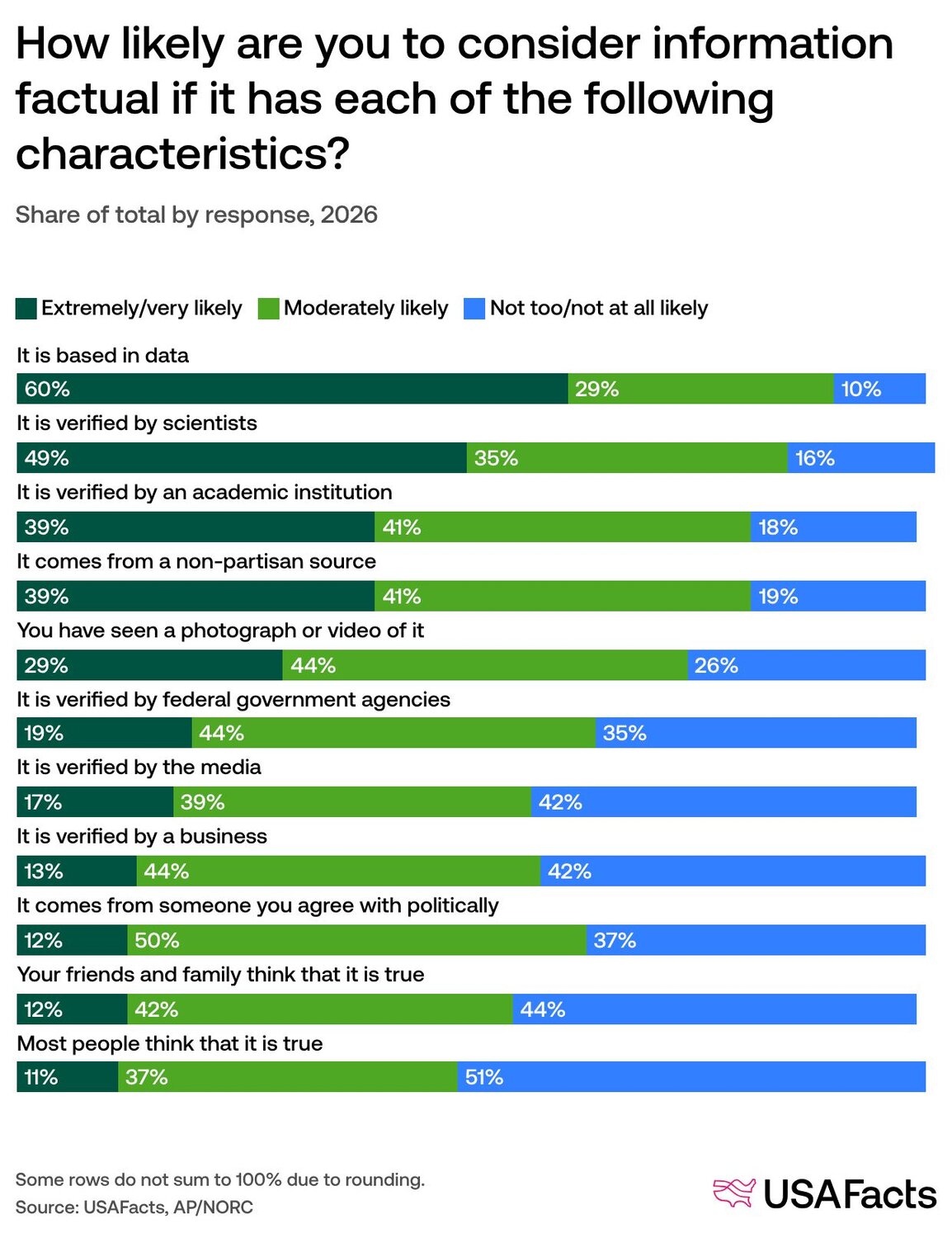
So how does this polarized public want to determine fact from fiction? Put simply, data. Sixty percent say they are very likely to see information as factual if it is based in data, the number one driver of confidence.
How likely are you to consider information factual if it has each of the following characteristics?
Share of total by response, 2026
And when they look at our political discourse, they don’t see it. Just 12% of adults feel that party campaign messages are based on factual information, while 10% feel debates between candidates and policy decisions are.
Nearly half of Americans don’t actually think we disagree ideologically on certain political issues, just that we have different information.
Taken together, this is a call to action. We need reliable federal data, the public is saying, and what we’re getting isn’t living up to our standards.
Whether by partial cause or by coincidence, this critical moment in public trust comes as artificial intelligence enters the daily lives of more and more Americans. Data from the Census Bureau shows that over half of American households are using AI tools, most commonly to find information of all kinds. But only 14% of those users trust the information they get from it. Additional context from the USAFacts/AP poll shows that Americans are generally more concerned about AI’s impact on information than excited about it.
About 14% of AI users trust the information they get from it.
Percentage of adults who reported household AI use by AI sentiment, June 2025
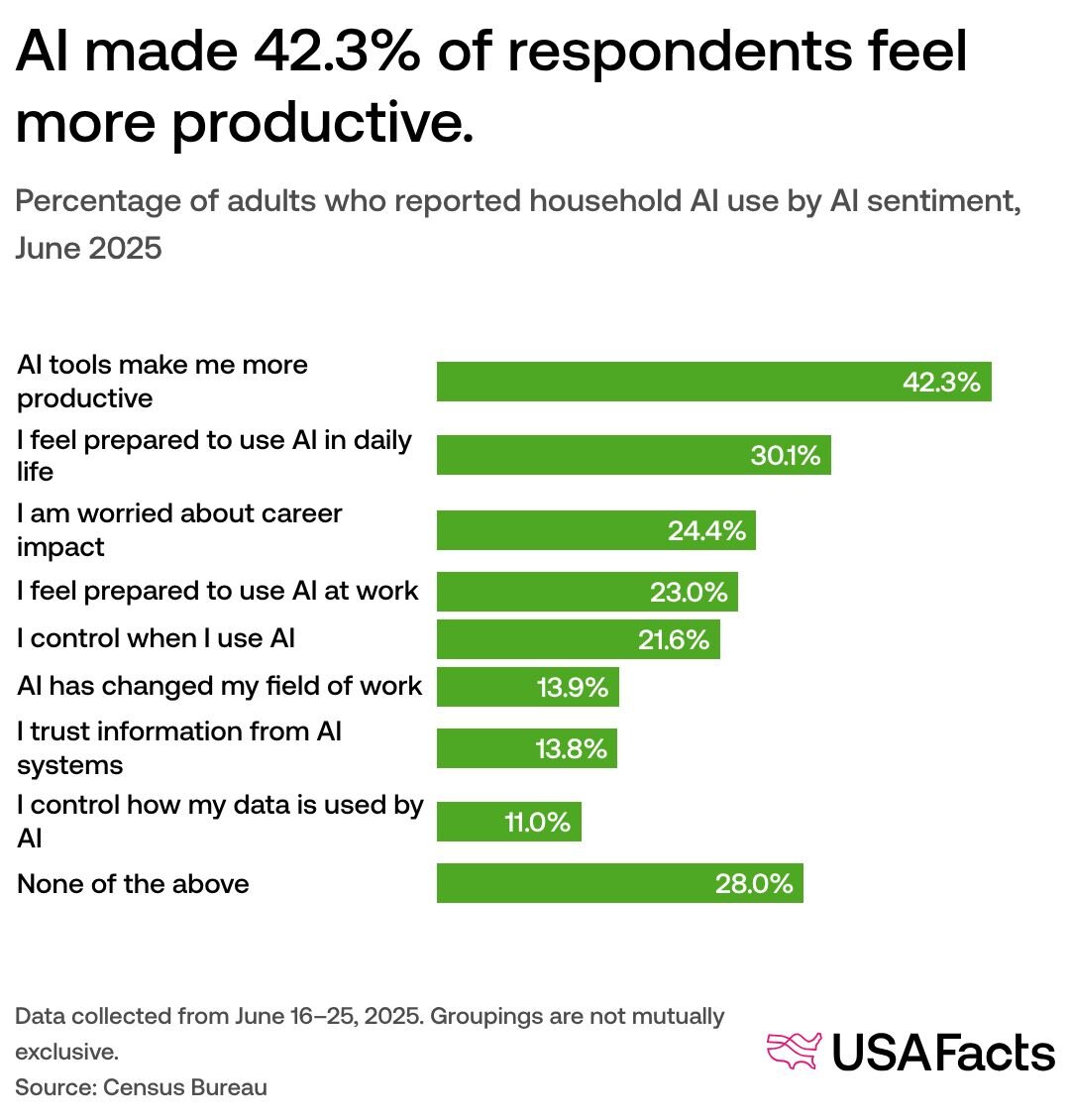
This much is true: AI is becoming a more common method for accessing information, and Americans report trusting it less than more traditional sources of information. That sharpens the issue.
The American public has identified a twofold need: for more reliable information, and for more of our discourse to be centered around it. Now it’s incumbent upon the public service industries to respond.
First, this means the federal government and its partners working together to improve data collection and reporting, particularly in a world where people are more frequently using AI to access this information. USAFacts, through our advocacy work, is directly asking Congress to commit to investing in robust and modern data infrastructure that is free of political influence, visible to the public, and ready for AI models to be a part of disseminating that information. We partnered with the Center for Open Data Enterprise to publish our data standards for the government to model after and are working to bring government data into the AI era.
But to get to the crux of the issue, we need not only to shore up the foundations of government data collection in the halls of Congress but also to bring that data to the spaces — digital and otherwise — where Americans are getting their information, including:
The internet in the AI era. As Americans adopt AI tools and existing companies integrate AI into their work, AI agents will be increasingly involved in answering Americans’ questions. We need leaders in the industry to invest in ensuring those answers are accurate. This fall at USAFacts, we are launching tools directly within AI platforms to make trustworthy government data directly available to people using AI to get information.
The sphere of public debate. When people can agree on the facts, we can have informed debate about political issues. USAFacts aims to bring facts to the public discourse, allowing ideological adversaries to have a productive debate by starting from the same set of facts.
The classroom and beyond. Our political discourse begins with our foundational understanding of how the country works. What is government for, and what does it do? During this midterm season, USAFacts is reaching new audiences with civic-forward content aimed at students in the classroom and lifelong learners, including a 15-part YouTube series with Crash Course and continued investment in our flagship Just the Facts video series.
In an age of waning trust, the American people are calling for clarity — for a world where sociopolitical discourse is grounded in data that is easy to access, understand, and use to make decisions. The call is all of ours to heed.
Read the full report and get the facts every week by signing up for our newsletter.

Keep exploring
- State of the Facts 2024: Americans’ views on data, election information, and AI - Americans are more likely to use “new media” as news sources, but less likely to trust them.
- How many Americans are using AI — and how? - 35% of American households are using AI to find information. 14% of people trust that information.
- Why does USAFacts use US government data? - Here's why we believe it's critical to give Americans a site where the data is 100% sourced from the government itself.
- How to use government data - The US government generates data on everything from unemployment rates to the status of endangered marine mammals. Here’s why that’s important.