How many Americans are using AI — and how?
35% of American households are using AI to find information. 14% of people trust that information.
New Census Bureau data shows that 57% of Americans have used AI tools to search, brainstorm, complete work or school tasks, and more. Forty-two percent of respondents reported a productivity boost, though the responses also show concern with trust, data privacy, and career impact.
This data comes from the Bureau’s Household Trends and Outlook Pulse Survey, which collected responses from June 16 to 25, 2025 and came out in April 2026.
How many people are using AI?
Over half of US adults reported that someone in their household had used AI at least once in the past two months. The most common use was searching for information (35.1% of respondents). Smaller shares used it to brainstorm or generate ideas (22.9%) or as an assistant for work (20.9%) or school (11.7%) projects.
Relatively few people said they’d used AI instead of hiring a human— just 4.5% of respondents, though that still equates to 12 million people.
The most common use of AI is to find information.
Percentage of US adults reporting household use of AI by use case, June 2025

Who is using AI?
AI use was more common among employed people; 66.7%, compared to 44.1% of unemployed respondents. Use also trended up with income, going from 40.2% of households making under $25,000 to 76.7% in families earning $150,000+.
Educational attainment also made it more likely that the respondent or someone in their household had engaged with AI: 29.6% of people who hadn’t completed high school, 46.1% of people with a high school diploma or GED, 55.8% of people with some college or an associate’s degree, and 74.9% of people with a bachelor’s degree.
Adults between 40 and 54 reported household AI use at a higher rate (65.2%) than those between 25 and 39 (62.6%) or over 55 (45.4%). (There weren’t enough responses from 18 to 24 year olds for meaningful comparison.)
Household AI use was also more commonly reported by men (61.7%) than women (52.4%). Asian respondents (78.3%) were more than 20 points more likely than white respondents (57.3%), while Hispanic (50.3%) and Black (46.6%) respondents reported it at below-average rates.
AI use increased with income and educational attainment.
Percentage of US adults reporting household AI use by demographic, June 2025

Age seemed to say more about how people used AI — for support in creative thinking vs. finding information — than whether they used it. While 28% to 38% of people in all age groups reported using it to find factual information, 36.1% of 25- to 39-year-olds used it for brainstorming and idea generation compared to just 7.4% of people 65 and older.
Older adults are using AI more for fact-finding than for brainstorming.
Percentage of respondents reporting household AI use by age, June 2025

This wasn’t true for other demographic patterns. Higher-income families reported using AI more across most categories, but more broadly for factfinding than for brainstorming.
How do people feel about AI?
As much as people are using AI, many still feel unprepared and/or concerned about its impacts.
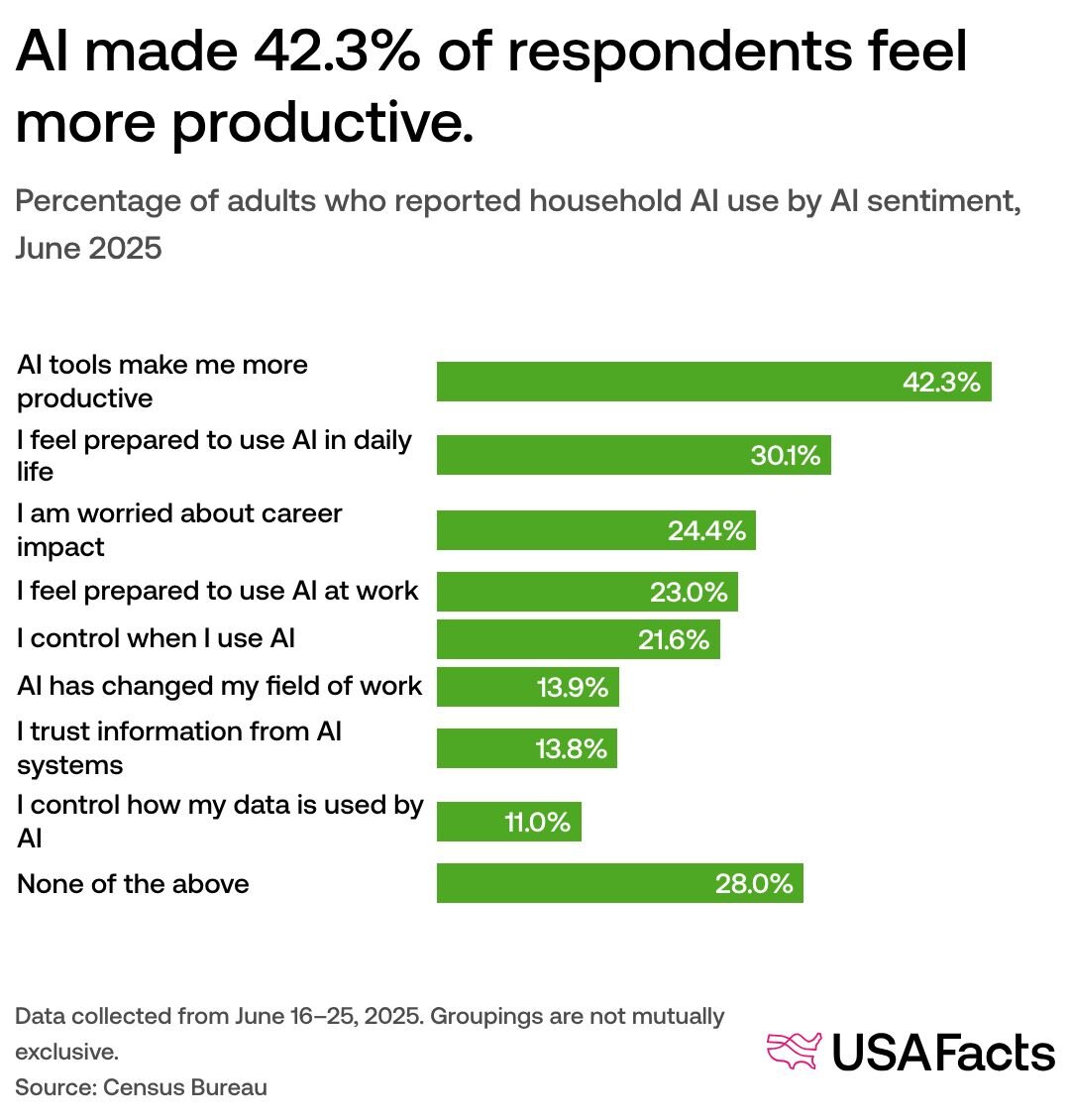
While 35.1% of adults reported household usage of AI to find information, only 13.8% of those who reported using AI trust the information they get from it. And just 11% percent felt that they had control over how their data was used by the tools — indeed, only 21.6% of people feel that they control when they’re using AI at all, given how many products now integrate it.
In the workplace, 13.9% reported that it has already changed their field. Only 23.0% feel prepared to use it at work, and nearly a quarter (24.4%) were worried about how it would impact their careers.
Still, 42.3% believed the tools made them more productive.
AI made 42.3% of respondents feel more productive.
Percentage of adults who reported household AI use by AI sentiment, June 2025
Using AI more doesn’t necessarily correlate with trusting it. Younger adults were most likely to feel prepared to use AI and the least likely to feel in control of how their data is used. Higher-educated people reported both more household AI use and increased concern for their careers.
Younger adults were more likely to feel prepared for AI and less likely to feel control over how their data is used.
Percentage of US adults who reported household AI use by AI sentiment, June 2025

Where does this data come from?
Where does this data come from?
In April 2026, the Census Bureau released the first data collected by the Household Trends and Outlook Pulse Survey, a reimagined version of a previous survey called the Household Pulse Survey. It collects data from a sample of Americans on topics including nutrition, employment, transportation, education, and now AI. New survey data will be released monthly.
Read on and get the data directly to your inbox by signing up for our newsletter.

Keep exploring
- Are AI data centers driving up your electric bill? A USAFacts deep dive. - Grab your favorite beverage and comfiest chair, because we’re going to learn some things.
- State of the Facts 2024: Americans’ views on data, election information, and AI - Americans are more likely to use “new media” as news sources, but less likely to trust them.
- 65% of households with children report the use of online learning during pandemic - Eleven percent of households with children reported having no live contact with a teacher in the past week.
- America's public data has a trust problem. Now what? - Americans are calling for better data and better discourse. How can we answer that call?
