How much are candidates spending for the 2026 midterm?
Refreshed monthly
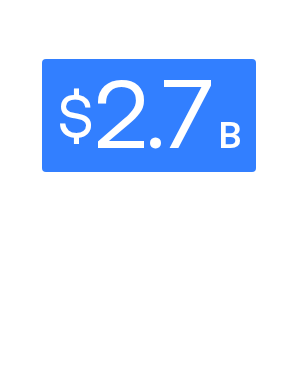
As of August 2026, Senate and House candidates have spent around $1.9 billion on races for the 2026 November midterm election. That's about 72.7% of campaign funds raised this election cycle.
$1.32B
spent by House candidates for federal campaigns from January 2025–August 2026
$622M
spent by Senate candidates on federal campaigns from January 2025–August 2026
The Federal Election Commission (FEC) tracks federal campaign contributions and spending in two-year periods. Each period begins in January and goes through December of the following year.
For example, the funding cycle for the November 2026 midterm election began in January 2025, and will end in December 2026. The next presidential election will be in 2028. Funding for that cycle will begin in January 2027.
Which candidates have spent the most money?
The 10 candidates to spend the most money as of August 2026 are:
James Talarico (Democrat, Texas Senate race): $47,007,775
Jon Ossoff (Democrat, Georgia Senate race): $39,682,882
Raja Krishnamoorthi (Democrat, Illinois Senate race): $31,484,015
David Trone (Democrat, Maryland House race): $24,745,121
Sherrod Brown (Democrat, Ohio Senate race): $22,336,493
Alexandria Ocasio-Cortez (Democrat, New York House race): $20,381,469
Lindsay Graham (Republican, South Carolina Senate race): $20,079,974
Graham Platner (Democrat, Maine Senate race): $19,287,361
Joshua Joseph Weil (Democrat, Florida Senate race): $15,933,478
Hakeem Jeffries (Democrat, New York House race): $14,854,086
James Talarico has spent the most money so far this election cycle: $47 million.
Spending by candidate, by party affiliation, January 2025–August 2026
Of the 10 candidates to spend the most money, nine are Democrats and one is Republican.
These spending totals include all candidates who have raised money for the 2025–2026 election cycle, including those who have since lost primaries or caucuses, or have otherwise withdrawn their candidacy.
The top Republican spender, Lindsay Graham, passed away on July 11, 2026. His sister, Darline Graham Nordone, was appointed to fill his vacancy in the current Senate term, which ends in January 2027. She has since launched her own Senate campaign in South Carolina for the 2026 midterm to serve a full six-year term.
Democrats, accounting for 1,356 of 2,583 congressional candidates, have spent $1.1 billion. Republicans, accounting for 1,029 candidates, have spent a total of $784.9 million.
Get weekly insights
Subscribe for data-driven insights. No spin, just the facts.
Some candidates have spent more than they have raised
Of the top 400 highest-spending candidates, 44 have spent more than they have raised.
For example, Shri Thanedar, an incumbent candidate running for a House seat in Michigan, reported raising $390,276, and spending $2,265,605. In other words, that's about 5.8 times more than they raised.
44 of the 400 top-spending congressional candidates have spent more than they've raised.
Funds raised and spent by the top 400 spending candidates, January 2025–August 2026
A campaign can spend more than it's raised by spending money it raised earlier (even in a previous election cycle), rather than new contributions, or if it has taken out loans. Candidates can take out personal loans, bank loans, and draw advances on a brokerage account, credit card, or home-equity line of credit, provided the loan is made under commercially reasonable terms in the ordinary course of the lender's business.
Which states have the highest spending by Senate candidates?
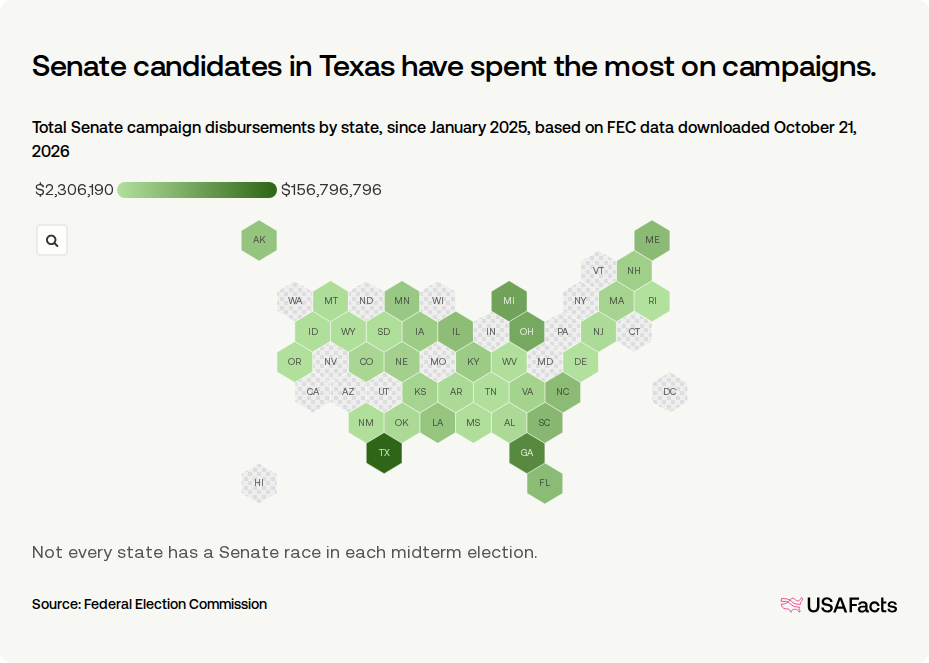
Candidates have spent a total of $622 million on 2026 Senate races. The Texas senate campaigns have spent more so far than those in any other state: $90.2 million.
Of that, Senate seat challenger Democrat James Talarico has spent the most of Texas's 14 candidates: $47.0 million, and seat incumbent Republican John Cornyn spent $12.2 million.
Why are there some states where no money has been spent? Not every state has a Senate election in 2026. Senators serve six-year terms and are divided into three election classes (Class I, Class II, and Class III), with staggered elections. That way, about one-third of Senate seats are up for election every two years. Each state's senators belong to different classes, no state has more than one regularly scheduled Senate election in the same year.
Senate candidates in Texas have spent the most on campaigns.
Total Senate campaign disbursements by state, January 2025–August 2026
Candidates in Georgia have spent the second-most of all states, totaling $60.8 million.
In Georgia, the top spender is Jon Ossoff, an incumbent Democrat who has spent $39.7 million, or around 65.2% of all Senate race money spent in Georgia.
The next highest Georgia spender is Buddy Carter, a Republican seat challenger who spent $10.3 million. In June 2026, Carter lost the Republican primary runoff to Michael Collins, who has spent $5.9 million.
Which House races have the highest candidate spending this midterm?
Maryland's 6th Congressional District is the highest spending House race of this midterm so far, with candidates spending a combined $37.4 million. Most of that spending came from challenger Democrat David Trone ($24.7 million) and incumbent Democrat April McClain Delaney ($12 million).
Trone represented Maryland's 6th district in the House from 2019 to 2025 and did not seek re-election for his seat in 2024. Delaney beat Trone in the June 2026 Maryland Democratic primary.
Candidates for Maryland's 6th District have spent a combined $37.4 million.
Total disbursements for federal congressional races by district, January 2025–August 2026
Candidates in New York's 17th Congressional District have spent the second-most among House districts, at $22.5 million.
Peter Chatzky, the challenger Democrat in New York's 17th Congressional District, has spent $11.7 million — more than 52.1% of the district's total. Republican incumbent Michael Lawler has spent about $3.5 million, and the district's remaining candidates account for the rest.
If a candidate has withdrawn or been eliminated from their race, they have a few options for unspent funds under the Federal Election Campaign Act (and later amendments), and FEC regulations. Remaining funds can cover both campaign and non-campaign expenses.
Campaign-related expenses include using extra funds for a future election. Candidates are required to have a principal committee registered with the FEC to raise and spend campaign funds. Under this type of expense, a candidate can:
Keep funds in their existing committee by redesignating it for their next race
Establish a new committee and, as long as the old committee doesn't have higher debts than cash on hand, transfer the funds over
Donations to state and local candidates (as state law allows)
Any other lawful purpose that isn't personal use
If the candidate was an officeholder, a candidate can spend money on "ordinary and necessary" officeholder expenses, including:
Travel expenses for the officeholder, spouse, and children, when directly connected to the officeholder's official responsibilities
"Winding down" costs for up to six months after leaving office
Winding down costs can include related expenses like moving costs (moving office furnishings from a federal office in Washington, DC, back to a candidate's home state), paying committee staff, and gifts of nominal value (the FEC hasn't established a dollar amount) to non-family members.
The FEC prohibits spending campaign funds for personal use.
Top 200 spending candidates
Top 200 spending candidates
Candidate name
Total spent
James Talarico (Democrat, TX)
TX Senate
$47,007,775
Jon Ossoff (Democrat, GA)
GA Senate
$39,682,882
Raja Krishnamoorthi (Democrat, IL)
IL Senate
$31,484,015
David Trone (Democrat, MD)
MD District 06
$24,745,121
Sherrod Brown (Democrat, OH)
OH Senate
$22,336,493
Alexandria Ocasio-Cortez (Democrat, NY)
NY District 14
$20,381,469
Lindsay Graham (Republican, SC)
SC Senate
$20,079,974
Graham Platner (Democrat, ME)
ME Senate
$19,287,361
Joshua Joseph Weil (Democrat, FL)
FL Senate
$15,933,478
Hakeem Jeffries (Democrat, NY)
NY District 08
$14,854,086
Keep exploring
Methodology
USAFacts standardizes data, in areas such as time and demographics, to make it easier to understand and compare.
Page sources
USAFacts endeavors to share the most up-to-date information available. We sourced the data on this page directly from government agencies; however, the intervals at which agencies publish updated data vary.