How many people overstay their visas?
360K
0.7%
Why does DHS estimate — rather than count — visa overstays?
Why does DHS estimate — rather than count — visa overstays?
US airports, seaports, and border infrastructure in the US are designed to precisely track arrivals to the country; departures are not tracked directly which is why we are given suspected in-country overstays. The names of people leaving the US by air or by sea are tracked on passenger lists maintained by private companies (e.g., the airline). Those who exit via land borders are logged when they enter Canada or Mexico, and this data is ultimately shared with DHS. This indirect system for exit processing means that confirming a departure takes time and can be imprecise.
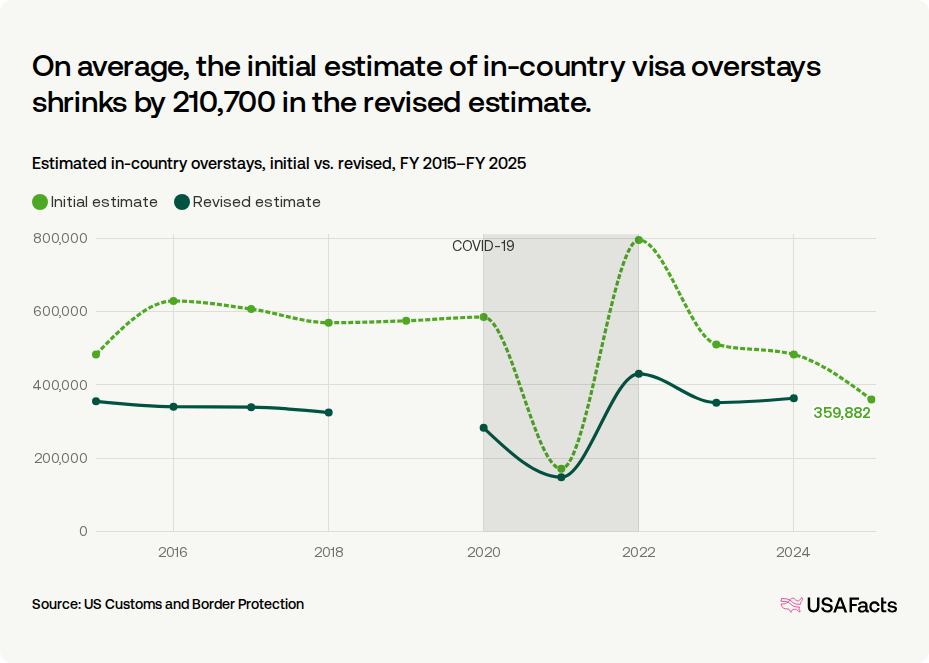
On average, the initial estimate of in-country visa overstays shrinks by 210,700 in the revised estimate.
Estimated in-country overstays, initial vs. revised, FY 2015–FY 2025
Get weekly insights
Subscribe for data-driven insights. No spin, just the facts.
How do overstays vary by type of visa?
- Business and tourist travelers. These are B1 or B2 visa holders. Eligible business or tourist travelers from Canada or from countries that are part of the Visa Waiver Program don’t require a visa; people from all other countries do.
- Canadian and Mexican visitors. Unlike people entering the US from other countries, visitors from Canada and Mexico primarily cross land borders to enter and exit the US, so they are handled separately by the source.
- Student and exchange visitors. These are F, M, and J visa holders.
- All other nonimmigrant visa classes. See methodology for a complete list of in-scope non-immigrant visas.
In FY 2025, tourism and business visitors from Visa Waiver Program countries had the lowest overstay rate but the third highest raw number of overstays.
Initial suspected in-country overstays vs. overstay rate by visa category

What countries have the highest visa overstay rates?
The three countries with the highest suspected in-country overstay rates in FY 2025 were:
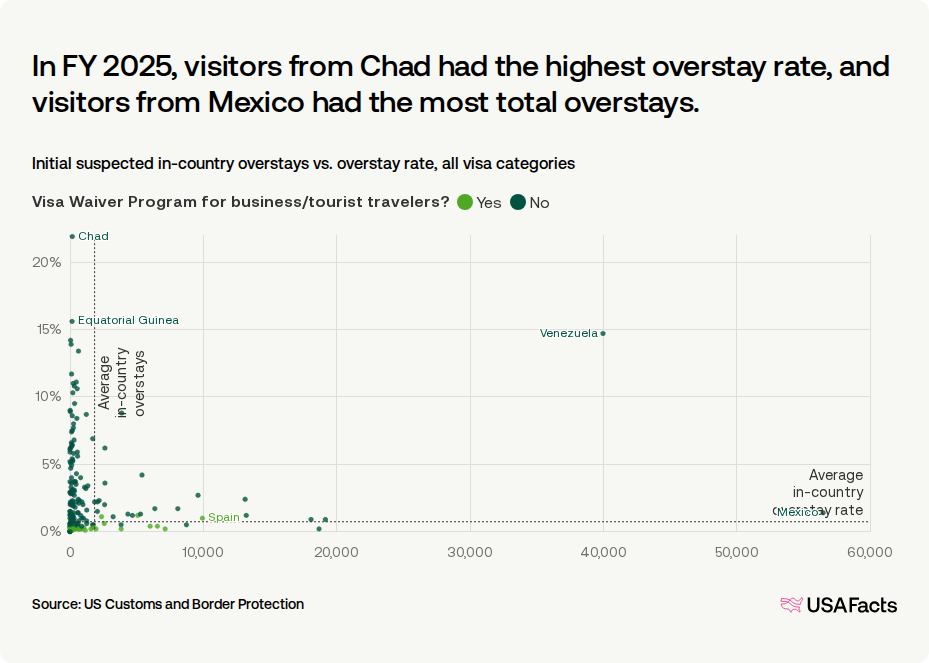
- Chad (overstay rate of 21.9%, 172 people total)
- Equatorial Guinea (15.6%, 156 total)
- Venezuela (14.7%, 39,976 total)
The three countries with the most suspected in-country overstays for FY 2025 were:
- Mexico (56,486 people, or 1.4% of expected departures)
- Venezuela (39,976, 14.7% of departures)
- India (19,160, 0.9% of departures)
In FY 2025, visitors from Chad had the highest overstay rate, and visitors from Mexico had the most total overstays.
Initial suspected in-country overstays vs. overstay rate, all visa categories
Initial suspected overstay estimates by country, FY 2025
| Country | In-country overstays | In-country overstay rate | Visa Waiver Program member? |
|---|---|---|---|
Mexico | 56,486 | 1.4% | No |
Venezuela | 39,976 | 14.7% | No |
India | 19,160 | 0.9% | No |
Canada | 18,678 | 0.2% | No |
Brazil | 18,078 | 0.9% | No |
Colombia | 13,221 | 1.2% | No |
Dominican Republic | 13,135 | 2.4% | No |
Spain | 9,928 | 1.0% | Yes |
Jamaica | 9,603 | 2.7% | No |
China | 8,734 | 0.5% | No |
Keep exploring

Methodology
USAFacts standardizes data, in areas such as time and demographics, to make it easier to understand and compare.
Page sources
USAFacts endeavors to share the most up-to-date information available. We sourced the data on this page directly from government agencies; however, the intervals at which agencies publish updated data vary.