What does the do?

Refreshed annually

The Office of Labor-Management Standards (OLMS) is a subdivision of the Department of Labor responsible for promoting and protecting democracy and integrity within labor unions by enforcing standards for union officer elections, investigating violations, and requiring public disclosure of union financial information. It was established in 1959.

In FY 2025,

$48M

was spent by the Office of Labor-Management Standards
In FY 2025,

<0.1%

of Dept. of Labor spending was by the Office of Labor-Management Standards

How much does the Office of Labor-Management Standards spend?

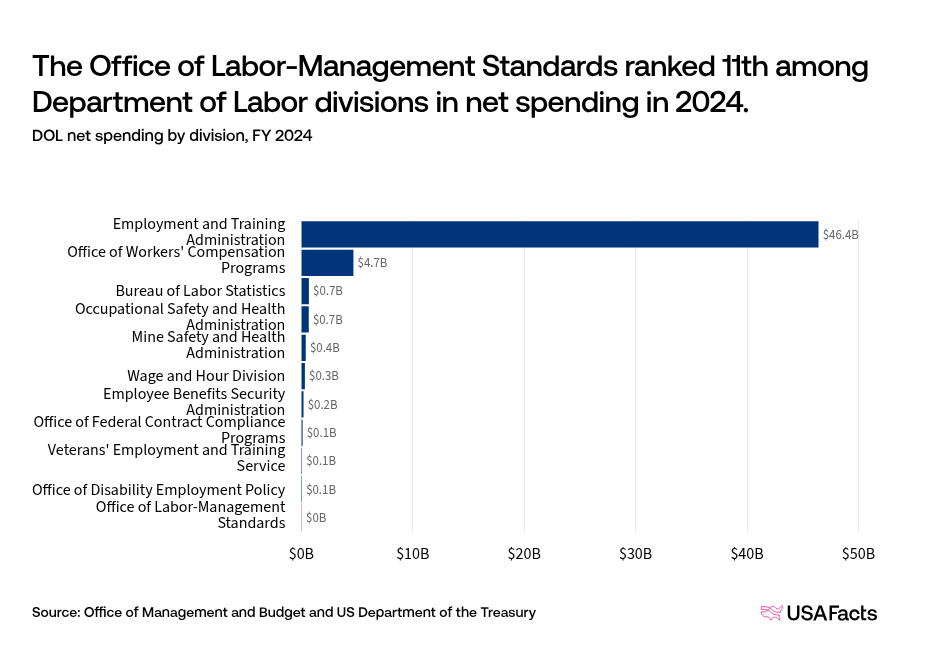
The Office of Labor-Management Standards spent a net total of $48 million in fiscal year (FY) 2025. This was 0.088% of the $54.6 billion spent by the Department of Labor, which itself was 0.8% of all federal spending. The OLMS ranked 12th among DOL subdivisions in net spending.
Net spending is the difference between agency spending and any financial accounts generating funds from the agency’s own activities, like fees or rent. When these funds offset all spending, net spending appears negative. Some agencies tend to operate with positive net spending while others will register negative net spending sometimes or often.

The Office of Labor-Management Standards ranked 12th among Department of Labor divisions in net spending in 2025.

DOL net spending by division, FY 2025
Like the overall federal budget, agency spending may shift over time due to population growth, changes in policy and programs, and emerging problems to address. Adjusting for inflation, the Office of Labor-Management Standards’ federal spending has decreased from $51.8 million in 2012 to $48 million in 2025.

Get weekly insights

Subscribe for data-driven insights. No spin, just the facts.

The Office of Labor-Management Standards’s federal spending in FY 2025 was lower than in FY 2012.

Yearly federal net spending by OLMS, adjusted for inflation (2025 dollars), FYs 2012–2025
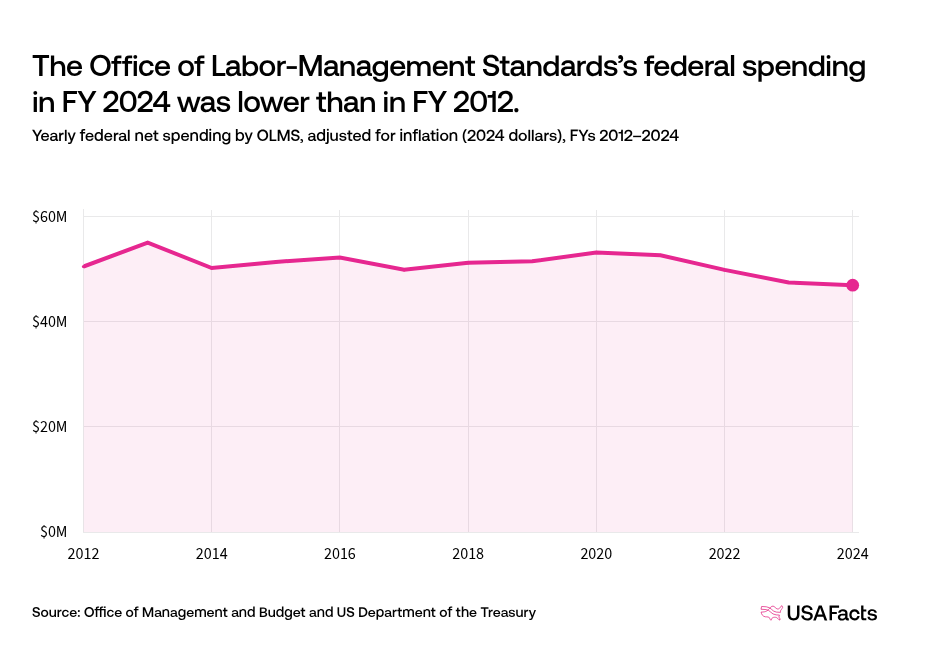
Since 2012, Office of Labor-Management Standards' spending has decreased 7.4%, while overall spending has increased 41.1%.
As a percentage of the overall federal budget, a positive number means agency net spending made up some positive share of total federal spending; a negative number means that net generated funds offset a portion of total spending. OLMS spending grew less than overall federal spending since 2012, which means that its share of the federal budget decreased. In 2025, OLMS accounted for 0.00068% of overall federal spending.
Major legislation, internal or global economic conditions, and acute events like the COVID-19 pandemic can affect spending year to year. For example, the federal budget fluctuated during the pandemic, rising from $5.3 trillion (in 2023 dollars) in 2019 to $7.7 trillion in 2020 and $7.8 trillion in 2021.

The Office of Labor-Management Standards’s share of federal spending in FY 2025 was lower than in FY 2012.

Net spending by OLMS as a share of federal spending, FYs 2012–2025

Most federal spending can be categorized as direct or indirect. Direct spending refers to money the federal government spends on budget items such as federal programs, employee salaries, and debt interest. Indirect spending refers to federal transfers to state and local governments.
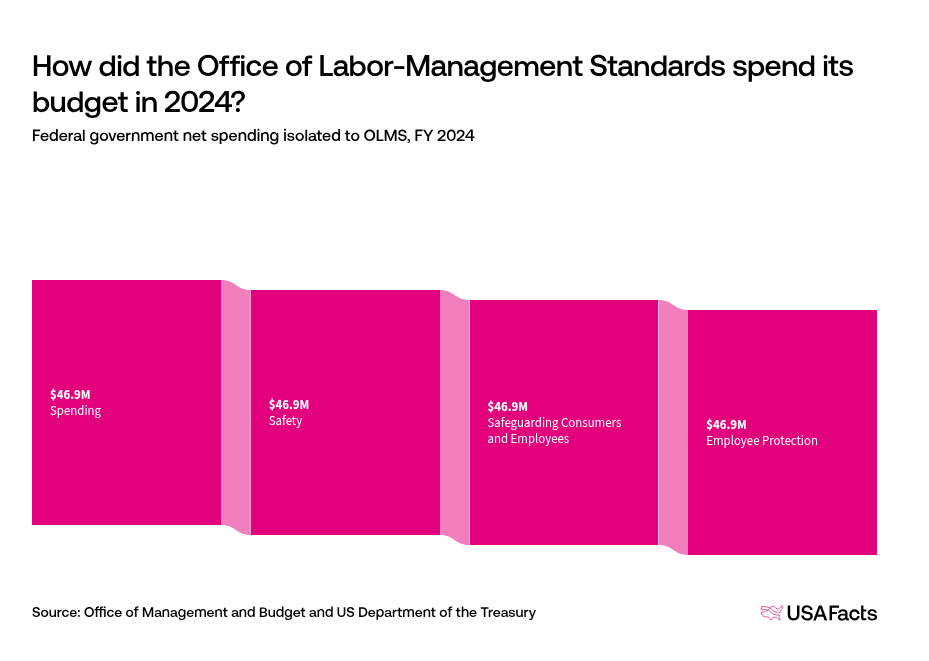
In FY 2025, all of the Office of Labor-Management Standards's spending was direct.
The chart below outlines all net OLMS spending.

How did the Office of Labor-Management Standards spend its budget in 2025?

Federal government net spending isolated to OLMS, FY 2025
Some 163 of the 2.03 million total civilian federal employees work for the Office of Labor-Management Standards as of May 2026. This is 27.9% fewer people than the division staffed in 2012.

The number of federal employees working for the Office of Labor-Management Standards has decreased 27.9% since 2012.

Number of federal employees working for OLMS, May 2012–2026

The Office of Labor-Management Standards accounts for 0.008% of the overall federal workforce. As the number of federal employees has changed, so too has the way the workforce is organized, with resources allocated to agencies depending on government priorities. The division constituted a smaller share of the overall federal workforce in May 2026 compared to 2012 (0.011%).
While the number of employees on an agency’s payroll contributes to that agency’s expenditures, some agencies have relatively few employees compared to their budget or vice versa, giving them an outsized share of either the budget or the workforce. According to the most recent data, the Office of Labor-Management Standards’ share of the workforce (0.008%) is larger than its share of the budget (0.00068%).

Who leads the Office of Labor-Management Standards?

The OLMS is led by a director. This individual is appointed by the president of the United States and does not require Senate confirmation. The OLMS director reports to the Secretary of Labor.

Keep exploring

Methodology

USAFacts standardizes data, in areas such as time and demographics, to make it easier to understand and compare.

Page sources

USAFacts endeavors to share the most up-to-date information available. We sourced the data on this page directly from government agencies; however, the intervals at which agencies publish updated data vary.