Episode 3
Where does campaign money really come from?
 Crash Course
 USAFactsCrash CourseUSAFacts
Featured visualization
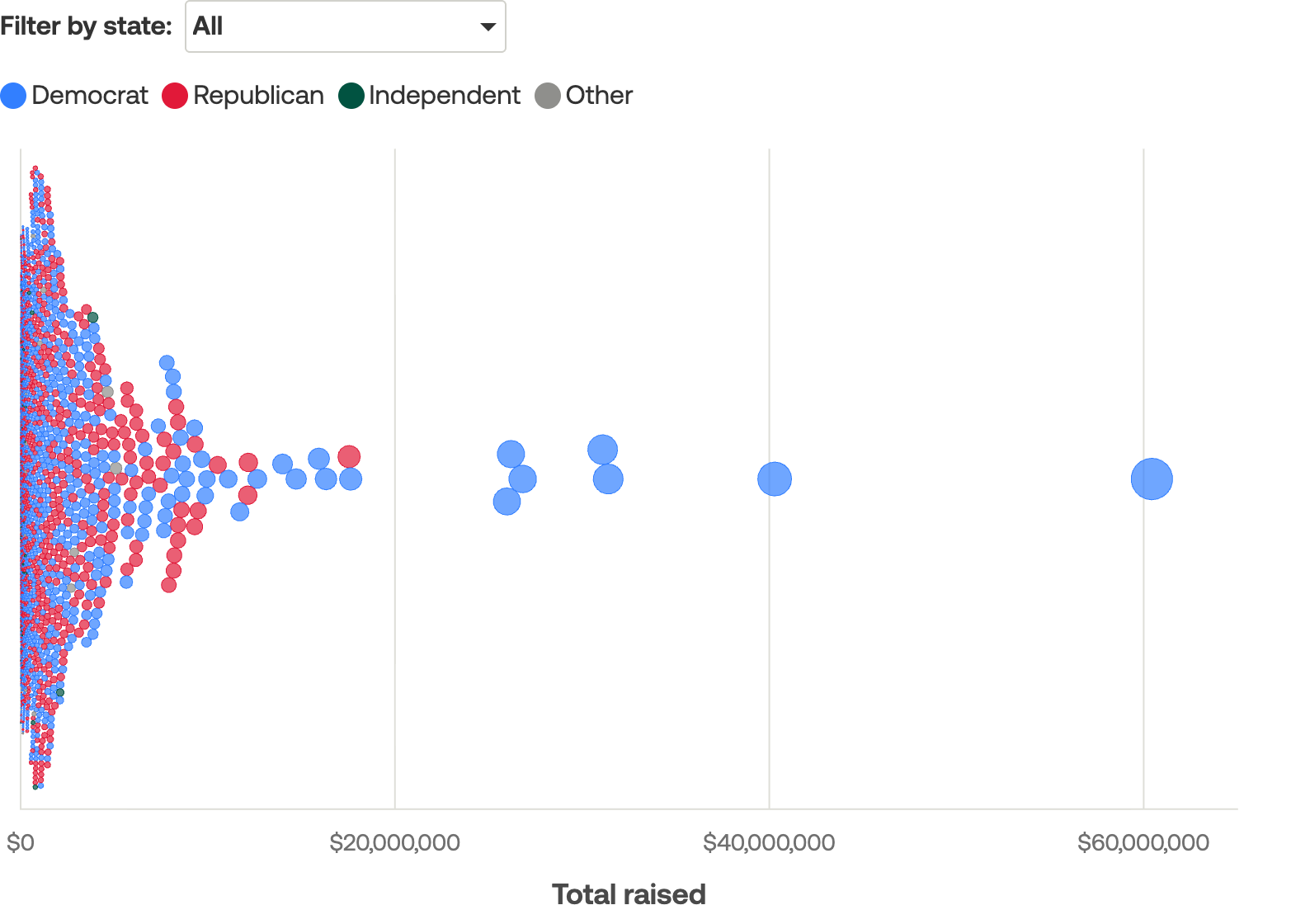
The episode dives into how much money candidates are raising and spending for political campaigns. As of August 2026, Senate and House candidates have raised around $2.67 billion toward federal races for the 2026 November midterm election.
Interpret the graph
Ask yourself
Issue ads
Advertising meant to influence voters by advocating around certain issues.
Incumbency advantage
Describes the advantage incumbent candidates have in fundraising and name recognition.
Negative partisanship
A strong dislike for the opposite party.
Surrogate representation
Political donations to candidates that don't directly represent you.
Description
Where do campaigns get all their money, and where does it go? In this episode of Crash Course Big Questions on U.S. Government, we’ll dig into the limits of campaign financing and the rising influence of super PACs, dark money, and independent spending. We’ll also look at why special interest groups, corporations, and individual voters donate to campaigns, and what that money is actually used for.
Transcript
Fourteen billion dollars. That’s the incomprehensible amount of money that was spent on just federal political campaigns in 2024. And generally with each passing election cycle, that number only keeps growing. But get this – /most/ Americans /don’t/ donate to political campaigns. And a whole chunk of the billions thrown around in the last election were donated by…well, we don’t exactly know. So where’s all this money /really/ coming from? And where is it actually going?
Fourteen billion dollars. That’s the incomprehensible amount of money that was spent on just federal political campaigns in 2024. And generally with each passing election cycle, that number only keeps growing.
But get this – /most/ Americans /don’t/ donate to political campaigns. And a whole chunk of the billions thrown around in the last election were donated by…well, we don’t exactly know.
So where’s all this money /really/ coming from? And where is it actually going?
Hi, I’m Kousha Navidar, this is Crash Course, and we’re answering Big Questions on U.S. Government.
Fourteen billion dollars is a /ton/ of money. And some of it comes from pretty obvious sources, like spending by the Democratic & Republican National Committees. But the rest of it has to come from a bunch of different places.
Now, the last time I checked, there’s no mention of campaign fundraising in the Constitution. Wait, hold on. [pause to skim document] Yep, still true. In fact, when the thing was first written, the idea of a politician asking regular folks for money was seen as peak cringe.
[B CAM] It /was/ okay to hand out free whiskey to voters, though. It was a different time.
By the mid-1800s, campaign fundraising started catching on. And pretty soon, money from wealthy donors and businesses had become big enough of a deal that over time, lawmakers began to implement some actual rules around it.
Today, the way you or I might be the most familiar with financially supporting a campaign is through campaign contributions—those are direct donations to a candidate. These can come from individual donors, like you and I, or by Political Act ion Committees, also known as PACS.
But in 1971, the Federal Election Campaign Act laid out requirements for campaigns to report all their donations, and an amendment implemented in 1974 introduced strict caps on how much and how often someone can give to individual candidates and their campaigns per election cycle.
Like, did you know campaigns can’t take more than $50 cash if it’s given anonymously? And a single person can’t give more than $3500 to a campaign each election? Meanwhile, for PACS, contributions can’t surpass $5,000.
Plus, each state can set its own limits for how much you can contribute in /their/ state-wide elections. There are a lot of rules, and when it comes to federal elections it’s up to the Federal Election Commission, or FEC, to make sure they get followed.
So in 2024, out of that fourteen billion dollars spent on federal campaigns, campaign contributions only made up about 4.7 billion.
But there’s a whole other way to spend money on campaigns: independent spending. That’s where, instead of giving directly to a campaign or party, donors spend as much of their own money as they’d like to boost advertising, organize rallies, or even help fund outside groups in support of a candidate– and those FEC rules don’t apply.
Now, it might seem like a sort of shifty loophole in the system. But the fact is, it got the OK from the Supreme Court. In the 2010 case Citizens United v. FEC, the court ruled that independent spending by corporations, unions, and nonprofits counts as free speech.
And later that same year, Speechnow.org v. FEC built on that decision to include individuals, too. So really, the only limits to how much you can spend to influence an election is how deep your pockets are.
And this decision had huge consequences. Since 2010, independent spending has become a powerful, quickly growing way of putting your money into your politics– especially for corporations and nonprofits.
It led to the creation of new organizations whose express purpose is to inject massive amounts of independent spending money into elections. And it’s paved the way for corporations and the very-wealthy to have more influence than ever on elections—while simultaneously getting around the rules that were supposed to keep donations transparent.
The most common independent spending organizations are Super PACs, also known as independent expenditure-only committees.
These are organizations like Make America Great Again Inc; WinSenatePAC; Democracy PAC, created and funded by billionaire George Soros; and America PAC, funded by Elon Musk.
Super PACS aren’t allowed to collaborate with the candidates they like or directly contribute to them --because then that would be a campaign contribution and have to follow the FEC rules— and Super Pacs do also report who their donors are to the FEC. But there’s no limit to how much a Super PAC can raise and spend. In fact, about 20% of total spending in the 2024 election came from Super PACs.
But hold on to your ballots, cause we’re not done here yet. There’s yet another, much more secretive way that billions of dollars get poured into elections: 501c4s and 501c6s.
[BCAM] That was anticlimactic.
501c4s and 501c6s are another type of independent spending organization.
Basically, they’re politically active nonprofits, like Heritage Action, the Planned Parenthood Action Fund, or the NRA, with no limits on how much they can accept from a single donor and no requirement to reveal who gave it— which is why you also might hear them called dark money groups.
Much like Super PACS, groups like these aren’t allowed to coordinate directly with campaigns, but they still spent almost two billion on the 2024 election.
And while there are some /suggested/ restrictions on dark money groups, like they aren’t supposed to spend more than half their budget on political advocacy, the reality is they can get around rules like that by funding issue ads – which are meant to influence voters by advocating around certain issues that /happen/ to align with certain candidates.
And since there’s no way of knowing where the money’s coming from, it can be hard for viewers to decipher the perspective or motive behind the information in the ad itself.
So, independent spending by Super PACS and dark money groups are responsible for billions of dollars of election spending. That’s a whole lot of money– and where is it actually going?
Well, like I mentioned earlier, all that Super PAC and dark money group cash can’t go directly to candidates themselves, so that all gets funnelled into independent issue ads and political outreach. But we also need to look into where exactly all those campaign contributions are going, too.
To find out, let’s focus on congressional races with our good friend, Congressperson John J. Johnson.
[Begin Tangent]
[JOHN J JOHNSON]: Yes, sorry, I am back to back for the next 4 years.
[KOUSHA]: Just give him a quick minute.
[JJJ]: Ok, thanks, Kousha. You look very handsome. They let you sleep, don’t they??
Now, when it comes to spending on congressional races, not every candidate –or every race– attracts the same amount of funding.
The more competitive a race is, the more dollars are generally gonna get spent. Which makes sense—in a tight race, your money actually stands a chance of swaying the outcome. It can feel like a good investment. So you won’t find Democrats pumping millions of dollars into a Congressional race in deeply Republican Idaho, where the money’s unlikely to help them win.
And when it comes to individual candidates, thanks to the incumbency advantage, folks who are running for /re/election tend to be able to fundraise more due to name recognition and connections that come with having already done the job.
Which helps explain why a whopping /90 percent/ of Congresspeople like me who run for reelection win.
But once a campaign’s got those benjys in the bank, what do they actually do with them?
Well, a decent chunk of it goes toward keeping the campaign-machine chugging along: paying for our staff, our office space, supplies. Sending you desperate texts at all hours of the day and night. You know, stuff like that.
And because elections in the US last /a really long time/, this can end up being a pretty significant amount. Some of it even gets spent on raising /more/ money to help support the campaign marathon. But far and away, the biggest chunk of cash gets spent on ads telling voters why I’m the best choice— or why my opponent stinks.
All in all, it’s estimated that you need a campaign chest of /at least/ $1 million to win a Congressional race– totally separate from independent spending from Super PACS and Dark Money Groups. Sorry, I gotta take this.
[End tangent]
[KOUSHA]: Aaaaand he’s gone.
So we know where campaign money goes, but you have to wonder what’s actually in it for those billionaires, corporations, and special interest groups— these folks throwing millions of bucks at these campaigns. And are their reasons for donating /different/ from regular voters like you and me, donating spare change toward a campaign we believe in?
It’s interesting: when regular people like you and me finally say, “you know what, I /will/ put some of my hard-earned money toward this Congressperson who keeps texting me,” it’s usually for the reasons you think: we like that candidate’s vibe and want to help them win. Although sometimes there’s some negative partisanship behind these donations, too — a strong hatred for the opposing party, motivating people to support anybody running against “the bad guy”.
And as politics become increasingly nationalized, some folks might turn to surrogate representation, where they donate to a candidate who isn’t even running in their area.
Like when progressives in Missouri give to Bernie Sanders in Vermont, or conservatives in California give to Ted Cruz in Texas– especially when they feel like the options in their own state don’t represent them.
You can think of it as saying, “if you can’t have my vote, at least have my money.”
And surrogate representation isn’t just for the little guys; sometimes those high level spenders will also drop the big bucks in areas where they aren’t actually based. But when it comes to big money donors who actually drive the election fundraising machine, the theoretical motivations are a little different, and a little murkier.
One possibility is that these big funders are essentially buying a candidate’s support once they’re in office. One theory proposes that these big donations are basically a legal bribe. I fund you, you get elected, you vote like I want you to on issues that matter to me, my corporation, or my special interest (or, in the recent case of Elon Musk, gift me my own government task force and hook my business up with government subsidies).
It sounds believable, right? But when political scientists have actually researched the issue, they haven’t found strong evidence that donations actually translate directly to a “yea” or “nay” on key legislation– although they do seem to influence which bills make it onto the agenda in the first place. So maybe big donors aren’t after /buying/ votes, per se– it’s more a matter of getting a vote to happen in the first place.
Putting money toward like-minded candidates is /also/ a way to make connections around issues a donor and a candidate have in common– like the Planned Parenthood Action Fund supporting a pro-choice candidate.
It’s a little like buying someone a coffee at a networking event. So when the NRA donates to a candidate who opposes gun control, it’s possible that the organization isn’t really “buying” the candidate’s support, but instead making important political connections and backing somebody who already shares their views, who’ll be more likely to support their organization’s interests.
And once those connections are made, it makes sense for an organization to /continue/ to fund that candidate– so when the time comes and that successfully elected lawmaker needs to craft some new policies, they know where to turn for advice.
All of these theories can be great things for the large donors themselves– but they’re not /necessarily/ in the best interest of the people. Even though that’s the thing elections are supposed to be about in the first place, right?
[computer smokes] It does that. [to computer] Why can’t you just work?? [color bars]
The boatloads of money it takes to win an election these days is a pretty new phenomenon. But it’s not all doom and gloom for us regular people. Money is important, but it’s not the only thing that makes an election go round. And while people like you and I may not have the big bucks
The boatloads of money it takes to win an election these days is a pretty new phenomenon. But it’s not all doom and gloom for us regular people. Money is important, but it’s not the only thing that makes an election go round. And while people like you and I may not have the big bucks, we have two other things that are absolutely /crucial/ when it comes to counterbalancing the advantage all th ose dollars can give a candidate: our /voices/ and our /votes/.
So, why don’t more people use them? We’ll get into that next time on Crash Course: Big Questions on US Government.
[OUTRO]
This episode of Crash Course Big Questions on U.S. Government was produced in partnership with USAFacts, a non-partisan civic tech project that makes government data easier to understand.
Thanks for watching this episode of Crash Course Big Questions on U.S. Government, which was filmed at our studio in Indianapolis, Indiana, and was made with the help of all these nice people. If you want to help keep Crash Course free for everyone, forever, you can join our community on Patreon.

Published Oct. 6, 2026
by Crash Course
Teaching the full Big Questions about US Government series? Get materials for every episode.
Subscribe to get classroom materials new Crash Course episodes, and USAFacts data for teaching civics.

