The new $8 billion farm aid package, explained
President Trump announced a new farm aid package that will provide $8 billion in one-time payments through the USDA to help farmers offset rising fuel costs.
On Monday, October 19, President Trump announced the creation of the Harvest Fuel Relief Program which the Department of Agriculture (USDA) will administer. The program will make $8 billion available for one-time payments to farmers this harvest season, primarily as assistance to increased fuel prices.
Diesel prices have recently hit record highs, exceeding $6 per gallon since late September.
Diesel prices have been higher than $6 per gallon since mid-September.
Average weekly national retail price of diesel, March 21, 1994–October 19, 2026
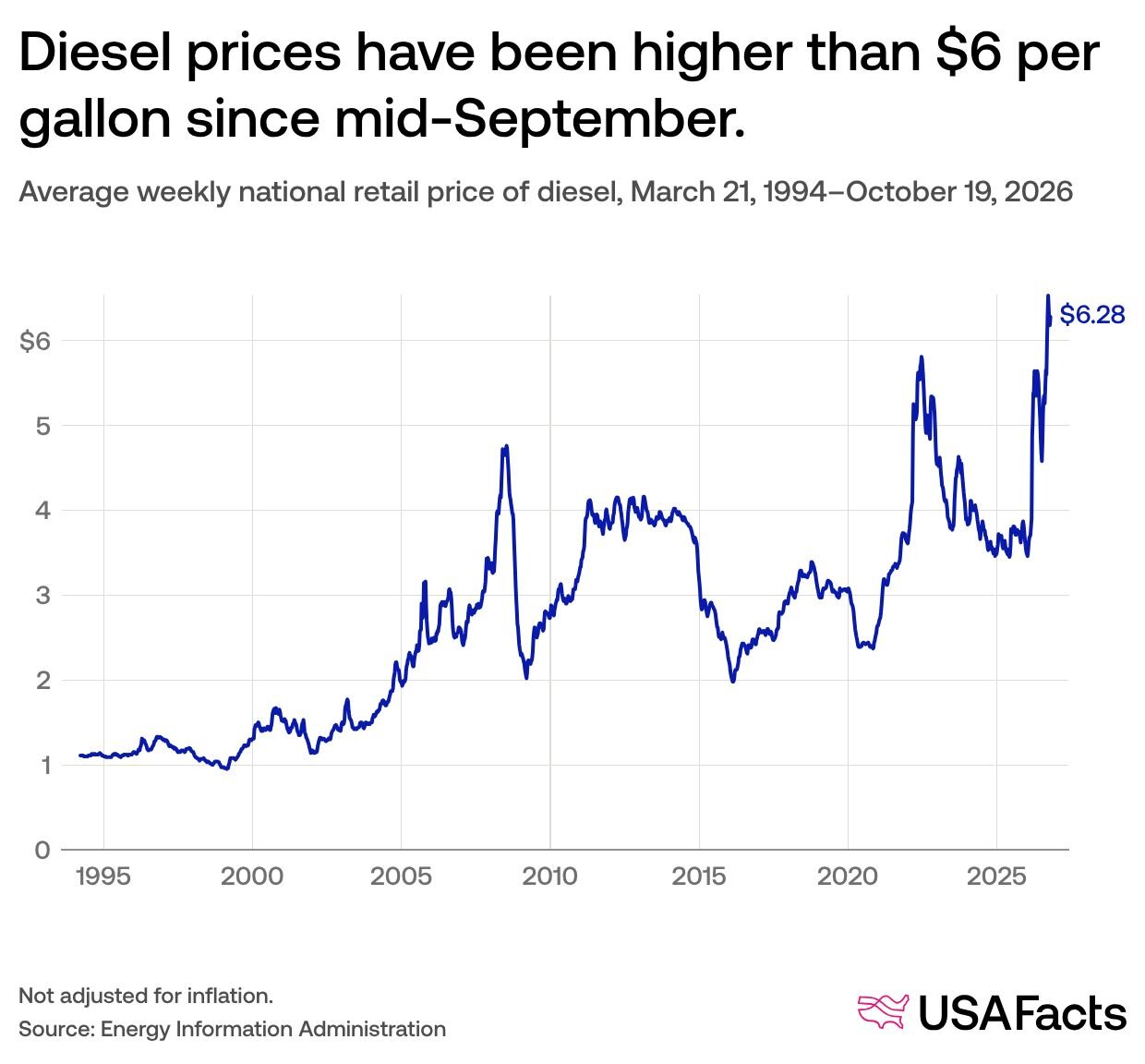
Farmers were already facing high costs before diesel prices hit $6 per gallon. In mid-September, Senator Roger Marshall (R-Kansas) wrote to the USDA Secretary Brooke Rollins asking for assistance during harvest, one of the most “diesel-intensive times of the year.” In the letter, Senator Marshall noted that farmers made planting and financing decisions months ago, and requested “temporary, targeted, and fiscally responsible” assistance for active farmers and ranchers.
The farm aid package payments are authorized under the Commodity Credit Corporation (CCC) Charter Act, which provides loans, direct payments, and surplus crop purchases to support farm income and stabilize farm commodity prices. The CCC is considered mandatory spending, meaning that its budget largely falls outside the congressional appropriations process.
How much support does the government provide to farmers?
In 2025, government farm subsidies in the form of direct payments totaled $27.9 billion. Subsidies vary from year to year, however: 2025’s government spending was 2.7 times the previous year’s subsidy total: $10.3 billion.
Government payments added $27.9 billion to net farm income in 2025.
Net farm income and government payments, 1913–2025, adjusted to 2025 dollars
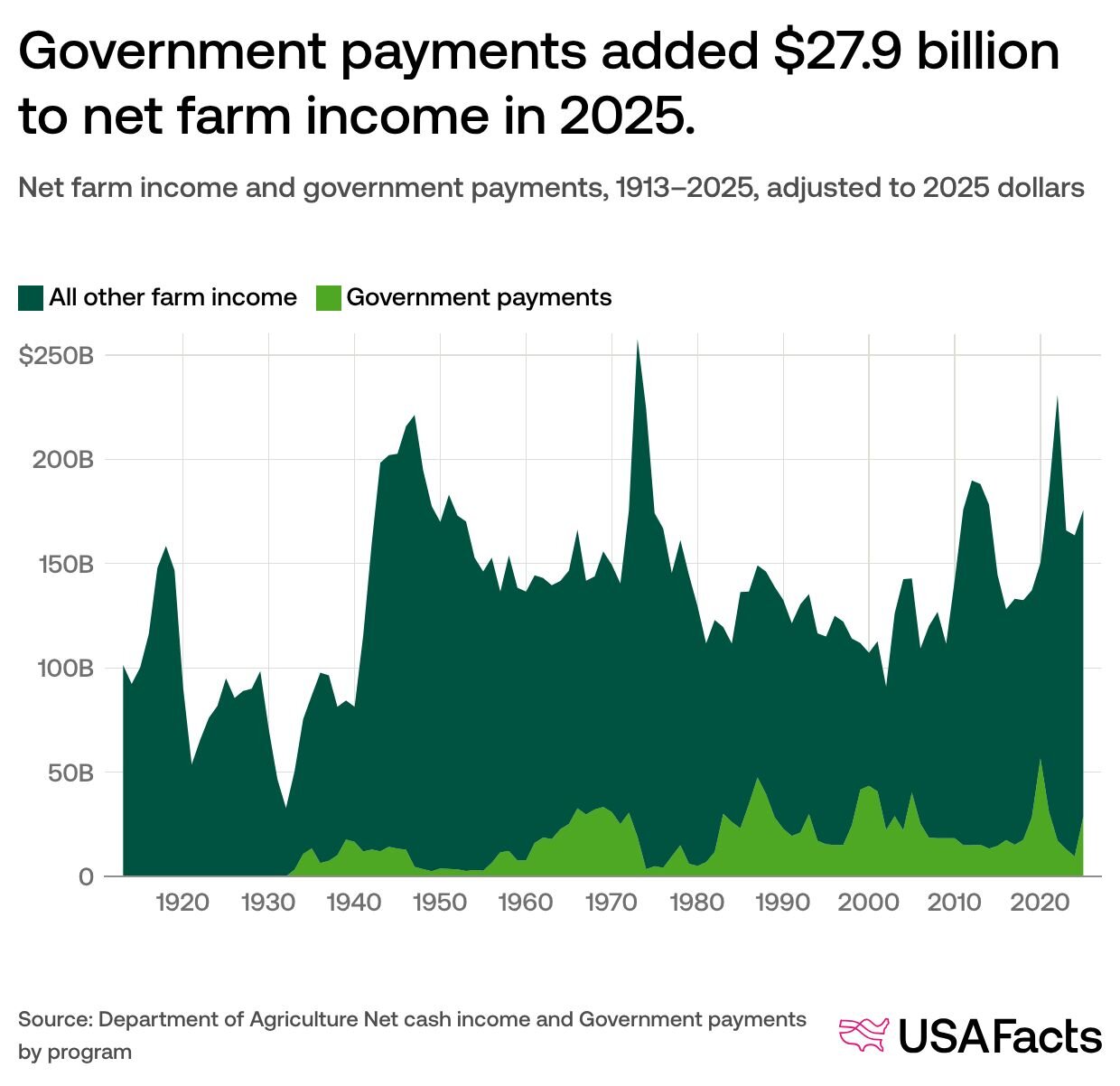
Why the difference from 2024 to 2025? Some recurring government programs, like the Agriculture Risk Coverage (ARC) and Price Loss Coverage (PLC) programs which provide payments each year, do not provide fixed amounts. Instead, they provide payments based on variables like historical data, market conditions, and commodity effective reference prices.
Other programs, like the Harvest Fuel Relief Program, are intended to provide one-time payments.
Government payments to farmers have added an average of $18.2 billion to farm income each year from 1933 to 2025, adjusted for inflation.
Government farm contributions were smallest in 1949 at $2.5 billion, as part of a shift in post-war direct payments. The highest was in 2020, at $56.7 billion, primarily due to pandemic-related aid.
Since subsidies in the form of direct payments began in 1933, they’ve contributed an average of 13.5% of net farm income nationwide. In 2025, subsidies totaled 15.9% of farm income, 2.4 percentage points higher than the 93-year average.
Government payments contribute an average of 13.5% to net farm income.
Government payments as a share of total net farm income from 1933–2025, adjusted to 2025 dollars

Learn more about farmer demographics and get the data directly in your inbox by signing up for our weekly newsletter.
