Analyst Notes: Are e-bikes dangerous? It’s surprisingly hard to know.
Injuries and fatalities for e-bikes and e-scooters have increased over the past several years, but does the data exist to help us understand why?
Growing up on a busy street made me a nervous biker. I prefer the slower (but more stable) pace of my own feet to get around. But over the past few years, it's been hard for me to ignore the growing number of e-bike and e-scooter riders zipping up our hilly city without breaking a sweat (something I've envied plenty of times walking to the bus in the summer heat.)
My unease stayed abstract until a few weeks ago, when a local teen died riding one.
And I started wondering more seriously: Are e-bikes and e-scooters dangerous?
As per usual, I turned to the data. Normally, this is where I'd let you skip to the clean, finished answer or read how I got there. This time I can't. The government doesn't have the data to give you one yet. What follows is a deep dive into what data does exist, and what’s still missing.
First stop, the emergency room
Have you ever wondered how the government knows when to issue a recall or a safety warning for a product? Well, the Consumer Product Safety Commission (CPSC) makes that call, in part, based on data from a sample of Emergency Rooms across the country. This dataset, called the National Electronic Injury Surveillance System (NEISS), details injuries associated with over 900 different "product codes," including everything from stairs and pogo sticks to Christmas decorations and, yes, e-bikes and e-scooters.
Get weekly insights
Subscribe for data-driven insights. No spin, just the facts.
According to the data, an estimated 855,000 people showed up at emergency rooms nationwide with injuries associated with motorized micromobility devices (e-bikes, e-scooters, and hoverboards) between 2020 and 2025. Patients reported injuries from non-motorized bikes and skateboards more often than they did injuries from e-bikes and hoverboards (motorized skateboards). However, there were around 19 e-scooter injuries for every one unpowered scooter injury in 2025.
One quick note about the data: e-scooters and hoverboards have been tracked separately from other products since 2020. But prior to 2024, e-bike injuries were mixed together with moped injuries. Keep that in mind, because this happens again later.
ER visits associated with e-bikes and e-scooters are increasing.
Weighted national estimate, 2020–2025
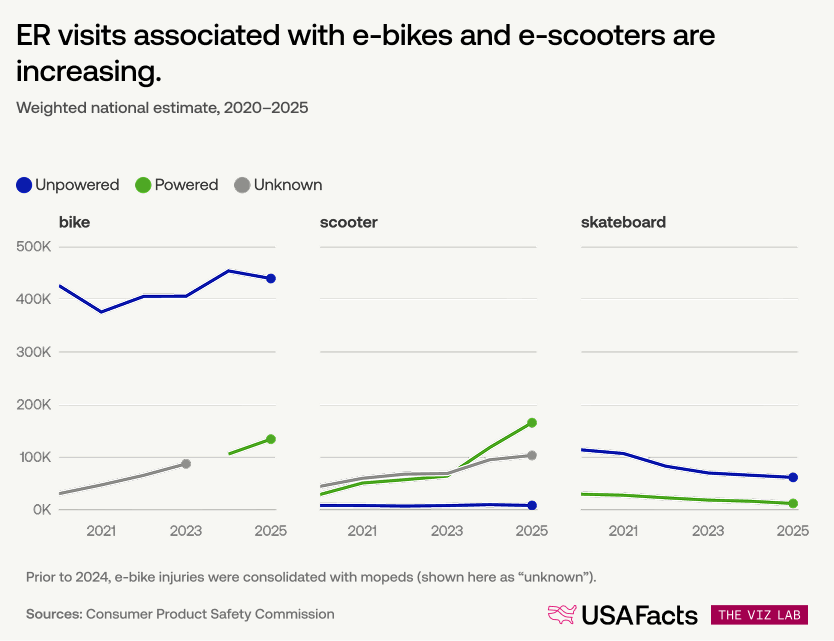
Injuries involving an e-bike or an e-scooter are on the rise. But not every ER visit is equally serious. For all three motorized device types, the rate of serious injury (i.e., that involves hospitalization) was higher for powered devices than unpowered ones.
Rates of serious injury are higher for motorized mobility devices than their unpowered counterparts
Rates of serious injury, 2020–2025
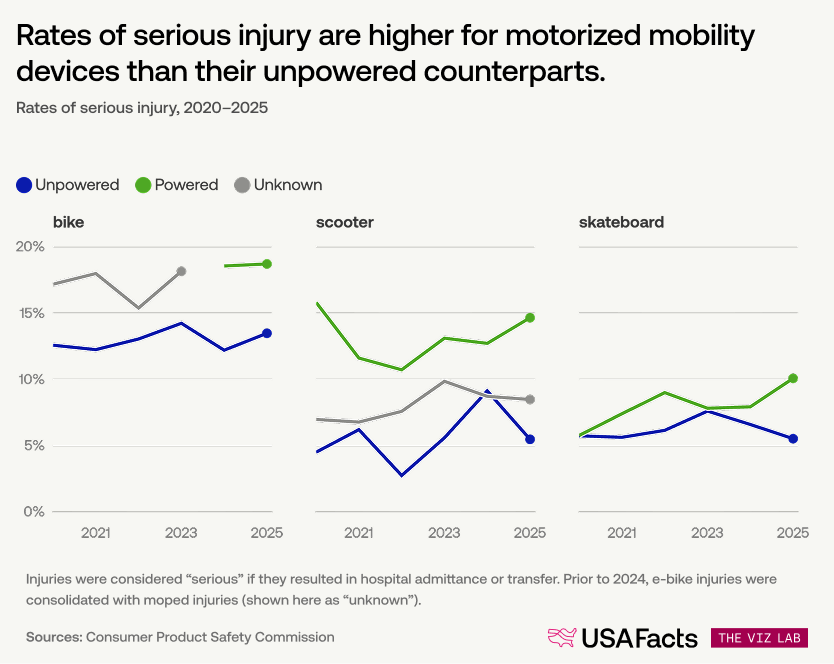
It may seem like I answered my question. I now know that motorized device injuries are increasing, especially when it comes to e-scooters, and those injuries are more likely to be serious. But, this answer felt incomplete for two reasons:
- This data only counts injuries where someone was brought to an ER. Deaths at the scene aren’t captured here and I have no way of knowing how often that happens.
- I have a raw estimate of injuries for each device, but no sense of how many people use them. Are e-scooter riders actually 19 times more likely to get injured while riding than those on an unpowered scooter? Or are there just more people who use the motorized versions?
So, I kept digging.
Trying to find the fatalities
While the National Electronic Injury Surveillance System dataset doesn't cover people who died at the scene of an accident, I thought there were two other government datasets that may record that data:
- the Center for Disease Control’s Mortality Data which collects information on every death certificate in the country and is accessible through their WONDER tool
- the National Highway Traffic Safety Administration’s Fatality Analysis Reporting System (FARS) which reports data on fatal accidents involving a motor vehicle
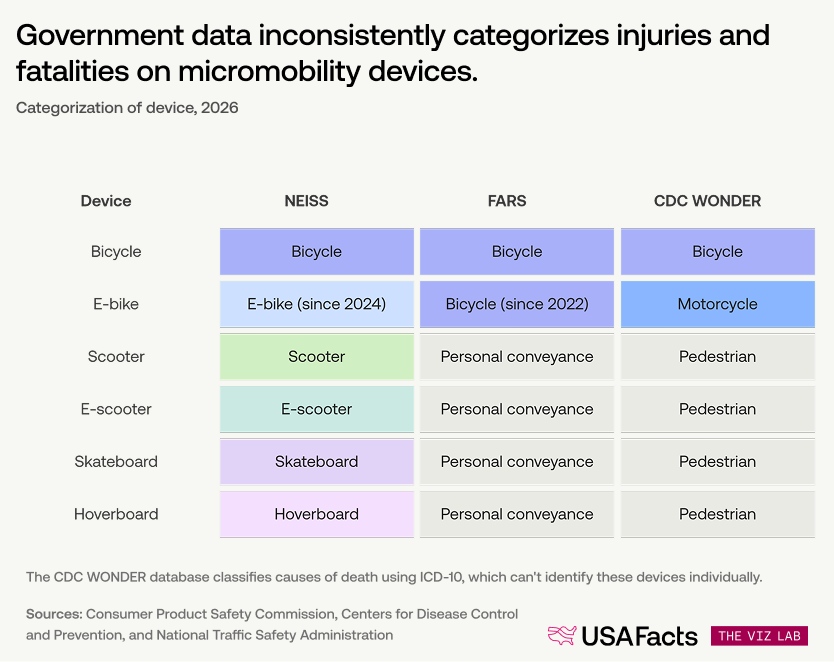
The CDC’s mortality data seemed like the best place to start as it's the most comprehensive dataset available. But death certificates have no code for “e-bike" or “e-scooter.” Fatal accidents involving an e-bike are grouped with those involving all motorcycles. E-scooter accidents are grouped with pedestrian deaths. There was no way to isolate micromobility deaths in the CDC data.

FARS was next, but it only tracks crashes involving motor vehicles — and most e-bikes and e-scooters aren’t legally considered motor vehicles. E-scooter fatalities land under “personal conveyance,” a catch-all that also includes wheelchairs and kids’ toy wagons. Similarly, e-bikes were reclassified in 2022 from mopeds to the same code as regular, non-motorized bicycles.
The way the government recorded data about injuries and fatalities from micromobility devices varied pretty drastically across three different datasets, making any question about true fatality count difficult to answer.
Government data inconsistently categorizes injuries and fatalities on micromobility devices
Categorization of device, 2026
Even the government’s own tallies don’t agree
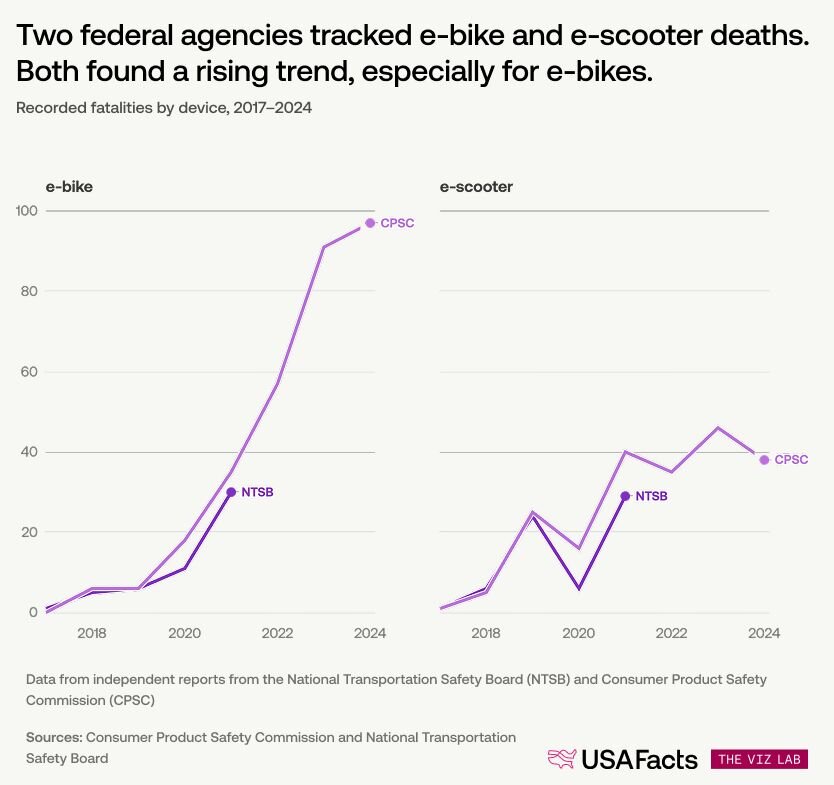
To get around the inconsistent coding issues, the Consumer Product Safety Commission (CPSC) has published its own annual fatality count since 2020. It’s based on an internal system that draws from news reports, death certificates, and manual follow-up investigations. Its latest release counts 272 deaths between 2023 and 2024, a 17-fold increase from 2017 and 2018, when data collection started.
In 2022, the National Transportation Safety Board (NTSB) attempted a similar count, cross-checking news reports against hand-searches for micromobility accidents under inaccurate labels in FARS, CPSC's internal system, and a non-governmental database. It found that even working from the same underlying sources, its numbers didn’t fully match those from CPSC’s report. But, both manual attempts identified more fatalities than any of the other individual data sources had identified independently.
Both CPSC and NTSB concede that their counts are also imperfect. They are likely undercounted, especially for the more recent years where data reporting delays may leave some deaths unaccounted for.
CPSC also describes its fatality reporting as anecdotal, since it's based on whatever cases happen to surface through news coverage and its other sources, rather than a nationally representative estimate like its emergency room injury data. That makes it more difficult to use to understand national trends.
Even with all of those caveats, both reports agree on the overall trend: fatalities for both e-bikes and e-scooters are rising; with e-bike fatalities increasing at a faster pace. That’s a different story than the ER data tells — there, e-scooter injuries have been rising fastest. Fatalities and injuries, in other words, aren’t necessarily tracking the same pattern.
Two federal agencies tracked e-bike and e-scooter deaths. Both found a rising trend, especially for e-bikes.
Recorded fatalities by device, 2017–2024
The missing data: miles traveled
When the federal government wants to know whether America’s roads are getting more or less dangerous, it doesn’t rely just on accident or death counts alone. It counts deaths per 100 million miles traveled. That lets us compare risk evenly across vehicles, time periods, or modes of transportation, regardless of how often or how far each is used. It’s the same method behind claims like “flying is safer than driving.”
We can’t make this calculation for e-bikes and e-scooters because there isn’t great data tracking how much these devices are actually being used.
The government does have a way to estimate this risk for walking and biking: combining FARS fatality data with “miles traveled” data from the National Household Travel Survey (NHTS), which asks Americans about how they get around. But it’s not a perfect solution here either. While e-scooter use is tracked, the last report (from 2022) had too few responses to draw reliable conclusions, and e-bike travel is again lumped in with regular bicycles.
What we do have is a sense that these devices are getting more popular — just not from a government source. According to the North American Bikeshare and Scootershare Association, a nonprofit industry group, trips on shared e-bikes and e-scooters hit an all-time high of 166 million across North America in 2025, up 11% from the year before. The number of systems offering these devices, meanwhile, has held roughly steady, so more people are riding, even though the market itself isn't really expanding.
What we still don't know is whether these devices are more dangerous than other forms of transport or if the increase in injuries and fatalities follows the increased usage of these devices nationwide.
When NTSB wrote its 2022 report, one recommendation to the Federal Highway Administration was to start collecting — and publishing — data on trip counts and miles traveled. That still hasn’t happened.
So where does that leave us?
I started this investigation trying to understand just how dangerous devices like e-bikes and e-scooters were. And after digging through several different data sources, I can say that injuries and fatalities for e-bikes and e-scooters have increased over the past several years, and injuries from these devices tend to result in hospitalization more often than their unpowered counterparts.
What I, and the government, can't say is what’s causing that increase. You can count how many people are hurt, but you can’t turn that into a rate of danger without knowing how many people are riding in the first place. No one has that number yet and until someone does, a full answer will be hard to come by.
None of this means that anything nefarious is happening. Nor does it mean that these devices are secretly super safe or super dangerous. It just means that right now, we don’t know and that we won't know until the data exists to help us answer that question more completely.


