Analyst Notes: Answering your questions about data centers and water
How to think about these questions when there’s little data available.
Hi, I’m Trygve, and I co-authored our recent deep dive on electricity prices and AI data centers. We got some great questions and feedback on it — you all are a bunch of curious critters, and I love that. It’s seldom that a piece invites so much critical engagement and curiosity. That’s a credit to you, reader, and I appreciate you digging in with us on this complex topic.
For this edition of Analyst Notes, we’re going to do something a bit different than we have before — answer your questions.
Many of you are curious about data centers and electricity prices and have big questions ranging from policy, economics, the electric grid, and how that all influences consumer costs; to the impacts of data centers on communities, like how they affect jobs, air quality, or housing values.
But overwhelmingly, you wanted to know about data centers and water. I think the question on everyone’s mind boils down to this: is there enough? With data centers popping up across the country and demanding water, does that leave enough available for other water users?
Let’s get into it.
How much data is there about data centers and water?
Not much!
…
…
Okay, so why write this piece if there’s no data?
I said not much data, not no data! The federal government gives us a bit, and local government offers some insights on individual projects, but none of it is centralized nor helpfully aggregated or disaggregated in the government data landscape.
Given this, what I’d like to do in this piece is give you a way to think about these questions. Of course, I’ll sprinkle in available data, identify the kinds of data that would be nice to have, and point out good questions to ask as you develop your understanding of what data center water use might mean for where you live. That local context is really important.
Get weekly insights
Subscribe for data-driven insights. No spin, just the facts.
Why don’t we have great federal data on data centers and water use?
I don’t know. I can speculate that at least part of it has to do with the necessary data being proprietary and/or paywalled for competitive reasons as the involved companies race to build more/better. Other factors might include the industry developing faster than any government system designed to track its requirements and impacts, and water getting regulated primarily at the state rather than federal level.
The relative lack of data for this important piece of the economy feels odd when you consider how robust the federal data collection programs are for other important sectors, whether that’s agriculture (visit the USDA’s Economic Research Service), fisheries (say hello to NOAA’s fisheries landings database), or home construction (check out the monthly release on new residential construction by the Census Bureau and the Department of Housing and Urban Development).
Why is everyone wondering about data centers and water use?
Here’s a snippet of a sentence from a major outlet that I came across recently that makes plain some of my hesitation:
“… data centers, which typically require a large amount of water to operate …”
This is pretty representative of how media sources talk about data centers. I share this not because the description is wrong, but because it’s not specific enough to really shape our understanding of the issue. Consider:
- Describing a “typical” data center is a challenge. They come in a variety of sizes and cool their equipment in different ways. How they use water depends on those details.
- Saying a “large” amount of water poses more questions than it answers. Water use is definitely measurable (my water utility is very firm on this point), but it’s not clear to me how often water use data is shared publicly and/or placed into its appropriate context. Again with the data constraints.
- Local context is important. There are no data centers (that I know of, at least … and federal data is no help here) in Forks, Washington — one of the wettest places in the US — but if there were, its water use would feel different from an identical data center located in a drier and more populous area.
Back to why people care about this issue. To state the incredibly obvious: people, animals, plants, and businesses all need steady access to water. Making and delivering water to where it’s used (we aren’t all drinking directly from streams, after all) comes with costs, and maybe you live in a place where water is scarce.
Let’s start thinking about our core question — is there enough? — by exploring something foundational.
How does a data center use water?
A data center may use water to cool the heat-generating computing equipment inside. That’s a liquid-cooled system. Air-cooled systems also exist, as do hybrid systems and other cooling technologies. What gets built depends on the facility size, location, cost, and other factors.
Sticking to liquid-cooled systems, there are broadly two types: closed-loop and open-loop.
- A closed-loop system fills with water, which absorbs heat from the computing equipment. Then, the water passes through chillers which cool it down so it can be used again. Aside from top-offs for leaks or maintenance, a true closed-loop system requires little additional water once it’s operational because it’s not exposed to the air. They tend to be more water efficient and more energy intensive.
- An open-loop system also uses water to absorb heat from the computing equipment, but it cools the warm water by exposing it to the air. This is an efficient cooling method, but requires a continuous water supply to replace what’s lost to evaporation. They tend to be more energy efficient and more water intensive.
If this is hard to visualize, here’s a simplified schematic of an open-loop cooling setup.

Source: Department of Energy
(Any closed-loop schematics I found made my head spin, so I won’t show them here. The Louisiana Department of Conservation and Energy has a helpful one-pager comparing open-loop and closed-loop systems.)
There are different ways of deploying these loops, but I’m not an engineer. What’s important to keep in mind is this: closed loop cooling requires water periodically, while open loop requires it consistently.
Data centers also use a small amount of what’s known as domestic water –– for toilets, drinking fountains, that sort of thing. Domestic water use happens in all buildings. It isn’t unique to data centers and will be a fraction of the water used by a liquid-cooled system, but it’s there.
All of the above is called “direct water use.” If a data center includes any on-site water treatment or power plants that use water, that would also count.2
To understand how “thirsty” a given data center is, we would need to know how it cools the equipment inside. And federal data doesn’t provide answers at the data center level or in the aggregate.
So each data center is different. How much water do they use all together?
A 2024 study from the Lawrence Berkeley National Laboratory provides the most recent government estimate of data center water usage. It showed that data centers directly used 5.6 billion gallons of water in 2013, and about 17 billion gallons in 2023. That’s nearly tripled in 10 years, but I don’t really have a sense for how much 17 billion gallons is (besides a lot of gallons). Time for some back of the envelope math.
Let’s start with 300 gallons, which is what the US Environmental Protection Agency estimates the average American household uses per day; that works out to 109,500 gallons per household per year. That means that the 17 billion gallons used by data centers in 2023 was about the same amount of water used by 155,251 homes. There were 2.51 people per household that year, so data center water use was equivalent to the annual water use of about 389,700 people — a bit less than the population of Wichita, Kansas, which was the 52nd largest city in the nation at that time.
But that’s 2023 usage. This study clearly doesn’t capture the flurry of recent AI data center construction we’ve all been reading about.
The Congressional Research Service (CRS) says that liquid-cooled systems operate more efficiently than air-cooled systems, but that they’re only cost-effective for large data centers. We also know that data centers built for the purpose of housing AI infrastructure (versus the ones that have been around for a while and store your photos in the cloud) are large — a hyperscale data center houses more than 5,000 computer servers in 10,000 to 1 million square feet of space and draws more than 100 megawatts of power.
If we put those two pieces of information together, we might suspect that the construction boom is relying more on liquid-cooled systems. That means more water use, but how much more? Again, it’s going to depend on how many adopt a closed-loop or open-loop approach to cooling, and we can’t pin that down with the available data.
That means that the 17 billion gallons of water used by data centers in 2023 was about the same amount of water used by 155,251 homes.
How much water do the largest data centers use?
Say it with me: we don’t really know. One claim I often see reads something like this:
“… a large data center will use up to 5 million gallons of water every day …”
I have tried tracing that 5 million number back to the source but run into a dead end at “researchers say,” without finding any additional citations or evidence. It’s a number that’s often referenced, but never sourced. And it shows up online often.
Here’s a screenshot from Google image search showing how this number gets turned into infographics that are then shared across social channels.

Google image search result for “data centers use 5 million gallons of water every day.”
I do have one specific question about this number. Does 5 million gallons per day count only direct use, or does it also include indirect use (which would include water used offsite to manufacturing computing equipment and to generate power for the data center)? Unfortunately, what goes into this number — as well as its original source — both remain a mystery to me.
Are the catchy headlines we read reporting actual water use?
I’ll piggyback on this question with a few of my own: does 5 million gallons represent actual water use? If so, is that consistent daily use, average daily use, or a potential daily maximum use? If not, does that number represent something else entirely?
With the limitations of federal data well established, let’s turn to Virginia — a hub for data centers in the US — for some answers.
The Western Virginia Water Authority (WVWA) entered into an agreement in October 2025 to provide water for a hyperscale data center in Botetourt County. The agreement states that WVWA will reserve no more than 2 million gallons per day of water supply capacity.
On its page explaining the project, the county takes pains to explain that “reserve” is different from “use”:
“… reserving 2 million gallons per day ensures the system can meet maximum anticipated demand. Actual daily water use would more often be lower than the reserved capacity. Daily usage will change depending on the seasons, with the peak demand being on the hottest days of the year.”
Maybe other regulatory documents for individual projects around the US will report average daily use or actual daily use, but at least in the case of Botetourt County, we’re looking at a number — 2 million gallons per day — that guarantees access to a maximum amount that won’t be reached for a fraction/some/most of the year.
Knowing a data center’s reserved water needs helps a utility plan ahead to make sure enough water is available for all users during times when that reserve is called in.
What might happen when they need all 2 million gallons in a day? Or an average of 1.7 million per day for a whole week? For a month? Maybe those spikes in water use would result in taps going dry, similar to times of peak electrical demand when customers are asked to curtail usage or face blackouts or brownouts. Or maybe it wouldn’t work like that, and service would go on without interruption. I just don’t know — these are great questions for your utility, which engages in long-term water resource planning so it’s able to provide consistent service for all customers.
Does 5 million gallons per day represent water that’s reserved or used?
Once again, we don’t know for sure. However, if we bring together data we do have on water use and power draw for both Botetourt County and the largest data centers, we can make an educated guess.
Starting local, Cardinal News examined regulatory filings made by the power company servicing the data center in Botetourt County showing that it would draw 300 MW of power (and it will reserve 2 million gallons per day). The largest data centers are widely reported to use 1,000 MW or more of power, and consume 5 million gallons per day.
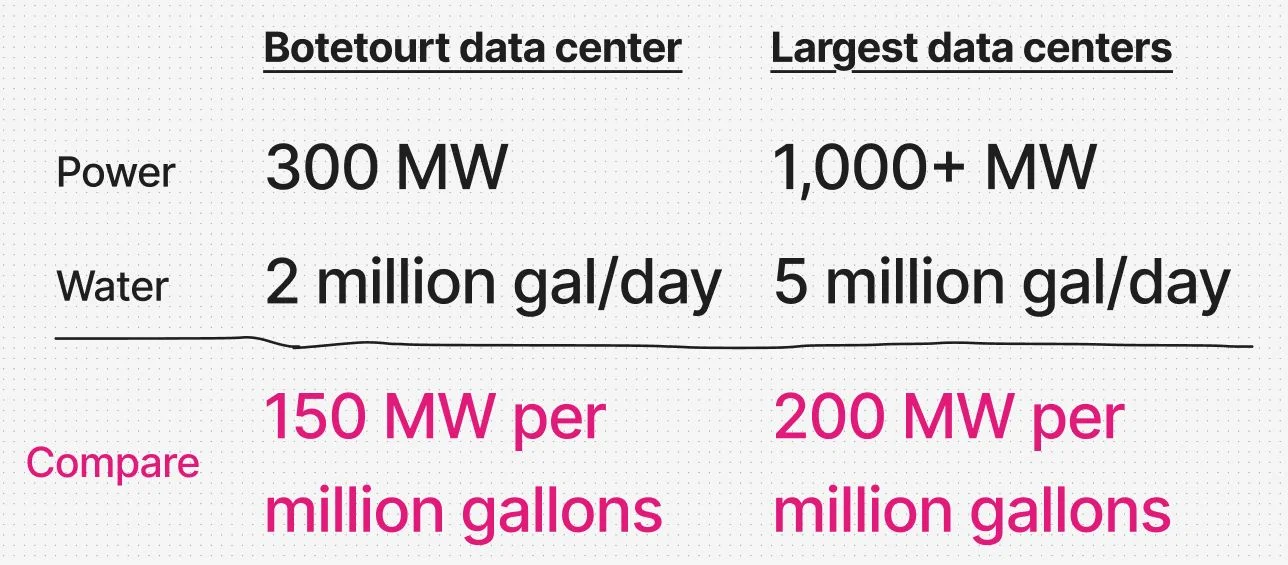
Comparing actual data against widely reported maximums
If you squint, the amount of water per million gallons demanded by the Botetourt County data center — which we know is water reserved rather than water used — looks a bit like the amount demanded by the largest data centers. This makes me wonder if 5 million gallons per day would be better characterized as “reserved” rather than “used.”
What does it mean to “use” water?
When water evaporates (as it does in open-loop cooling systems), it’s lost to the atmosphere. In the water resource world that’s called consumptive use, meaning it can’t be reused for another purpose. But, if water is discharged back into a watershed, then it’s available for reuse downstream. Same goes for water discharged to a wastewater treatment system — once treated, it can be used for watering, or industrial use, or to augment groundwater or surface water.
In Botetourt County, the data center will use evaporative cooling. It will also discharge some pretreated water to the sewer system, where the WVWA Water Pollution Control Plant will clean it before sending it to the Roanoke River. That’s a mix of consumptive and nonconsumptive use. How much water will be available for reuse? That’s something else we don’t know — not from the feds, or in this case, from the county.
Where do data centers get their water from?
Water resources are classified either as groundwater (the water comes from underground) or surface water (it doesn’t). A water user may either get water themselves (“self-supply”) by drilling a well or taking water out of a stream, or they’ll get it from a public water system, or PWS (a water utility that provides you, your neighbors, and local businesses with potable water).
CRS reports on one analysis that showed US data centers in 2025 relied on PWS for 97% of their direct water use. A handful of others opted to self-supply. Check out the EPA’s Safe Drinking Water Information System to find the names of public water systems, where they source their water, and how many people they serve.
Public water systems (and self-suppliers) may use surface water, groundwater, or a mix. Loudoun County, Virginia — commonly known as Data Center Alley — even notes that some data centers are capable of using treated wastewater for their operations.
Why does this matter? Because if a data center’s water comes from a PWS, that PWS is a great place to start learning about where the water comes from and about any supply or demand constraints. If you’re also served by the same PWS, they can help you understand how your water service might change — or not — because of data center water demand.
A note on costs: treating water to a potable standard — like they do in a PWS — is costlier than less intensive treatments. Connecting a data center that uses lots of that potable water in a non-potable way for its cooling systems might raise costs for the PWS and for other users.
Furthermore, understanding where water comes from can help you understand what the new water resource demands of a data center might mean for where you live. Take for example a data center that’s connecting to a PWS, which in turn gets its water from a reservoir, which only gets filled when water flows in. You’ll want to know how and when it fills, how much water there is, if there’s a buffer in case of drought, things like that.
One report shows that public water systems are estimated to supply 97% of the water for US data centers.
Can data centers affect water quality?
CRS points to when a data center is built and made operational as a key time for wastewater. Preparing the cooling equipment for water to circulate through involves different processes, both mechanical and chemical, that can result in “… short-term, high-volume discharges with higher pollutant concentrations than those generated during operational phase.”
Whenever wastewater is generated, there are two options for disposing of it.
First and most commonly, wastewater gets discharged to a wastewater collection and treatment system. This requires a permit from the system operator specifying volume and water quality, and a hookup to the system. This is the case in Botetourt County, where data center wastewater will be pre-treated to an agreed-upon standard before being treated by Roanoke Regional Water Pollution Control Plant before its eventual release back into the Roanoke River.
Alternatively, wastewater could exit the facility from a specific location (“point source”) and enter a water body. This is called direct discharge, and entities are prohibited by the Clean Water Act from doing this unless they have an EPA National Pollutant Discharge Elimination System (NPDES) permit. These regulate specific pollutants and are generally issued by states; relevant to data centers, heat is classified as one such pollutant.
Part of NPDES is the National Pretreatment Program, which directs local governments to set up rules that prevent introducing pollutants that would mess up or slip through wastewater treatment operations. Once these plans are approved, the requirements are baked into permits for entities discharging wastewater to water treatment facilities. This program is at the heart of the headlines out of Cheyenne, Wyoming, where fill and flush operations for a closed-loop system resulted in a rare bacteria being discharged to the water treatment facility and contaminated its wastewater treatment processes.3
Of course, construction may also introduce water quality concerns, especially if dredged or fill materials end up influencing any water bodies on site. That’s not unique to data centers, but this kind of activity is also regulated by the Clean Water Act.
What to remember when thinking about data centers and water use.
The key question underpinning everything we’ve covered is this: would adding a data center where you live affect water resource availability for others? Studying data centers in the aggregate isn’t helpful for answering this distinctly local question, so maybe that’s another partial explanation for why federal data on this topic is so lacking.
I’ll leave you with this. As you develop your own understanding of how much data center water use will matter for your community, here are a few key questions and points to keep in mind:
- Data center size. The bigger it is, the bigger its cooling needs.
- Data center cooling tech. How is the data center planning to cool its equipment? Open-loop cooling will require a consistent supply of water. Closed-loop cooling will not.
- Actual use vs. guaranteed access. Is water use data actually describing water use, or is it describing maximum water use? If the latter, how often will the data center use that maximum amount?
- Reuse potential. Is any of the water that’s withdrawn available for reuse, or is it all used consumptively?
- Water source. Where does water for the data center come from? Will it self-supply or get its water through the local utility?
- Wastewater. How is the data center planning to dispose of wastewater it generates?
- Water is local. Water supply is almost entirely regulated at the state, not federal, level.
- The state of the water resource. Is it generally more wet or dry where you live? How much demand is there right now? Are the surface water and groundwater resources abundant or constrained? How do these resources get replenished?
I hope that these points and this Q&A more broadly provide a helpful framework for how to think about data centers — a large and growing sector of the economy — and water use/quality, even when federal data isn’t readily available.
That’s twice now you’ve claimed that AI is an important part of the US economy without providing evidence.
Not a question, but yes, fair. Here’s a brief coda.
On August 28, 2026, CRS noted that:
“… several large technology companies with significant AI-related activities … account for more than 40% of the S&P 500’s total market capitalization.”
I’m not a finance guy, but here’s what that’s saying: the money invested in AI is a big chunk of the value of the stock market right now.
You might (correctly) argue that “the stock market” is not the same as “the economy,” so here’s another data point: The St. Louis Fed estimates that AI spending — which includes data center construction — accounted for 30% and 11% of GDP growth in the second and third quarters of 2025, respectively.
A final point: the Census Bureau estimates that the private sector invested more than $7.5 billion in data center construction in August 2026.
Not saying any of this is bad or good, just giving you the numbers.
