What is the federal government's budget deficit?
Refreshed monthly
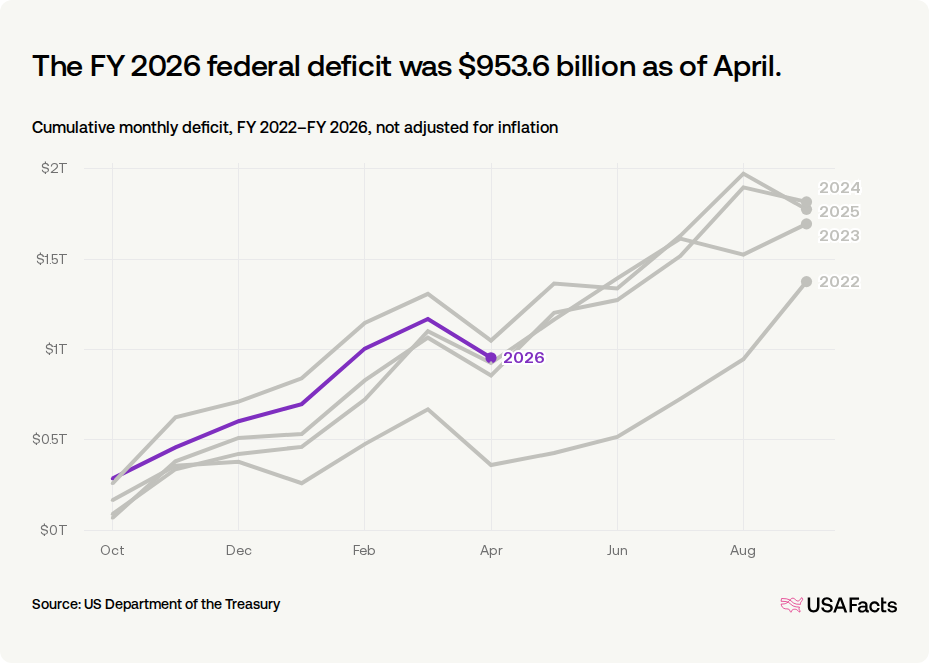
The federal government’s fiscal year (FY) 2026 budget deficit is about $1.97 trillion as of August. A budget deficit occurs when the federal government spends more money than it brings in through taxes, customs duties, the sale of assets, and other revenues. When the government has a deficit, it borrows money by selling bonds and other securities in order to pay for it, adding to the national debt. A budget surplus, on the other hand, occurs when the government brings in more money than it spends.
$1.97T
was the federal budget deficit so far in FY 2026 (August 2026)
$1.78T
was the federal budget deficit last fiscal year (FY 2025)
Government spending and the health of the economy influence the size of a budget deficit or surplus. Government revenues come primarily from taxes, so when people and businesses are doing well and making money, the government brings in more money. But if the economy is stagnant and people are earning and spending less, government revenues decrease. The government also impacts its revenue and spending by, for example, increasing or decreasing tax rates and increasing or decreasing spending.
Get weekly insights
Subscribe for data-driven insights. No spin, just the facts.
Compared to the same month last fiscal year, the budget deficit is about $7.72 billion lower, or about 0.39% less.
The FY 2026 federal deficit was $1.97 trillion as of August.
Cumulative monthly deficit, FY 2022–FY 2026, not adjusted for inflation
How has the federal budget deficit or surplus changed over time?
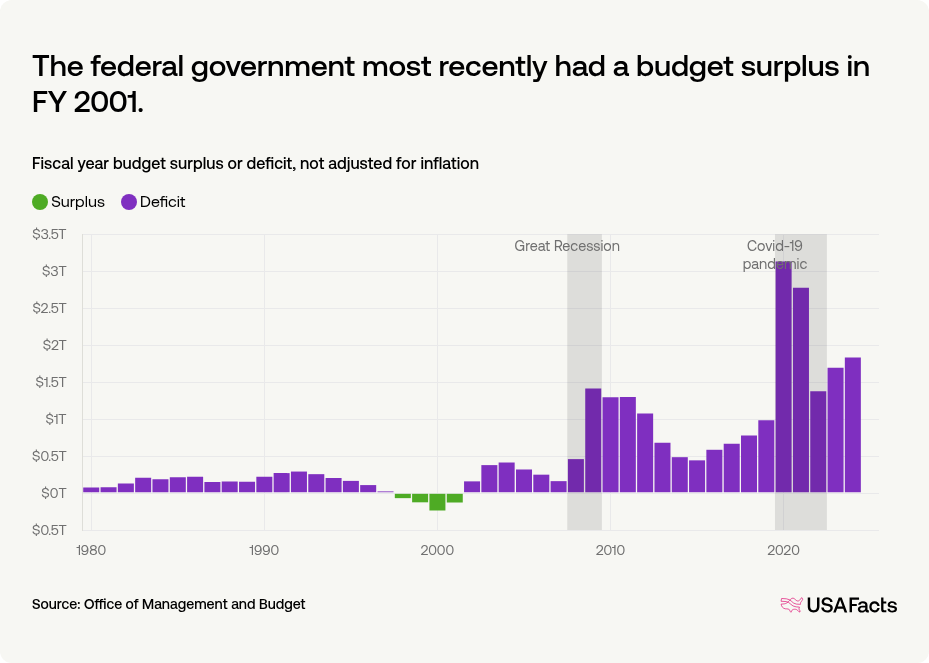
The federal government has had a budget surplus in 12 nonconsecutive years since 1933, the most recent occurring in FY 2001.
The federal deficit more than tripled from $983.6 billion in FY 2019 to $3.1 trillion in FY 2020. That year, the federal government expanded unemployment insurance, sent stimulus checks directly to Americans, provided financial support for small businesses, and increased other spending in response to the COVID-19 pandemic. In FY 2025, the most recent year for which there is complete data, the federal deficit was $1.78 trillion.
The federal government most recently had a budget surplus in FY 2001.
Fiscal year budget surplus or deficit, FY 1980–FY 2025, not adjusted for inflation
How big or small is the budget deficit?
Compared to the size of the economy, the deficit reached 5.8% of GDP in FY 2025. Comparing the surplus or deficit to the country’s gross domestic product (GDP), a measure of the value of the US economy, accounts for changes in the size of the economy and inflation, allowing for comparisons in the deficit over time.
The deficit was 5.8% of GDP in FY 2025 compared to 6.2% in FY 2024.
Ratio of federal budget deficit or surplus to gross domestic product, FY 1933–FY 2025
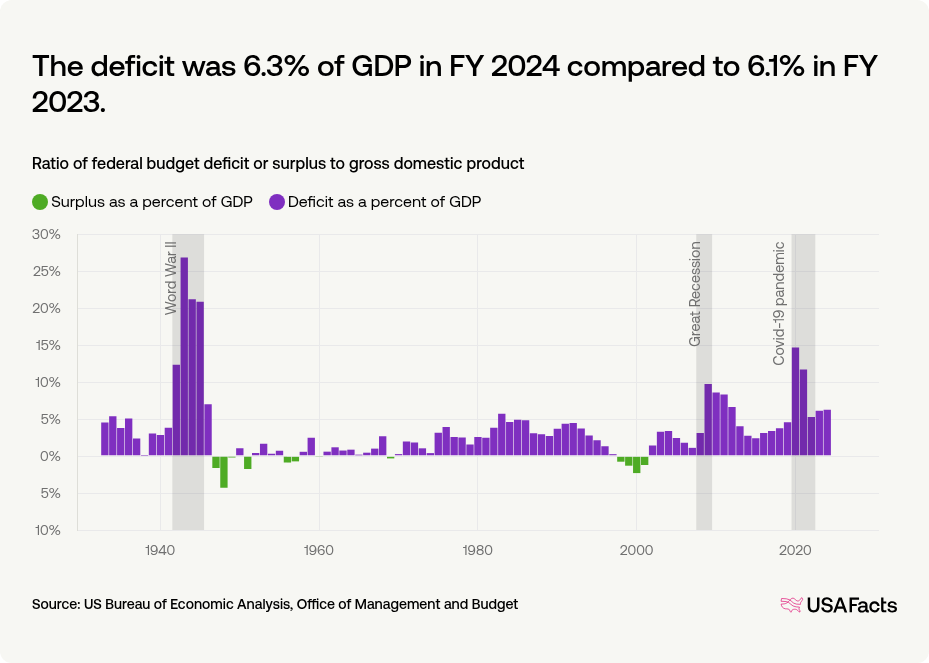
Looking at the history of the deficit, it reached 26.9% of GDP in FY 1943. It then fell following the end of World War II and the nation had a surplus in FY 1947. From then until the start of the Great Recession in 2007, the deficit exceeded 5% of GDP once: in FY 1983. It has done so in 10 out of 19 years since 2007.
Keep exploring

Methodology
USAFacts standardizes data, in areas such as time and demographics, to make it easier to understand and compare.
Page sources
USAFacts endeavors to share the most up-to-date information available. We sourced the data on this page directly from government agencies; however, the intervals at which agencies publish updated data vary.

