What percentage of students in Iowa are proficient in math?
Refreshed intermittently
About 39% of 4th graders and 27% of 8th graders in Iowa were considered proficient in math in 2024, according to the National Assessment of Educational Progress (NAEP). The NAEP, also known as the Nation's Report Card, assesses 4th and 8th graders' progress in reading and math approximately every two years. Students in public, private, and charter schools are included in NAEP testing.
39%
of Iowa 4th graders were proficient in math in 2024
27%
of Iowa 8th graders were proficient in math in 2024
The NAEP uses a scale of 0-500 points to group 4th and 8th grade students into three achievement levels (basic, proficient, or advanced). "Proficient" is the benchmark used to describe students who demonstrate competency with challenging subject matter. However, NAEP proficiency is not the same as being on "grade level," which is often assessed by other state and district tests. More information on NAEP skill expectations at each grade level is available here.
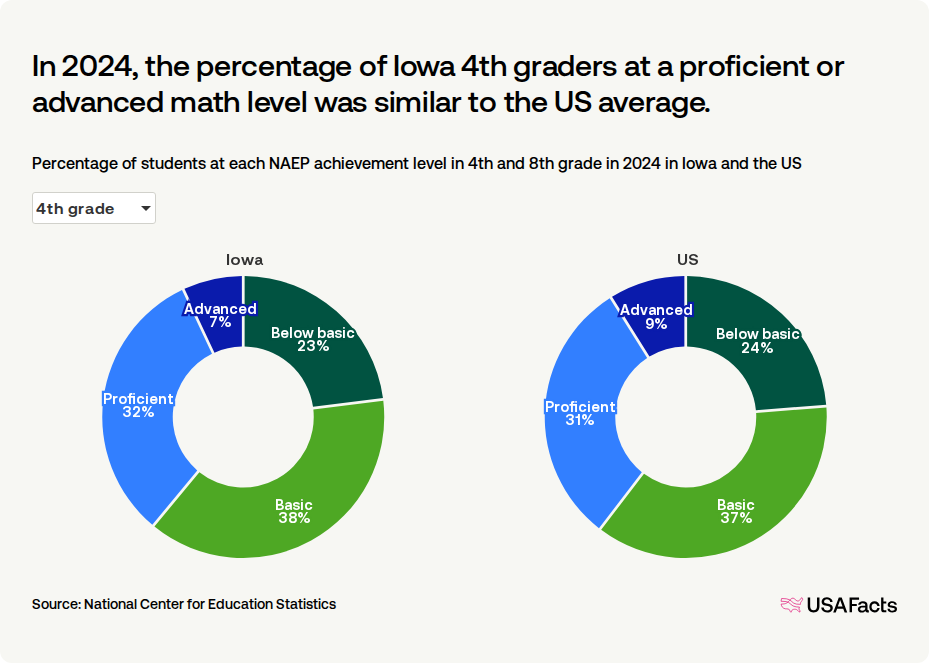
In 2024, 7% of 4th graders in Iowa were advanced in math and 32% were proficient, which means that about 3 out of 5 (61%) scored at basic or below. Seventy-three percent of 8th graders scored at basic or below.
Iowa 4th graders in 2024 were not significantly different from the US average in math proficiency. 8th grade proficiency was also not significantly different from the US.
In 2024, the percentage of Iowa 4th graders at a proficient or advanced math level was similar to the US average.
Percentage of students at each NAEP achievement level in 4th and 8th grade in 2024 in Iowa and the US
How has math proficiency changed over time?
From this point onward, “proficiency” includes students who were at or above proficient in math (proficient and advanced students).
Among 4th graders, math proficiency in Iowa was higher than the US in 6 test years (2003, 2007, 2013, 2015, 2017, and 2022). In all other test years since 2003, there was not a significant difference between Iowa and the US. Among 8th graders, math proficiency in Iowa was higher than the US in 5 test years (2003, 2005, 2007, 2015, and 2017). In all other test years since 2003, there was not a significant difference between Iowa and the US.
Iowa 4th graders had higher math proficiency than the US in 6 out of 11 test years
Percentage of 4th and 8th graders who were proficient in math in Iowa and the US, 1992–2024
Math proficiency has also varied over time for students of varying demographics. This is often referred to as the achievement gap.
Get weekly insights
Subscribe for data-driven insights. No spin, just the facts.
Among 4th graders in 2024, white students had the highest rate of math proficiency. This has been the case since 2022.
Among 8th graders in 2024, Asian/Pacific Islander students had the highest rate of math proficiency.
The math proficiency rate for white students in 4th grade is 3.9 times higher than the group with the lowest (Black students) in 2024.
Percentage of 4th and 8th graders who were proficient in math in Iowa, by race/ethnicity, 1992–2024
Does math proficiency differ by gender?
In 2024, male students had higher math proficiency than female students in 4th grade (44% and 33%, respectively). However, among 8th graders, female students had similar proficiency compared to male students (26% and 29%, respectively).
How do Iowa students compare to other states in math proficiency?
Iowa had the 24th lowest 4th grade math proficiency rate in the US in 2024, in between Kansas and Kentucky. This is 12 percentage points lower than Massachusetts, the state with the highest proficiency (51%). For 8th graders, Iowa was 24th highest in math proficiency.
Iowa is 24th lowest in 4th grade math proficiency and 24th highest in 8th grade
Percentage of 4th and 8th graders in each state who were proficient in math in 2024
Keep exploring
Methodology
USAFacts standardizes data, in areas such as time and demographics, to make it easier to understand and compare.
Page sources
USAFacts endeavors to share the most up-to-date information available. We sourced the data on this page directly from government agencies; however, the intervals at which agencies publish updated data vary.