What percentage of public school funding in Pennsylvania comes from the federal government?
11.2%
$2.81K
During the 2023–24 school year, public schools in Pennsylvania received 11.2% of funding from the federal government.
Share of public school district revenue coming from federal sources

Get weekly insights
Subscribe for data-driven insights. No spin, just the facts.
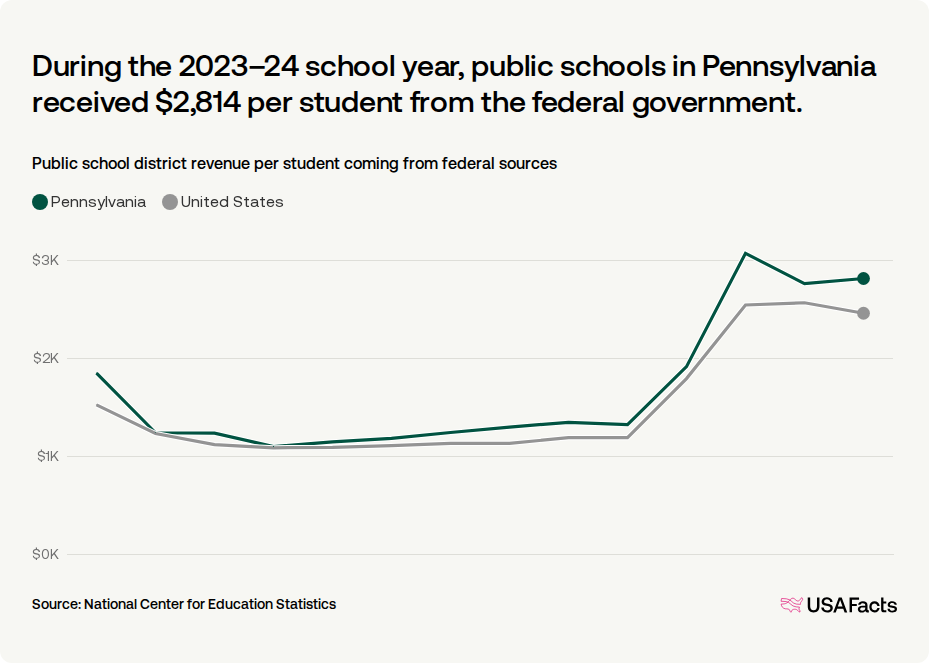
During the 2023–24 school year, public schools in Pennsylvania received $2,814 per student from the federal government.
Public school district revenue per student coming from federal sources
- Child nutrition programs: Administered by the Department of Agriculture, this includes the National School Lunch Program and the School Breakfast Program.
- Education for the disadvantaged: Also known as Title I, the federal government provides additional funds to schools with relatively high concentrations of low-income students.
- Special education: According to the Individuals with Disabilities Education Improvement Act of 2004, the federal government is authorized, though not mandated, to supply 40% of special education funds.
Federal funding made up 0.71% to 33.3% of Pennsylvania school district budgets in 2022–23.
Share of public school district revenue coming from federal sources
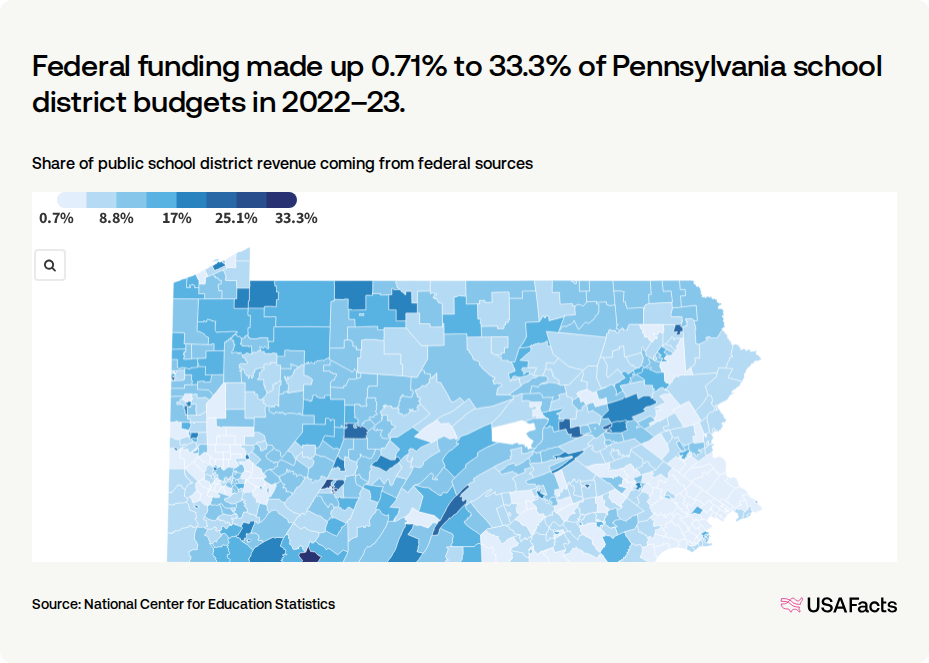
The 10 largest school districts in Pennsylvania based on 2022–23 enrollment.
| 1. | Reading School District | 17.1% |
| 2. | Allentown City School District | 14.4% |
| 3. | Philadelphia City School District | 13.6% |
| 4. | Upper Darby School District | 13.1% |
| 5. | Pittsburgh School District | 11.7% |
| 6. | Central Dauphin School District | 9.9% |
| 7. | Bethlehem Area School District | 9.8% |
| 8. | North Penn School District | 3.5% |
| 9. | Central Bucks School District | 3.3% |
| 10. | Downingtown Area School District | 2% |
Keep exploring

Methodology
USAFacts standardizes data, in areas such as time and demographics, to make it easier to understand and compare.
Page sources
USAFacts endeavors to share the most up-to-date information available. We sourced the data on this page directly from government agencies; however, the intervals at which agencies publish updated data vary.
