What percentage of public school funding in Hawaii comes from the federal government?
Refreshed annually
About 12.2% or 1 in 8 dollars of Hawaii public school funding came from the federal government during the 2023–24 school year. As with most schools nationwide, Hawaii received more funding from local or state governments than it did from federal sources. The totals differ by district, depending on factors such as student demographics (like poverty levels), availability of state and local revenues, and whether a district is urban, suburban, or rural.
12.2%
of public school funding came from federal sources, 2023–24 school year
$3.2K
federal funding of K-12 public schools per student, 2023–24 school year
During the 2023–24 school year, the latest year data was available, Hawaii schools received a higher share of funding from federal sources compared with the US average (11.7%).
During the 2023–24 school year, public schools in Hawaii received 12.2% of funding from the federal government.
Share of public school district revenue coming from federal sources
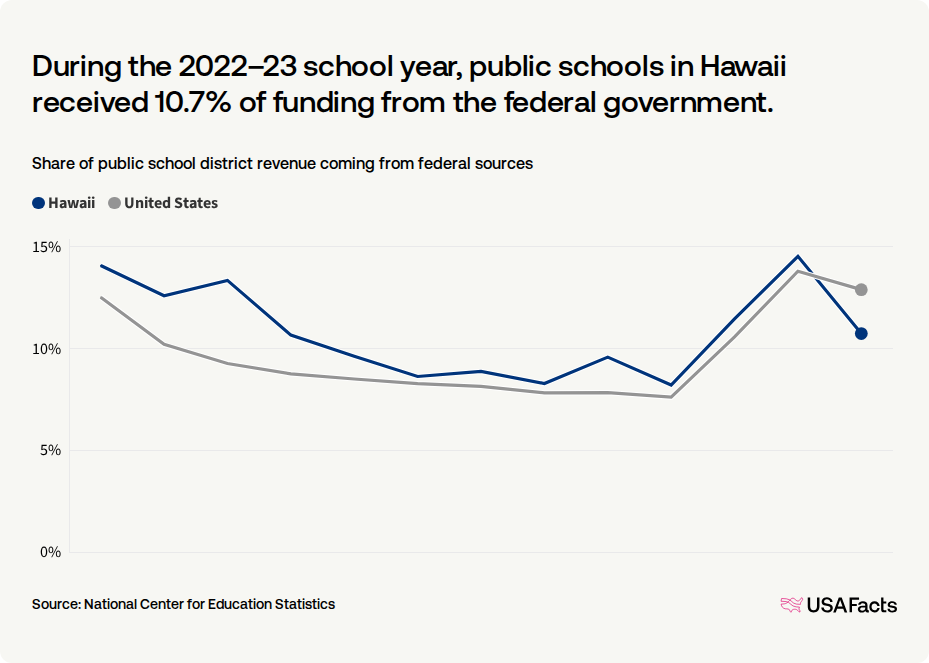
In all, public schools in Hawaii received $541.6 million, or $3,199 in federal funds per student. That's 30% higher than the national average of $2,460 per student.
Get weekly insights
Subscribe for data-driven insights. No spin, just the facts.
During the 2023–24 school year, public schools in Hawaii received $3,199 per student from the federal government.
Public school district revenue per student coming from federal sources

Most federal public school funds are allocated based on formulas based on factors such as poverty status or a district’s rural location. Federal programs for schools include:
- Child nutrition programs: Administered by the Department of Agriculture, this includes the National School Lunch Program and the School Breakfast Program.
- Education for the disadvantaged: Also known as Title I, the federal government provides additional funds to schools with relatively high concentrations of low-income students.
- Special education: According to the Individuals with Disabilities Education Improvement Act of 2004, the federal government is authorized, though not mandated, to supply 40% of special education funds.
Keep exploring

Methodology
USAFacts standardizes data, in areas such as time and demographics, to make it easier to understand and compare.
Page sources
USAFacts endeavors to share the most up-to-date information available. We sourced the data on this page directly from government agencies; however, the intervals at which agencies publish updated data vary.
