Is Nebraska's population growing or shrinking?
+12.4K
+0.62%
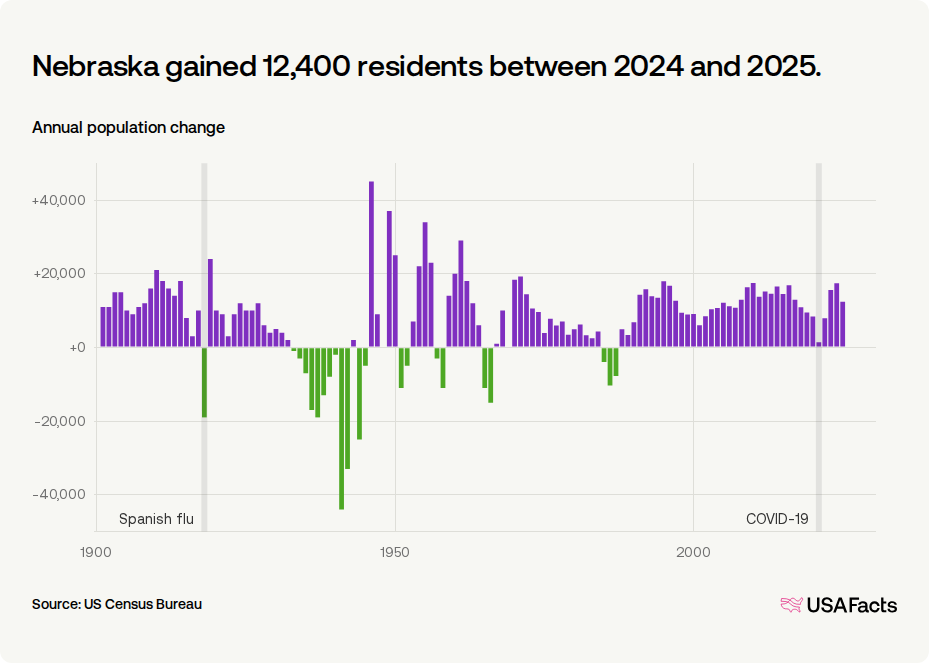
Nebraska gained 12,400 residents between 2024 and 2025.
Annual population change, 1901–2025
What contributes to population change in Nebraska?
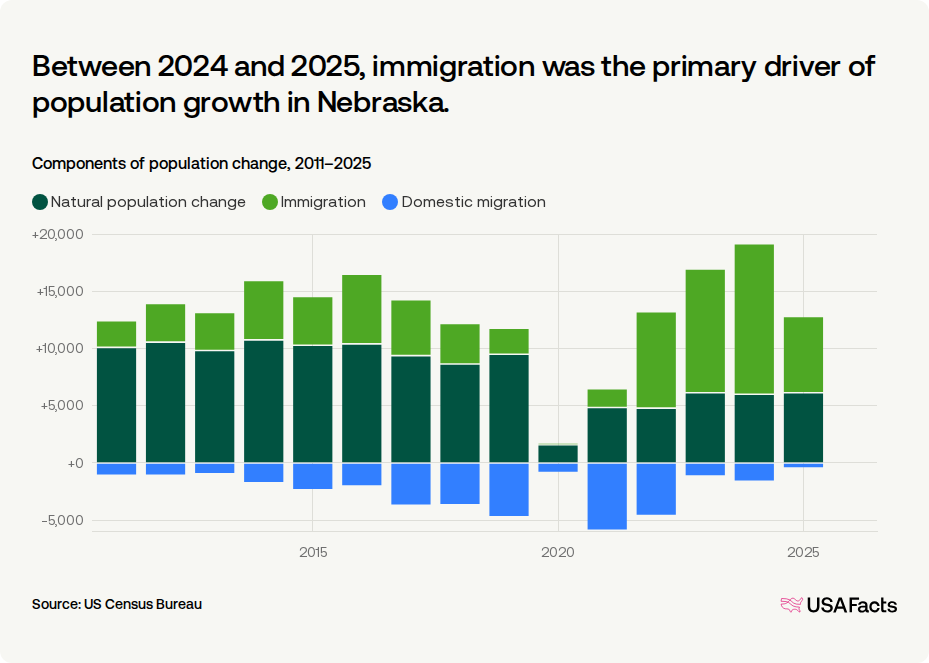
- Natural population change: If births outnumber deaths in a given year, natural population growth is positive. If deaths exceed births, it is negative. Between 2024 to 2025 natural population change was positive in Nebraska, with births exceeding deaths by 6,100.
- Immigration: international migration directly into or out of a state. If more people move in than move out, population change from immigration is positive. If more people move out than move in, it’s negative. Nebraska’s population change from immigration was positive, with about 6,600 more people coming from another country to Nebraska than leaving.
- Domestic migration, moving between states: Nebraska’s population change from domestic migration was negative, with about 366 more people leaving for another state than moving in.
Between 2024 and 2025, immigration was the primary driver of population growth in Nebraska.
Components of population change, 2011–2025
Which counties in Nebraska are growing? Which are shrinking?
Get weekly insights
Subscribe for data-driven insights. No spin, just the facts.
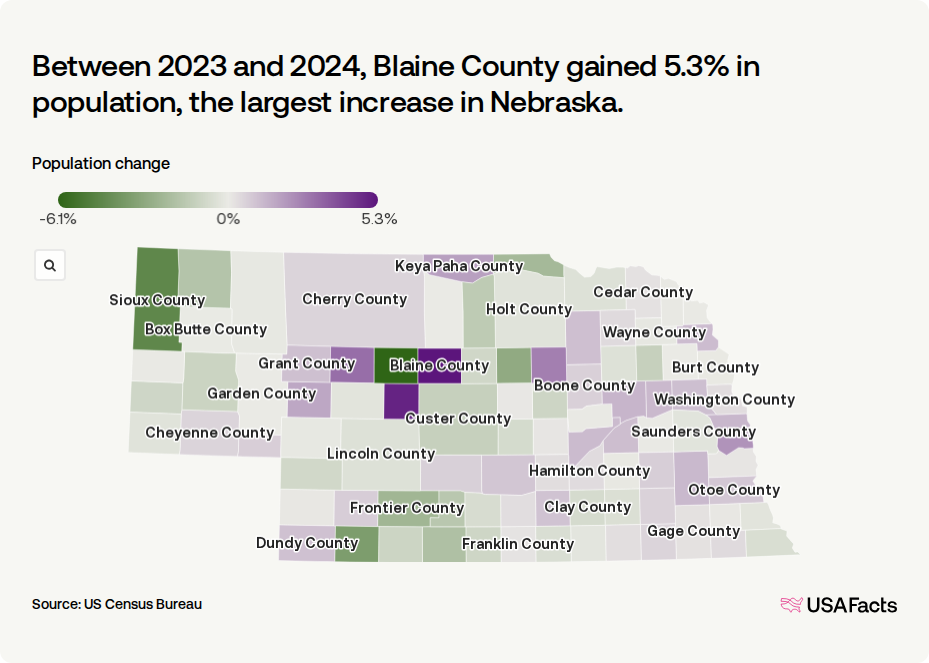
Between 2024 and 2025, Kimball County gained 2.8% in population, the largest increase in Nebraska.
Population change
How does population change in Nebraska compare to other states?
Nebraska ranked 17th in population growth between 2015 and 2025.
Percent change in population

Population change between 2024 and 2025, by county in Nebraska
| County | Population change rate | |
|---|---|---|
| 1. | Kimball County, NE | +2.8% |
| 2. | Banner County, NE | +2.4% |
| 3. | Thurston County, NE | +2.2% |
| 4. | Frontier County, NE | +1.9% |
| 5. | Sarpy County, NE | +1.8% |
| 6. | Perkins County, NE | +1.5% |
| 7. | Wayne County, NE | +1.2% |
| 8. | Furnas County, NE | +1.2% |
| 9. | Saunders County, NE | +1.1% |
| 10. | Douglas County, NE | +0.92% |
Population change between 2015 and 2025, by state
| State | Population change rate | |
|---|---|---|
| 1. | Idaho | +22% |
| 2. | Utah | +17.9% |
| 3. | Florida | +16.5% |
| 4. | Texas | +15.8% |
| 5. | Nevada | +14.9% |
| 6. | South Carolina | +14.8% |
| 7. | Arizona | +13.7% |
| 8. | North Carolina | +12.4% |
| 9. | Delaware | +12.2% |
| 10. | Washington state | +11.4% |
How is the US population changing?
Keep exploring

Methodology
USAFacts standardizes data, in areas such as time and demographics, to make it easier to understand and compare.
Page sources
USAFacts endeavors to share the most up-to-date information available. We sourced the data on this page directly from government agencies; however, the intervals at which agencies publish updated data vary.
