How much do households in Ohio spend on rent?
Refreshed annually
About $1,090, or 30% of their income, in 2024. This is measured by comparing median, or average, rent and median monthly income for renting households.
$1.09K
median monthly rent in Ohio (2024)
30%
average share of income spent on rent in Ohio (2024)
Comparing rent to renter income provides one measure of rental affordability. Dividing rent by income provides what is called a rent-to-income ratio. A higher ratio of rent-to-income indicates rent is less affordable while a lower ratio indicates it’s more affordable.
The Department of Housing and Urban Development considers households with a rent-to-income ratio of more than 30%, that is, households that spend more than 30% of their income on housing, to be cost-burdened. Cost-burdened households may have less money for other necessities such as food, healthcare, or savings. When median monthly rent is more than 30% of average monthly income, it means a typical household would meet the definition of housing cost-burdened.
Ohio’s rent-to-income ratio was lower than the US overall in 2024.
Ratio of median gross rent to median renter household income

The national rent-to-income ratio reached a high of 33.8% in 2011 following the Great Recession. In Ohio, the rent-to-income ratio reached 33.3% that year. Most recently, in 2024, Ohio’s rent-to-income ratio was 30%, 3 percentage points lower than the national rate.
Get weekly insights
Subscribe for data-driven insights. No spin, just the facts.
Which Ohio metros have the most and least affordable rent?
Across metro areas, the average rent-to-income ratio was 31.2% in 2020–2024.
Highlighting metro areas where at least one primary county is in Ohio
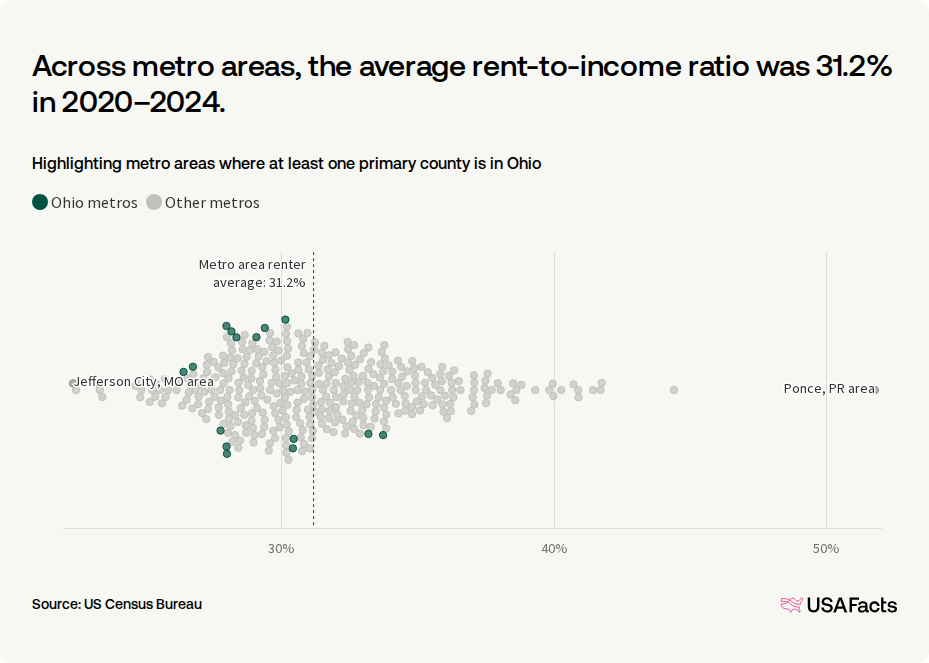
In 2020–2024, the average rent-to-income ratio across metro areas was 31.2%. Metro areas are made up of economically interconnected counties that include at least one urban area. A single metro area can include multiple cities and cross state lines. The metro areas with the highest and lowest ratios were the Ponce, PR area at 51.8% (highest) and the Jefferson City, MO area, at 22.3% (lowest). In Ohio, the highest and lowest were the Wheeling, WV area at 33.7% and the Mansfield, OH area at 26.4%.
During that period, the Columbus, OH area had the highest median rent at $1,274 per month and highest median monthly income at $4,382 out of 15 Ohio metro areas. It’s rent-to-income ratio was seventh highest in Ohio.
Renter income and rent, Ohio metro areas (2020–2024)
Metro areas where at least one of the primary counties is within Ohio
| 1. | $4,382 | |
| 2. | $3,761 | |
| 3. | $3,712 | |
| 4. | $3,485 | |
| 5. | $3,450 | |
| 6. | $3,397 | |
| 7. | $3,322 | |
| 8. | $3,314 | |
| 9. | $3,246 | |
| 10. | $3,122 |
Keep exploring

Methodology
USAFacts standardizes data, in areas such as time and demographics, to make it easier to understand and compare.
Page sources
USAFacts endeavors to share the most up-to-date information available. We sourced the data on this page directly from government agencies; however, the intervals at which agencies publish updated data vary.
