How many people live in the Charleston, SC area?
Refreshed annually
In 2024 there were 869,900 people in the Charleston, SC area. That makes the Charleston, SC area metropolitan statistical area the 71st-most populous metro area in the US. It is home to 0.26% of the nation's population.
870K
population of Charleston, SC area (2024)
0.26%
Charleston, SC area share of US population (2024)
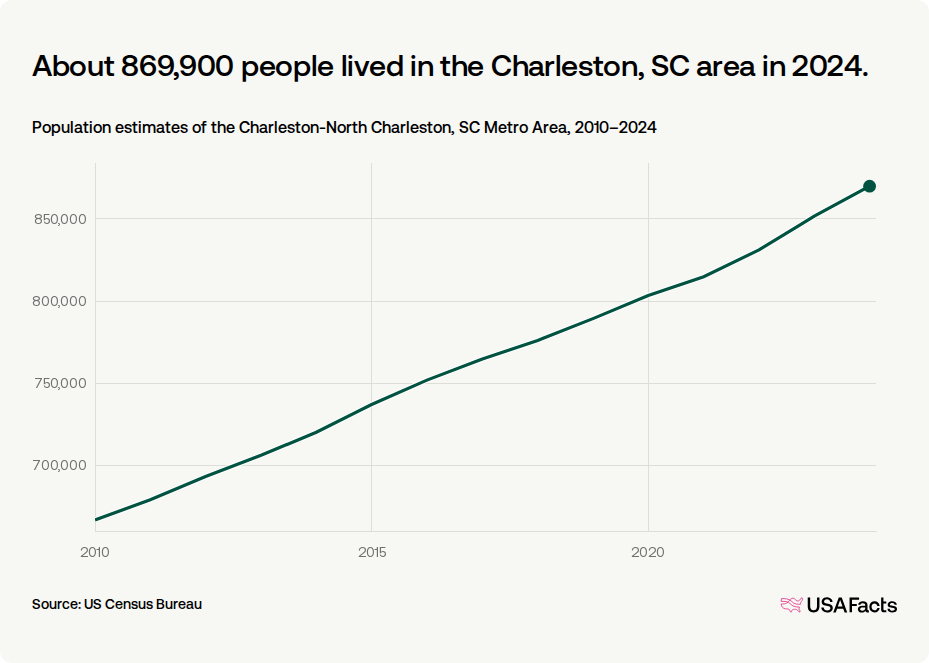
Between 2010 and 2024, the population of the Charleston, SC area increased from 667,100 to 869,900—a 30.4% increase. During that same period, the US population grew 9.9%.
About 869,900 people lived in the Charleston, SC area in 2024.
Population estimates of the Charleston-North Charleston, SC Metro Area, 2010–2024
What are the age demographics of the Charleston, SC area?
About 17.2% of the Charleston, SC area's population in 2024 was aged 65 years or older, lower than the 18% share in the nation overall. Children (under 18) account for 21.2% of the Charleston, SC area population, below the 21.6% population share of children nationwide.
A lower share of the Charleston, SC area population is 65 and older than the US overall.
Population share by age group in Charleston-North Charleston, SC Metro Area and the US overall (2024)

What is the racial and ethnic makeup of the Charleston, SC area?
Non-Hispanic Black or African American residents make up 23.2% of the Charleston, SC area population, higher than the national share of 12.6%. Non-Hispanic white residents make up 63.6% of the population, higher than the national share of 57.5%.
Racial and ethnic make up differ based on location. These figures reflect how people identified their race alone (not in combination with other races), and separate out Hispanic or Latino ethnicity, following Census reporting standards.
A lower share of the Charleston, SC area population is Hispanic than the US overall.
Population share by race and ethnicity in Charleston-North Charleston, SC Metro Area and the US overall (2024)

Keep exploring

Methodology
USAFacts standardizes data, in areas such as time and demographics, to make it easier to understand and compare.
Page sources
USAFacts endeavors to share the most up-to-date information available. We sourced the data on this page directly from government agencies; however, the intervals at which agencies publish updated data vary.
