How many people have a disability in the US?
45.8M
13.7%
How does the federal government determine who has a disability?
How does the federal government determine who has a disability?
How does the federal government determine who has a disability?
The Americans with Disabilities Act (ADA) defines a person with a disability as someone who:
- has a physical or mental condition that significantly limits one or more major life activities,
- has a past history or documented record of such a condition (for example, cancer in remission), or
- is regarded by others as having such a condition, even if it does not currently limit major life activities (for example, someone with visible burn scars).
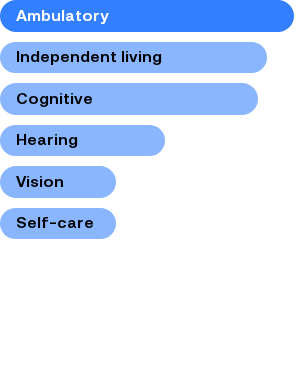
There is no standard government approach to measuring disability, but in its American Community Survey (ACS), the Census Bureau considers a person with a disability as an individual who self-reports difficulty with walking or climbing stairs, hearing, independent living, vision, self-care, and/or cognition.
Around 45.8 million people, or 13.7% of the population, had a disability in 2024.
Share of people with a disability

Which age group has the highest rate of disability in the US?
In 2024, 45% of adults aged 75 and older had a disability.
Share of people with a disability, by age group (2024)

In 2024, West Virginia had the highest share of people with a disability, at 19.6%.
Share of people with a disability, by state (2024)

Keep exploring

Methodology
USAFacts standardizes data, in areas such as time and demographics, to make it easier to understand and compare.
Page sources
USAFacts endeavors to share the most up-to-date information available. We sourced the data on this page directly from government agencies; however, the intervals at which agencies publish updated data vary.
