How many jobs were added in Cheyenne, WY area last month?
Refreshed monthly
It gained zero jobs in September 2026. Those figures come from the Bureau of Labor Statistics’ state and local employment report, which tracks monthly job changes. Job numbers can swing month to month as local economies expand or contract, but over the past five years the Cheyenne, WY Metro Area has averaged about 18 new jobs per month. These figures are often revised in later months as more complete data rolls in.
+0
month to month change in number of jobs (September 2026)
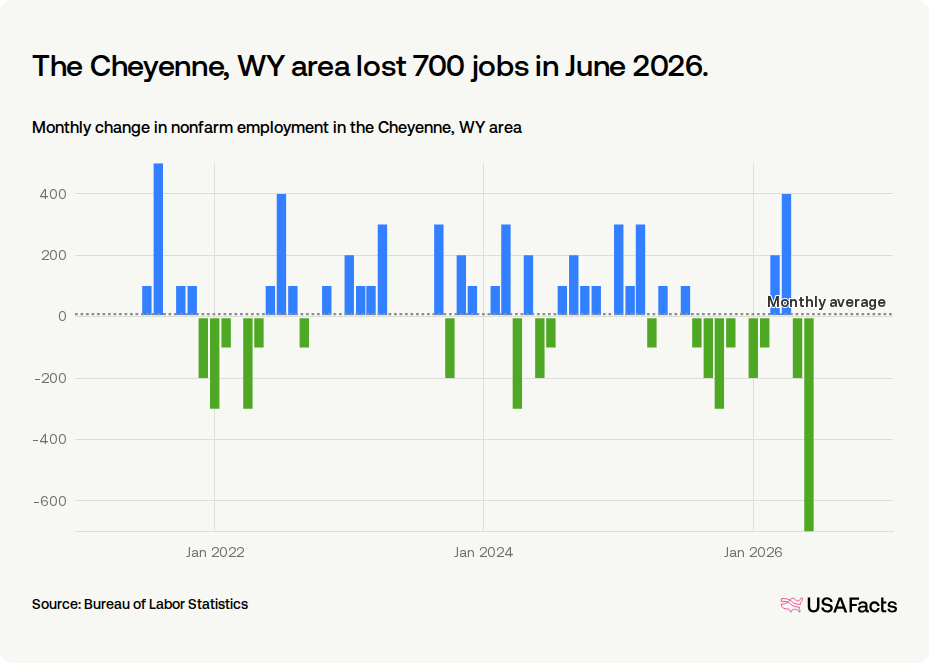
The Cheyenne, WY area had a net change of zero jobs in September 2026, following a loss of 100 jobs in August 2026.
During the latest five-year period (October 2021 to September 2026), the Cheyenne, WY area gained jobs in 28 out of 60 months. September 2026 had the 21st-lowest job growth during this period. The highest gains during this period occurred in July 2022 (+400) while job growth was weakest in June 2026 (-600).
The Cheyenne, WY area lost 0 jobs in September 2026.
Monthly change in nonfarm employment in the Cheyenne, WY area
How has the Cheyenne, WY area's job growth changed over time?
In 2025, the Cheyenne, WY area has gained an average of 8 jobs every month. That's lower than the 2024 average monthly increase of 42. The 2025 average ranks as 12th-highest in job growth since 2007.
When excluding the two pandemic-affected years of 2020 and 2021, job growth ranged from a loss of 108 every month in 2009 to a gain of 133 every month in 2007.
Get weekly insights
Subscribe for data-driven insights. No spin, just the facts.
In 2025, the Cheyenne, WY area gained an average of 8 jobs every month.
Average monthly change in the number of jobs in the Cheyenne, WY area, seasonally adjusted

Keep exploring

Methodology
USAFacts standardizes data, in areas such as time and demographics, to make it easier to understand and compare.
Page sources
USAFacts endeavors to share the most up-to-date information available. We sourced the data on this page directly from government agencies; however, the intervals at which agencies publish updated data vary.
