How many households in Wisconsin spend too much on housing?
Refreshed annually
About 695,700 households were cost-burdened in 2025. That's 27.7% of all households in Wisconsin. These households spent at least 30% of their total income on rent or mortgage payments and utilities. The Department of Housing and Urban Development considers households that spend more than 30% of their income on housing to be cost-burdened. Cost-burdened households may have less money for other necessities such as food, healthcare, or savings.
696K
Wisconsin households were cost burdened in 2025
27.7%
of Wisconsin households were cost burdened in 2025
The number of cost-burdened households in Wisconsin increased from 655,800 in 2015 to 695,700 in 2025. Cost burden considers both household income and housing costs, so factors affecting either of these can influence the number of burdened households. For example:
Changes in wages, employment status, or the number of people in a household can impact household income.
Changes in housing supply/demand or interest rates can affect costs.
A growing or declining US population can also affect the number of cost-burdened households. To counteract this, USAFacts analyzed the percentages of cost-burdened households rather than just the number. This prevents such population changes from skewing the data.
In 2025, 27.7% of households in Wisconsin were cost burdened, lower than the national average of 33.6%.
In Wisconsin, 27.7% of households were cost burdened in 2025.
Share of households that spent at least 30% of their income on housing, 2005–2025
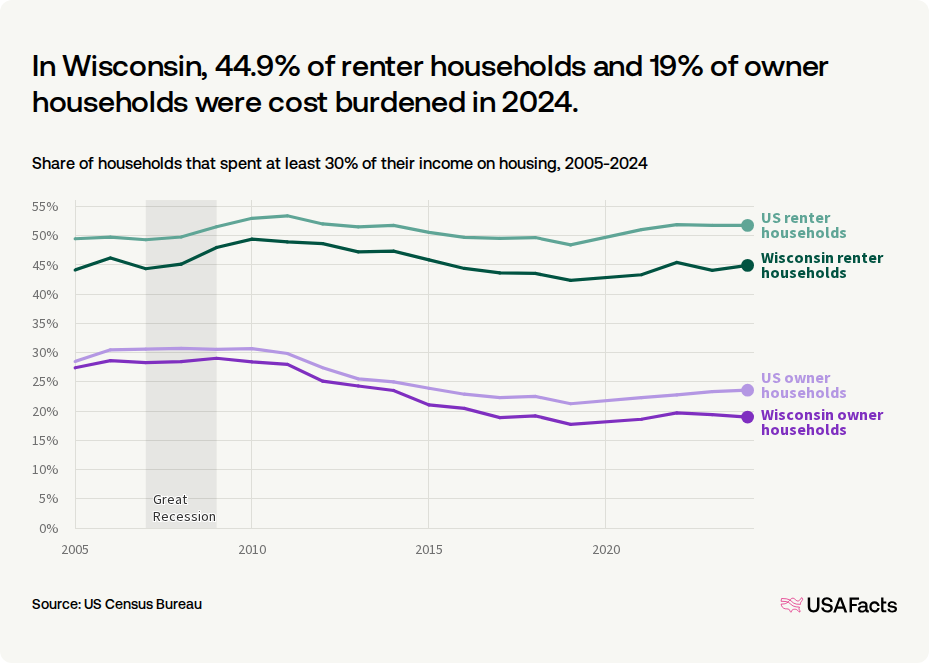
Cost burden varies for renters and homeowners. For example, during the Great Recession (2007–2009) unemployment rose, millions of homes entered foreclosure, and rental demand increased. By 2010, cost burden had increased among renters while staying flat among homeowner households.
What is the difference in housing cost burden for renters versus homeowners in Wisconsin? How does this compare to the US overall?
Since 2015, the proportion of cost-burdened owner households in Wisconsin has decreased from 21.1% to 19.7% in 2025. Meanwhile, cost burden decreased from 45.9% to 45.7% among renter households. In Wisconsin, the cost-burdened share of owner households was lower and the cost-burdened share of renter households was lower than the national average in 2025.
Get weekly insights
Subscribe for data-driven insights. No spin, just the facts.
In Wisconsin, 45.7% of renter households and 19.7% of owner households were cost burdened in 2025.
Share of households that spent at least 30% of their income on housing, 2005–2025
How high is cost burden for renters in Wisconsin cities compared to other US cities?
In 2020–2024, the share of owner households in metro areas that were cost burdened was 23.3%. (Metro areas are made up of a city with at least 50,000 people and the economically and socially interconnected counties.) The metro areas with the highest and lowest share of cost-burdened owner households were the Miami, FL area at 35.1% (highest) and Morgantown, WV area, at 13.2% (lowest).
Among the metros at least partially in Wisconsin, the highest and lowest were Racine, WI area at 21.6% and Wausau, WI area at 14.4%.
Across metro areas, 23.3% of owner households were cost burdened.
Share of owner households that spent at least 30% of their income on housing, 2020–2024
In 2020–2024, the share of renter households in metro areas that were cost burdened was 51.8%. The metro areas in the US with the highest and lowest share of cost-burdened renter households were the Miami, FL area at 64.2% (highest) and the Sheboygan, WI area, at 34% (lowest). In Wisconsin, the highest and lowest were Duluth, MN area at 50.7% and Sheboygan, WI area at 34%.
Across metro areas, 51.8% of renter households were cost burdened.
Share of renter households that spent at least 30% of their income on housing, 2020–2024
The difference between the cost-burdened share of owner and renter households was narrowest in the Sheboygan, WI area, where cost burden was 18.3 percentage points higher among renters than owners, and widest in the Duluth, MN area, where the gap was 32.2 percentage points. Within Wisconsin overall, the gap was 25.9 percentage points.
Cost-burdened households, Wisconsin metro areas (2020–2024)
Metro areas where at least one of its primary counties are within Wisconsin
Cost-burdened households, Wisconsin metro areas (2020–2024)
1.
Duluth, MN area
Duluth, MN-WI Metro Area
50.7%
2.
Milwaukee, WI area
Milwaukee-Waukesha, WI Metro Area
47.6%
3.
Kenosha, WI area
Kenosha, WI Metro Area
47.3%
4.
Madison, WI area
Madison, WI Metro Area
46.6%
5.
La Crosse, WI area
La Crosse-Onalaska, WI-MN Metro Area
43.1%
6.
Racine, WI area
Racine-Mount Pleasant, WI Metro Area
43.1%
7.
Janesville, WI area
Janesville-Beloit, WI Metro Area
42.9%
8.
Wausau, WI area
Wausau, WI Metro Area
42%
9.
Oshkosh, WI area
Oshkosh-Neenah, WI Metro Area
41.2%
10.
Fond du Lac, WI area
Fond du Lac, WI Metro Area
41.2%
Keep exploring
Methodology
USAFacts standardizes data, in areas such as time and demographics, to make it easier to understand and compare.
Page sources
USAFacts endeavors to share the most up-to-date information available. We sourced the data on this page directly from government agencies; however, the intervals at which agencies publish updated data vary.