How many veterans are in the US and who are they?
As of 2025, 15.7 million Americans identified as veterans. Half of the veteran population is 65 or older, and nearly three-quarters are white.
According to the Census Bureau, 5.9% of the adult American population, or 15.7 million people, identified as veterans in 2025. This number has been declining for decades. Between 2005 and 2025, the total number of veterans fell by 7.7 million, or nearly 33%.
The veteran population has fallen 33% since 2005.
US veteran population, 2005–2025

What is a veteran, and who is considered one?
What is a veteran, and who is considered one?
Title 38 of the United States Code defines a veteran as “a person who served in the active military, naval, or air service, and who was discharged or released therefrom under conditions other than dishonorable.”
The code also outlines who qualifies for veteran status beyond active duty to include service members such as reservists, members of the National Guard, cadets and midshipmen at military academies, commissioned officers outside the Armed Forces, and those in training for military service. The Department of Veteran Affairs is responsible for determining veteran status and maintaining veteran benefit eligibility.
What is a protected veteran?
The Vietnam Era Veterans’ Readjustment Assistance Act of 1974 prohibits discrimination against certain veterans. Protected veterans meet the Title 38 qualifications but are afforded additional consideration due to disability, recent discharge, participation in wartime, or service recognition.
How many WWII, Korean War and Vietnam veterans are still alive?
In 2025, over half of living American veterans, nearly 9 million, served during the Persian Gulf War or the Post-9/11 wars — Persian Gulf veterans between August 1990 and August 2001 (4.0 million), post-9/11 between September 2001 and later (4.9 million).
Nearly one-third of living veterans, 4.9 million, served in Vietnam. The Census Bureau also reports 366,936 living veterans who served in the Korean War and 41,561 who served in World War II.
Vietnam-era and post-9/11 veterans are the largest cohorts of living veterans.
Number of US veterans by period of service, 2010–2025

What are the demographics of US veterans?
In 2025, 71.8% of living veterans identified as white. In 2025, Black Americans were the second largest veteran racial group (13.1%), while 9.8% of veterans identified as Hispanic or Latino. Meanwhile, 8.7% of living veterans identified as two or more races.
Get weekly insights
Subscribe for data-driven insights. No spin, just the facts.
The racial and ethnic makeup of the veteran population differs from the country as a whole. Combined, white and Black Americans are 72.9% of the US population but 84.9% of the veteran population. Meanwhile, Asian Americans (6.8% of the US population) are underrepresented among veterans (2.3%).
The US veteran population is less racially and ethnically diverse than the nation overall.
Racial and ethnic makeup of US veterans compared to total US population, 2025

How old are US veterans?
The veteran population is aging. In 2025, almost half of veterans (49.7%) were 65 or older, while 30.5% were 75 or older. Meanwhile, 8.4% of veterans in 2025 were 34 or younger.
Three in 10 veterans are over age 75.
Percentage of US veterans by age group, 2005–2025

What is the share of veterans by gender?
More than one in 10 living veterans are women. The share of women veterans has steadily increased — in 2010, 7.2% of veterans were women, compared to 11.4% in 2025. (The Census Bureau does not provide data on the number of transgender or nonbinary veterans.)
The share of female veterans has increased 4 percentage points since 2010.
Percent of US veterans by sex, 2010–2025

How educated are veterans?
Veterans’ education levels have also shifted. 70.1% of veterans in 2025 had at least some college experience, an associate’s degree, or a bachelor's degree or higher. In 2010, the rate of veterans with some college was 62.0%, up 8.1 percentage points.
The rate of veterans with at least some college is up 8.1 percentage points since 2010.
Percent of US veterans by educational attainment, 2010–2025

How many veterans are unemployed?
In 2025, 3.5% of veterans — around 294,000 people — were unemployed, according to the Bureau of Labor Statistics (BLS). The veteran population had a lower unemployment rate than non-veterans (4.2%).
Of all Americans, veteran and not, younger people tend to have the highest unemployment rate. This is true for veterans aged 18 to 24, whose unemployment rate of 9.0% is nearly triple the general veteran average.
Veterans have lower unemployment rates than the overall population.
Unemployment rate of US veterans and the overall adult population, annual averages, 2000–2025

What is the median income for veterans?
On average, employed veterans earn more than employed non-veterans. The Census Bureau reports that veterans’ median 2025 income was $57,483; the median income of adult non-veterans was $42,878.
How many veterans have a disability?
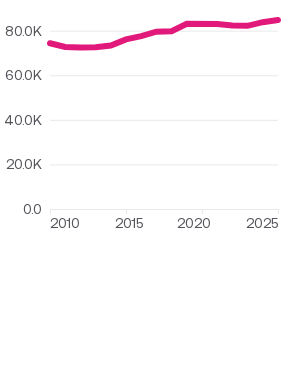
Five million veterans, or 32.0% of vets, had at least one disability in 2025. The proportion of veterans with disabilities has risen in recent years — in 2010, 25.5% of veterans reported having a disability. Veterans are twice as likely to be affected by disabilities than the general adult public, 16.1% of whom report disabilities.
Disability among veterans has risen 6.5 percentage points since 2010.
Percent of US veterans with a disability, 2010–2025

How many veterans live in poverty?
Veterans are less likely than the general 18+ population to live below the poverty line. The Census Bureau estimates that 7.5% of veterans in 2025 (approximately 1.2 million people) reported incomes below the poverty level. The overall poverty rate for the US adult population is 11.0%.
Veterans are less likely to be impoverished than the general adult population.
Percent of US veterans and adults in poverty, 2010–2025

How many veterans are homeless?
Department of Housing and Urban Development (HUD) estimates have veteran homelessness falling 55.3% from 2010 to 2022 before increasing 7.4% in 2023. As of 2025, the US had 32,495 unhoused veterans, an 8.7% decrease since the last increase in 2023.
The number of homeless veterans has decreased by more than half since 2010.
Total US veteran homeless population, 2010–2025

How many veterans commit suicide?
The Department of Veterans Affairs (VA) reports that 6,488 veterans died from suicide in 2024. When adjusting for age, the veteran suicide rate was 39.3 per 100,000 veterans. When comparing rates to the non-veteran population, the veteran age-adjusted suicide rate was more than double that of non-veterans (16.5 per 100,000 people).
The suicide rate for veterans is more than double that of non-veterans.
Age-adjusted suicide rates per 100,000 US veterans and non-veterans, 2010–2024

Explore more data about the US military, including how much the federal government spends on defense, and get data delivered to your inbox weekly by signing up for our newsletter.

Keep exploring
- How does the government support veterans? - Over 93% of the Department of Veterans Affairs’ annual spending funds pensions, compensation, medical care, and education programs for veterans.
- Is Congress representative of the American people? - Congress is older, more educated, and made up of a higher share of men than the US population.
- How many homeless people are in the US? What does the data miss? - Of the 745,652 people experiencing homelessness in January 2025, white adults ages 35 to 44 represented the largest demographic group.
- Who is the American farmer? - There are 3.4 million agricultural producers, 63.2% over the age of 55, in the United States.
