What impacts the price of oil?
Why do geopolitical tensions with Iran have such a large impact on how much everyday Americans pay for gas at the pump? And why are we seeing oil prices rise when the US is such a large producer of oil? Oil is a global market, so if supply is threatened anywhere, prices can rise everywhere — including at your local gas station.
Up Next

Transcript
When you hear oil is $100 a barrel, this is what that means. $100 for 42 gallons of crude oil.
When the price of a barrel of oil goes up, gas prices usually go up, too. But it's not a one-to-one match. About 50% of what you pay at the pump is tied to crude oil.
So, what's really driving that number? And why are we seeing oil prices go up when the US is such a big oil producer?
I'm Steve Ballmer, and this is Just the Facts. Data-driven facts to help you make up your own mind. In this episode, the price of oil.
Let's break this down: what a barrel of oil actually is, how much oil the world and the US uses, and why something happening 5,000 miles away, like in the Strait of Hormuz, can hit your wallet.
First, what is a barrel of oil? It's just a unit of measurement. It dates back to the 1860s oil boom in Pennsylvania, when producers used old barrels, often whiskey barrels, to store oil. Problem was, they weren't all the same size, so the industry standardized at 42 gallons.
The barrels themselves are mostly gone, but the measurement stuck. It's crazy, right?
And one barrel does a lot. Gasoline is the biggest share, but it's not the only thing. That same barrel can also produce diesel, jet fuel, heating oil, and the building blocks for plastics, fertilizers, and chemicals. So when we talk about oil prices, we're really talking about the cost of a whole system of products.
So, how much are we using? Globally, we use about 104 million barrels per day. In the United States, we use about 21 million barrels of oil per day, or roughly seven and a half billion a year. And here's what's surprising: US consumption of oil has been relatively steady for decades, even as the economy and the population have grown.
But prices of oil not steady at all. They move a lot. You can see spikes tied to major global events. The Iranian revolution, the financial crisis in 2008 when demand dropped, the COVID-19 pandemic in 2020 when demand collapsed, and recently geopolitical tensions involving Iran have driven the largest price spike since 2022.
Globally, we use about 104 million barrels per day. In the US, we use about 21 million barrels of oil per day, or roughly 7.5 billion a year.
So, who sets the price? There's no single who. Oil prices are set in global markets through trading on exchanges. Two of the biggest are the New York Mercantile Exchange, NYMEX, and the Intercontinental Exchange, ICE.
Think of these like giant marketplaces where buyers and sellers meet to agree on prices, but they're not trading physical barrels. They're trading contracts: agreements to buy or sell oil at a set price, at a set time in the future.
Those trades determine benchmark prices you'll hear all the time. The WTI: West Texas Intermediate, the main US benchmark. Brent crude: the global benchmark. These are reference prices that help set the value of oil around the world.
Brent crude, the global benchmark, has swung from under $20 to over $100 a barrel over time, showing you just how volatile this market can be.
But here's where it gets tricky. Crude oil is just the starting point. What you actually buy is refined products like gasoline. And those products depend on more than the price of crude. They depend on refining capacity, transportation and logistics costs, regulations and fuel standards, and seasonal demand. So sometimes gas prices rise even when crude oil prices don't move as much.
Now, the US produces a lot of oil. So why are we still tied to global prices?
First, the facts. The US is one of the world's top oil producers. Total petroleum production, which includes crude oil and other liquids, has increased significantly since 2010.
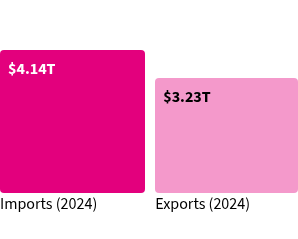
But we still both import and export petroleum. Why?
Explaining that requires a bit of history. Between 1975 and the end of 2015, the Energy Policy and Conservation Act of Congress directed a ban on nearly all exports of US crude oil. Not a big deal at first because we didn't produce much oil, but US crude oil production roughly doubled from 2009 to 2015 due in part to advancements in drilling technologies.
So far in 2026, the US has exported nearly 40% more oil than it has imported
US imports and exports of crude oil and petroleum products in barrels, January 1981–March 2026

Congress effectively removed the ban, allowing the free export of US crude oil worldwide. You can see here how much exports expanded after the ban was repealed, but imports decreased.
Why do we import and export? Because not all oil is the same, and not all refineries are built for every type of oil. The US produces a lot of light crude, but many refineries are designed for heavier crude, which we import.
But whether the oil is imported or exported, all the oil is priced globally. That's because producers always have a choice. Sell the oil here or sell it abroad. If global prices are higher, that's where it goes.
The Netherlands is the top importer of US petroleum.
US exports of crude oil and petroleum products by geography in barrels, 2025

Finally, the Strait of Hormuz. This is one of the most important choke points in the world. A narrow waterway connecting the Persian Gulf to the open ocean. About 20 million barrels passed through it every day in 2025. That's roughly one fifth of global consumption. Most of that oil doesn't even come to the United States. It goes primarily to Asia.
So why does this matter to you? Because oil is a global market. If supply is threatened anywhere, prices can rise everywhere, including at your local gas station.
So, when you hear $80 a barrel, it's not just a number. It's a global system shaped by markets, infrastructure, and world events. And it all connects back to what you pay at the pump.