Why are unauthorized immigrants allowed to enter the US?
Does someone have to be an American citizen to live in the US? Not necessarily; millions of noncitizens live here legally as permanent residents, visa holders, and refugees.
According to the latest available data, an estimated 11 million unauthorized immigrants were living in the United States as of 2022 — roughly the population of Georgia in 2025.
11M
5%
How are millions of noncitizens living in the US without legal status?
Some entered the country on temporary visas but overstayed them. Others entered without being officially admitted. Some are in the middle of immigration court proceedings, and others have temporary protection like Deferred Action for Childhood Arrivals (DACA).
What is an unauthorized immigrant?
An unauthorized immigrant is a noncitizen who doesn’t have lawful permanent resident status and or a valid visa (permanent or temporary) to remain in the United States.
This generally includes:
- People who entered without inspection at an official port of entry.
- People with temporary protections (like Temporary Protected Status or Deferred Action for Childhood Arrivals) or who have pending immigration proceedings (like waiting for a decision on an asylum application) and are waiting to obtain lawful permanent status.
- People who have overstayed a temporary visa or have violated the terms of their admission.
Get weekly insights
Subscribe for data-driven insights. No spin, just the facts.
Crossing the border without presenting to immigration authorities
Some individuals enter the United States without inspection, meaning they cross the border between official ports of entry and are not formally admitted by immigration authorities.
Since these people aren’t formally admitted, there’s no direct way to count how many people successfully enter this way. Estimates rely on modeling; border encounter data, including apprehensions reported by Customs and Border Protection (CBP), is one way to measure enforcement activity but doesn’t capture the total number of people who enter the US without being detected.
The number of apprehensions has decreased recently: From February 2025 to March 2026, there were an average of 8,829 apprehensions per month, down from a recent peak of 251,178 apprehensions in December 2023.
There have been an average of 8,829 monthly border apprehensions since February 2025.
Nationwide apprehensions, October 2023–March 2026

Although the exact rates fluctuate, the bulk of apprehensions typically happen at the southern border — they’ve been between over 70%, and as much as 99%, of all border apprehensions since October 2023. For this reason, trends at the southern border are sometimes used as an indicator of changes in border activity, even though they don’t measure the number of people entering informally.
In 2025, apprehensions at the US-Mexico border reached the lowest level recorded in available data.
Apprehensions at the US-Mexico border were down 86% between December 2024 to December 2025.
Apprehensions by Border Patrol between official ports of entry at the US-Mexico border, January 2000–December 2025

Noncitizens who enter without authorization may be subject to arrest, detention, and removal proceedings.
Pending immigration proceedings
Some unauthorized immigrants are in the US awaiting the resolution of an immigration proceeding, often related to asylum applications.
People who fear persecution in their home country related to their race, religion, nationality, political opinion, or membership in a social group can file asylum claims in the US. This isn’t the same as a refugee: an asylum seeker applies once they're on US soil, while someone claiming refugee status applies from outside the US.
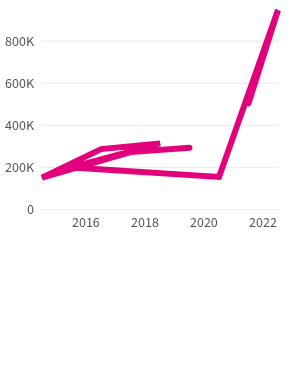
Asylum claims can be affirmative, meaning the person proactively applies upon arrival (even if they are not facing deportation), or defensive, meaning the person applies for asylum as a mechanism to keep from being deported.
Defensive asylum filings increased by a factor of 10 from FY 2016 to FY 2025, from 83,502 to 874,106.
Defensive asylum cases increased 10X from FY 2016 to 2025.
New defensive asylum cases by filing origin, FY 2016–2025

In FY 2024, immigration courts received 1.78 million new cases related to immigration. In addition to asylum cases, judges hear cases on adjustment of status, bond hearings, and withholding or deferring removal.
Noncitizens temporarily allowed to remain in the US: TPS and DACA
Some noncitizens are unauthorized but are allowed to remain in the US because they meet the requirements of Temporary Protected Status (TPS) or Deferred Action for Childhood Arrivals (DACA).
If the Secretary of the Department of Homeland Security (DHS) determines that a person’s home country isn’t safe to return to, due to natural disaster, political turmoil, or other event, it is listed for temporary protected status. This means that citizens of that country who are already in the US can apply for protection from deportation under the TPS designation.
As of March 2025, nearly 1.3 million people in the US had Temporary Protected Status.
DHS maintains a list of countries considered unsafe for return; the list is regularly reviewed and updated by each administration based on changing conditions in those countries.

DACA protects people who were brought to the US as minors from deportation. If the child is meets the eligibility conditions — which include entering the US as a minor, continuously residing here, and being in school — their deportation is deferred, though they have to renew their status each year. In June 2025, there were 515,570 active DACA recipients. That number has been gradually declining since May 2018, when it peaked at 702,250.
DACA is not a path to citizenship, and the agency that administers it, US Citizenship and Immigration Services, has been blocked by court proceedings from processing new requests since September 13, 2023 (although they still accept them).
The number of people with active DACA status in June 2025 is 26.6% below the May 2018 peak.
Active DACA recipients, September 2017–June 2025

How many people overstay a visa?
Some people enter the US legally with temporary visas that allow them to be in the country for a limited time, but then stay beyond the term of their visa. (Temporary visas, or nonimmigrant visas, are granted for reasons like tourism, short-term work, business, medical treatment, and education.) When a visa expires, the visa holder must either renew it (if they’re eligible) or leave the country. If the person doesn’t renew or leave, they have transitioned from lawful entry to unauthorized presence.
In fiscal year 2024, the Department of Homeland Security estimated that 1.15% of all nonimmigrant visa holders stayed in the US past their visa expiration dates. That amounted to 538,548 people, or a little more than the population of Sacramento, California.
Where does this data come from?
Where does this data come from?
Department of Homeland Security:
The Department of Homeland Security is responsible for protecting the United States from threats through activities such as counterterrorism, border and immigration enforcement, cybersecurity, and disaster prevention and response. Their report, “Estimates of the Unauthorized Immigrant Population Residing in the United States,” provides estimates of the noncitizen population. It was last updated on April 18, 2024, with data from January 2018–January 2022. The publication of this report varies: sometimes, it is updated yearly, and other times, it is not unusual for there to be a multi-year gap (typically not exceeding four years).
Customs and Border Protection:
Customs and Border Protection (CBP) is a subagency of the Department of Homeland Security. CBP is responsible for keeping US borders secure and facilitating lawful trade by enforcing immigration laws and preventing illegal entry. CBP’s “Nationwide Encounters” dataset includes encounter data from the northern border, the southern border, and other encounters by air, land, and sea. Data are usually released monthly for the previous month. When new data is released, it’s possible that data from other recent previous months may be slightly modified to include the most up-to-date data.
Department of Justice:
The Department of Justice is responsible for enforcing federal laws and ensuring public safety through prosecuting cases, overseeing federal law enforcement, managing federal prisons, upholding civil rights, and administering justice-related grants. Their report, “Total Asylum Applications,” updated quarterly, and reports on the number of affirmative, defensive, and other asylum cases filed each quarter of the federal fiscal year.
Citizenship and Immigration Services:
Citizenship and Immigration Services (USCIS) is a subagency of the Department of Homeland Security. USCIS is responsible for overseeing lawful immigration to the United States by administering the immigration and naturalization system, and processing citizenship and immigration benefit applications. Their “Active DACA Recipients” reports on demographics of DACA recipients, including age, sex, state, country of birth, and marital status. It was last updated at the end of the third quarter of the 2025 fiscal year, on June 30, 2025.

Keep exploring
- What’s in the “One Big Beautiful Bill”? - From tax reform to shifts in healthcare, immigration, and SNAP, this legislation will likely affect you.
- What can the data tell us about unauthorized immigration? - The US has reported nearly 11 million unauthorized border encounters between October 2019 and June 2024.
- How many immigrants come to the US each year? - Immigration was the primary driver in the nation’s population growth in each year from 2021 to 2023.
- What is the main reason people immigrate to the US via authorized channels?
Methodology
USAFacts standardizes data, in areas such as time and demographics, to make it easier to understand and compare.
Page sources
USAFacts endeavors to share the most up-to-date information available. We sourced the data on this page directly from government agencies; however, the intervals at which agencies publish updated data vary.