What is the Seventh Amendment?
1791
What is a constitutional amendment?
The constitutional amendment process is as follows:
Two-thirds vote
An amendment may be proposed by a two-thirds vote in both the House of Representatives and the Senate or by a constitutional convention called by two-thirds of state legislatures.
Three-fourths ratification
Once proposed, the archivist of the United States submits the amendment to the states for consideration. It becomes part of the Constitution once it is ratified by three-fourths of the states.
Full text of the Seventh Amendment
"In Suits at common law, where the value in controversy shall exceed twenty dollars, the right of trial by jury shall be preserved, and no fact tried by a jury, shall be otherwise reexamined in any Court of the United States, than according to the rules of the common law."
When did the states ratify the Seventh Amendment?
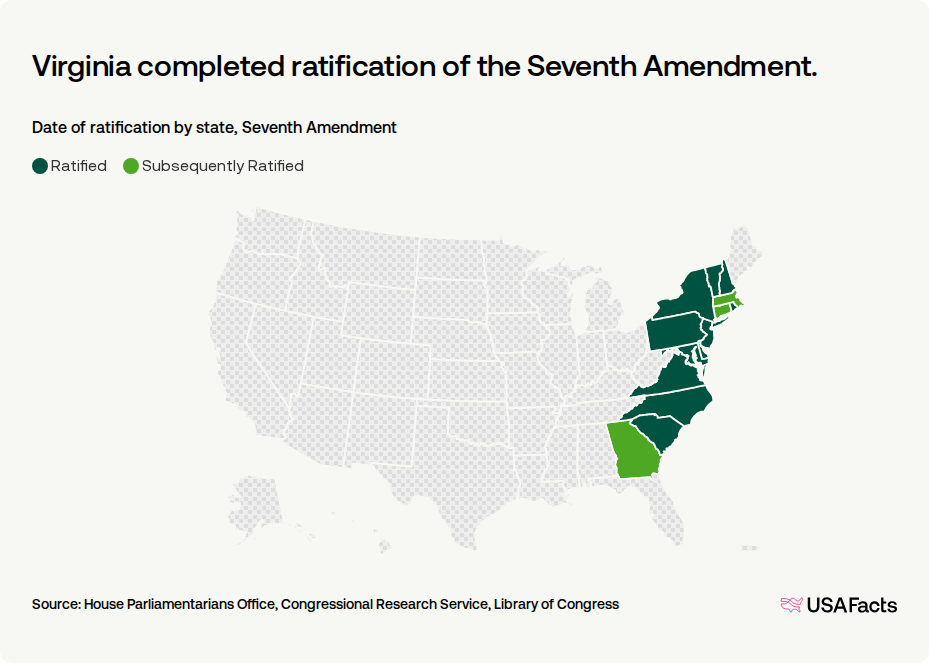
Virginia completed ratification of the Seventh Amendment.
Date of ratification by state, Seventh Amendment
Get weekly insights
Subscribe for data-driven insights. No spin, just the facts.
How has the Seventh Amendment shaped Supreme Court rulings?
Under judicial review, there has been one case where the Court struck down laws as unconstitutional using the Seventh Amendment.
Supreme Court cases invoking this amendment
Cases, 1798–2021
| Case | Year |
|---|---|
The Justices v. Murray | 1869 |
Keep exploring

Methodology
USAFacts standardizes data, in areas such as time and demographics, to make it easier to understand and compare.
Page sources
USAFacts endeavors to share the most up-to-date information available. We sourced the data on this page directly from government agencies; however, the intervals at which agencies publish updated data vary.