What is the 25th Amendment?
1967
What is a constitutional amendment?
The constitutional amendment process is as follows:
Two-thirds vote
An amendment may be proposed by a two-thirds vote in both the House of Representatives and the Senate or by a constitutional convention called by two-thirds of state legislatures.
Three-fourths ratification
Once proposed, the archivist of the United States submits the amendment to the states for consideration. It becomes part of the Constitution once it is ratified by three-fourths of the states.
Full text of the 25th Amendment
"Section 1. In case of the removal of the President from office or of his death or resignation, the Vice President shall become President. Section 2. Whenever there is a vacancy in the office of the Vice President, the President shall nominate a Vice President who shall take office upon confirmation by a majority vote of both Houses of Congress. Section 3. Whenever the President transmits to the President pro tempore of the Senate and the Speaker of the House of Representatives his written declaration that he is unable to discharge the powers and duties of his office, and until he transmits to them a written declaration to the contrary, such powers and duties shall be discharged by the Vice President as Acting President. Section 4. Whenever the Vice President and a majority of either the principal officers of the executive departments or of such other body as Congress may by law provide, transmit to the President pro tempore of the Senate and the Speaker of the House of Representatives their written declaration that the President is unable to discharge the powers and duties of his office, the Vice President shall immediately assume the powers and duties of the office as Acting President. Thereafter, when the President transmits to the President pro tempore of the Senate and the Speaker of the House of Representatives his written declaration that no inability exists, he shall resume the powers and duties of his office unless the Vice President and a majority of either the principal officers of the executive department or of such other body as Congress may by law provide, transmit within four days to the President pro tempore of the Senate and the Speaker of the House of Representatives their written declaration that the President is unable to discharge the powers and duties of his office. Thereupon Congress shall decide the issue, assembling within forty-eight hours for that purpose if not in session. If the Congress within twenty-one days after receipt of the latter written declaration, or, if Congress is not in session, within twenty-one days after Congress is required to assemble, determines by two-thirds vote of both Houses that the President is unable to discharge the powers and duties of his office, the Vice President shall continue to discharge the same as Acting President; otherwise, the President shall resume the powers and duties of his office."
When did the states ratify the 25th Amendment?
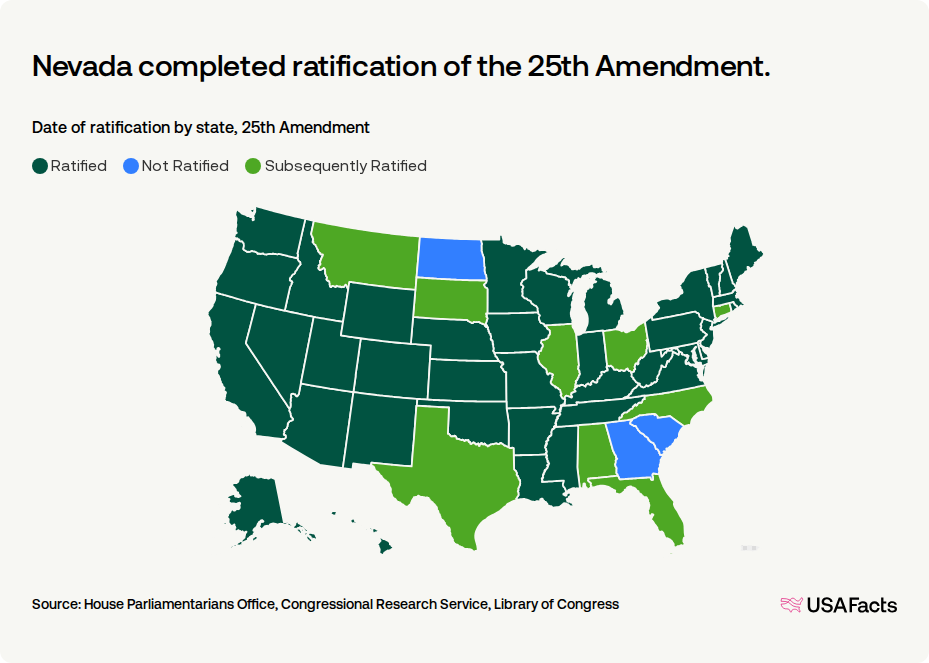
Nevada completed ratification of the 25th Amendment.
Date of ratification by state, 25th Amendment
Get weekly insights
Subscribe for data-driven insights. No spin, just the facts.
How has the 25th Amendment shaped Supreme Court rulings?
Under judicial review, there have been zero cases where the Court struck down laws as unconstitutional using the 25th Amendment.
Keep exploring

Methodology
USAFacts standardizes data, in areas such as time and demographics, to make it easier to understand and compare.
Page sources
USAFacts endeavors to share the most up-to-date information available. We sourced the data on this page directly from government agencies; however, the intervals at which agencies publish updated data vary.