When President Truman moved into the White House in the late 1940s, he thought the building was haunted. Chandeliers swayed. Floors creaked. Drapes fluttered.
Inspectors eventually found the “ghost”: the 150-year-old structure was on the verge of collapse. One described it as standing “from force of habit only.”
The solution? A drastic one — gut the interior of the Executive Residence, the central building where the first family lives, while preserving the historic exterior. To fund the project, Truman requested $5.4 million (around $72 million in today’s dollars) from Congress.
Seventy-five years later, the White House is again under construction, this time to build a ballroom where the East Wing once stood. This is far from the first time the White House has been under construction since the Truman administration, but the estimated price tag and private donor funding have prompted questions amongst officials and the public.
To understand how the cost of the new ballroom compares to past renovations, USAFacts reviewed government documents to identify how much money was requested from Congress or raised through private donations for some of the largest White House projects of the past century.
Few White House renovations have cost more than $10 million in the past 100 years
By fiscal year that the funding was requested or funds were raised, adjusted to FY 2025 dollars

In the past 100 years, three projects stand out for their scale and cost: the Truman-era reconstruction of the Executive Residence in the 1940s, the modernization of the East and West Wings around 2008, and the current East Wing ballroom construction.
Like the Truman-era restoration, 2008’s modernization was prompted by worries about the White House’s aging infrastructure. A federal study found that the electrical, plumbing, and security systems beneath the East and West Wings had reached the end of their reliable service lives and were in “critical need” of replacement to prevent “imminent failure.”
The Bush administration made an initial funding request for repairs to the West Wing in 2008, and the project expanded under the Obama administration in 2009 to include similar work on the East Wing. The combined effort carried a requested total cost of about $376 million ($561 million today).
The third major renovation is underway now: construction of a new ballroom. According to the Trump administration, the project is intended to address limited indoor space for large events. The existing indoor hosting spaces – the East Room and the State Dining Room, both located inside the Executive Residence – seat about 200 and 140 guests respectively and have not been included in publicly released renovation plans.
The new facility will be roughly 90,000 square feet or about 60% larger than the Executive Residence. Alongside support and service spaces, the new wing is planned to contain a 22,000 square foot ballroom, designed to seat around 1,000 guests, based on information presented to the National Capital Planning Commission in January 2026.
Building it meant demolishing the entire existing East Wing, which had been home to offices for the First Lady and her staff and the main visitors’ entrance to the White House.
While the major projects in the 1940s and 2000s were federally funded, the ballroom is expected to rely on private donations. Early estimates from the Trump administration placed its cost around $200 million. In subsequent public statements, President Trump referenced higher figures, with the most recent statement in December 2025 citing $400 million.
How are White House renovations funded?
Most structural renovations to the White House are paid for through federal appropriations approved by Congress. Private donations have occasionally supported changes to the White House, but these have typically focused on non-structural projects such as interior refurbishments or restorations. Privately funded projects that permanently alter the building are historically uncommon.
In the early 1930s, The New York Daily News launched a campaign to raise money for an indoor swimming pool at the White House for President Franklin D. Roosevelt. The campaign reportedly collected thousands of small contributions from individuals nationwide, raising around $22,000, roughly $560,000 today to finance the pool. (Roosevelt’s pool has since been covered and now houses electronics beneath the press briefing room.)
The single-lane bowling alley added to the North Portico of the White House in 1973 was also privately financed. The project was reportedly funded by three donors at a cost of about $41,000, or roughly $299,000 in today’s dollars.
The new East Wing ballroom follows that tradition but on a much larger scale. The estimated cost at the time of writing is between $200 and $400 million, requiring donations hundreds of times larger (or many, many more small donations) than the next-biggest privately funded renovations on record.
Privately funded White House renovations have typically involved less than $1 million
By fiscal year that the funding was requested or funds were raised, adjusted to FY 2025 dollars

Ongoing maintenance of the Executive Residence
Big renovation projects make headlines, but most of the work that keeps the White House functioning happens quietly. The Executive Residence is over 200 years old and, like any old building, requires constant upkeep, from preserving historic rooms to maintaining utilities, kitchens, and security systems.
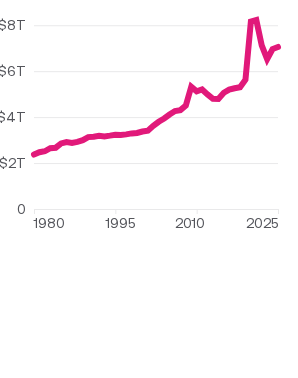
These day-to-day operations are managed by the Chief Usher’s office and funded by Congress through the Executive Office of the President (EOP). The EOP requested $16 million (about 0.00024% of the $6.8 trillion spent by the federal government that year) from Congress for Executive Residence operations and infrastructure in FY 2024.
One-time renovation projects can be difficult to trace across decades — they’re often folded into larger budget reporting — but routine maintenance spending has been reported in the federal budget for nearly a century.

Even accounting for inflation, those costs have steadily grown. Part of this may be due to a shift in what’s included in the maintenance budget: around the 1960s, the maintenance budget started to include non-structural elements, such as official entertainment costs associated with hosting events inside the Executive Residence. According to the latest audit from the Government Accountability Office, these costs typically make up around two percent of the maintenance budget.
Most of the Executive Residence budget goes to the people who keep it running — the ushers, electricians, plumbers, and housekeeping staff. Salaries and benefits account for about $12 million, or around two-thirds of total spending, while the rest covers supplies, repairs, and utilities.
A quick data note
For the analysis of individual projects, the USAFacts team focused on the types of major White House renovations that are most often referenced by presidential administrations and discussed in the media. This isn't a complete list of every renovation over the past century, but it reflects the projects where cost information is most commonly available and discussed.
As a general rule, the team only included costs that can be traced back to official government records. When those records weren't available, costs are listed as unknown, even if estimates have appeared in news coverage.
That also means this page can grow over time. If you know of official government records for renovations or costs that aren't included here, the team at USAFacts would love to take a look. Please send sources to [email protected].

Keep exploring visualizations
- The Supreme Court has had 116 justices. Here's who put them there. - An analysis of Supreme Court confirmations across US history shows how the power to shape the court has been distributed among presidents.
- Who shows up to the midterms? - Voter turnout in the last two midterm elections has been higher compared to midterms in the past four decades.
- More voters are registering outside the two party system - We mapped voter registration in every state that tracks party affiliation. In three out of four counties, the share of voters registered outside the two major parties grew over the past decade.
- What foods are Americans putting in their shopping carts? - The average American doesn't buy enough fruits, vegetables, or dairy to meet dietary guidelines.

