US-Canada trade history in six charts
Tariff increases by the US and Canada in 2026 have intensified trade tensions between two of North America's largest trading partners.
2026 has been a year of economic tensions and new tariffs between the United States and Canada. The Trump administration announced the latest tariffs in July, 50% on some Canadian goods.
In a statement on its website, the White House said the tariffs were in response to Canadian trade practices related to US auto, alcohol, and dairy exporters. The tariffs took effect on August 22, 2026.
On August 25, Canada responded by imposing 15%, 20%, and 50% tariff rates on certain US goods, effective September 8.
So, is the US in a trade war with Canada? Here’s how much the US and Canada have previously traded, what flows across the border in each direction, and how tariff collection has changed during this administration.
Canada is the nation’s second-largest trading partner
In 2025, the US traded $879.9 billion in goods and services with Canada. Around $454 billion of that was in goods and services imported from Canada. Around $426 billion were in goods the US sent north.
In 2025, the US traded $879.9 billion in goods and services with Canada.
Total trade value (imports + exports) with the US (2025), by select countries
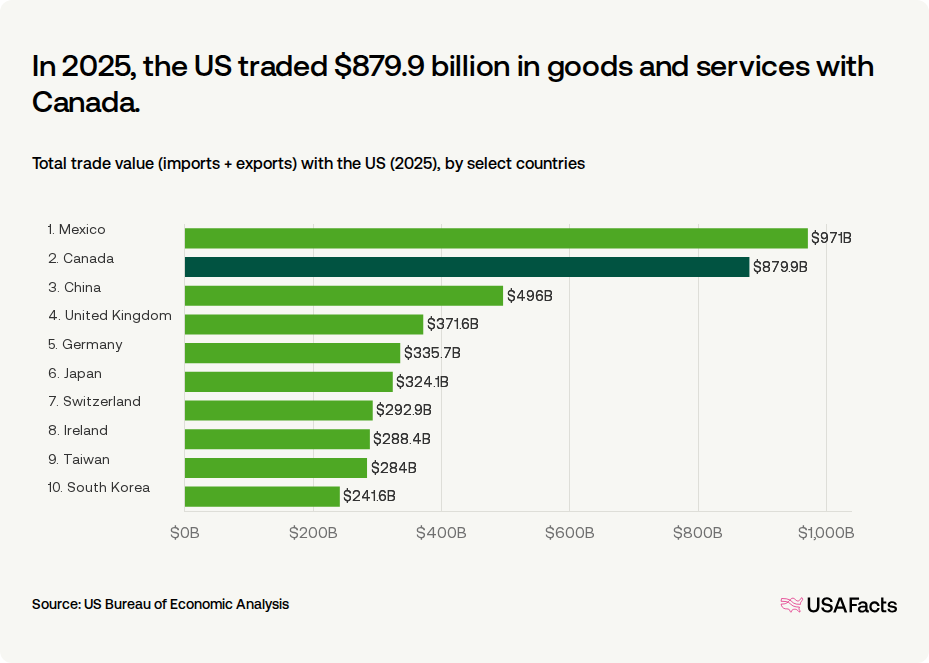
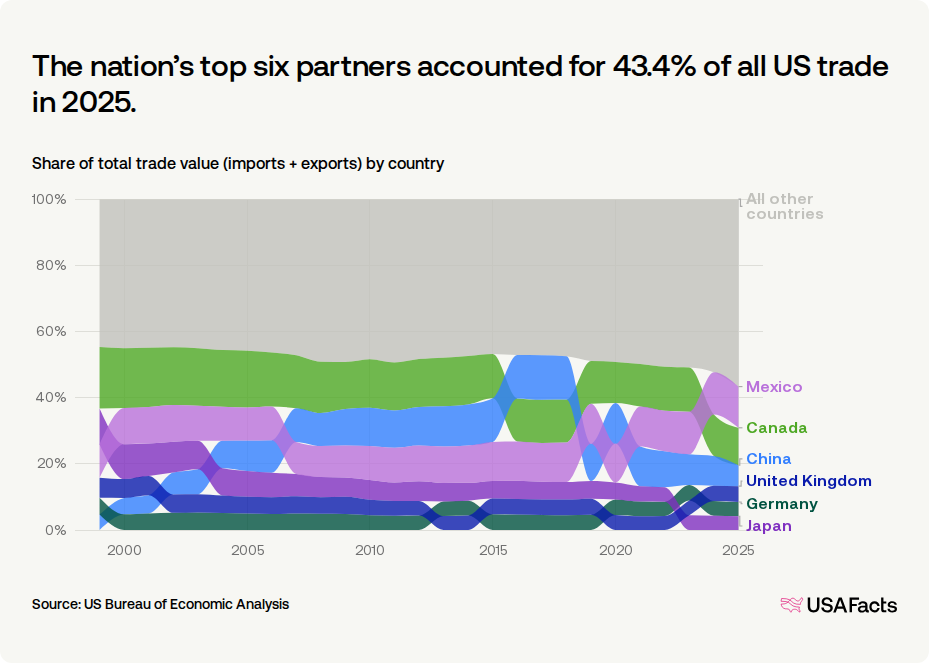
Canada has been the United States largest or second-largest trading partner since 2000.
Canada has historically been the US' top or second trading partner.
Share of total trade value (imports + exports) by country
US-Canada trade balance and deficit
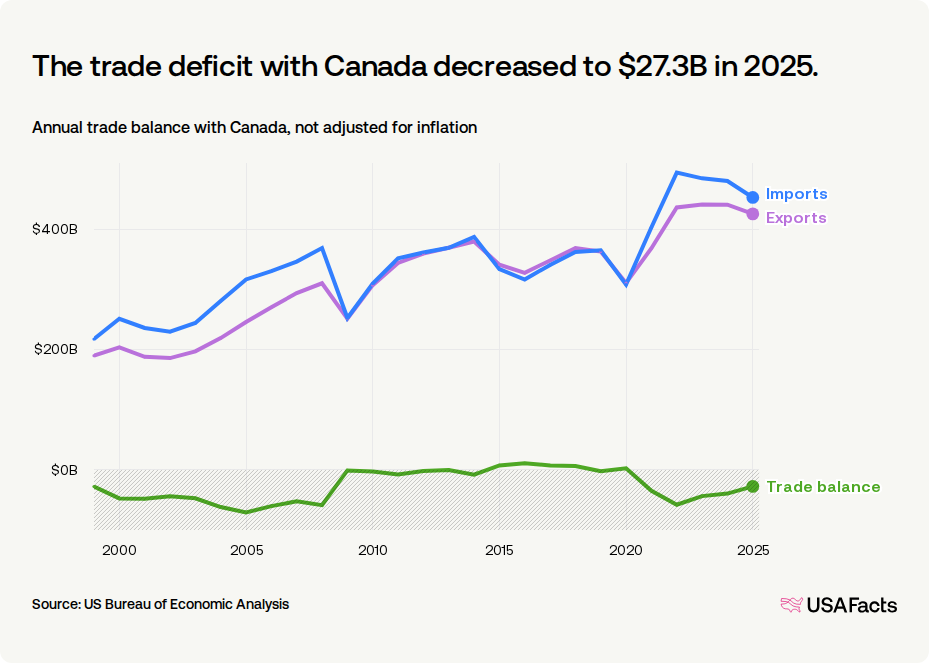
The trade balance between the two countries has historically run in Canada’s favor, meaning the US imports more from Canada than it exports there.
If a nation imports more than it exports, it’s called a “trade deficit.” If it exports more than it imports, it’s a “trade surplus.” Neither is inherently good or bad; trade balance is just a metric that shows the relationship between imports and exports.
Get weekly insights
Subscribe for data-driven insights. No spin, just the facts.
The US trade deficit with Canada has decreased each year since 2022, falling to $27.3 billion in 2025.
The trade deficit with Canada decreased to $27.3B in 2025.
Annual trade balance with Canada, not adjusted for inflation
What does the US import from Canada?
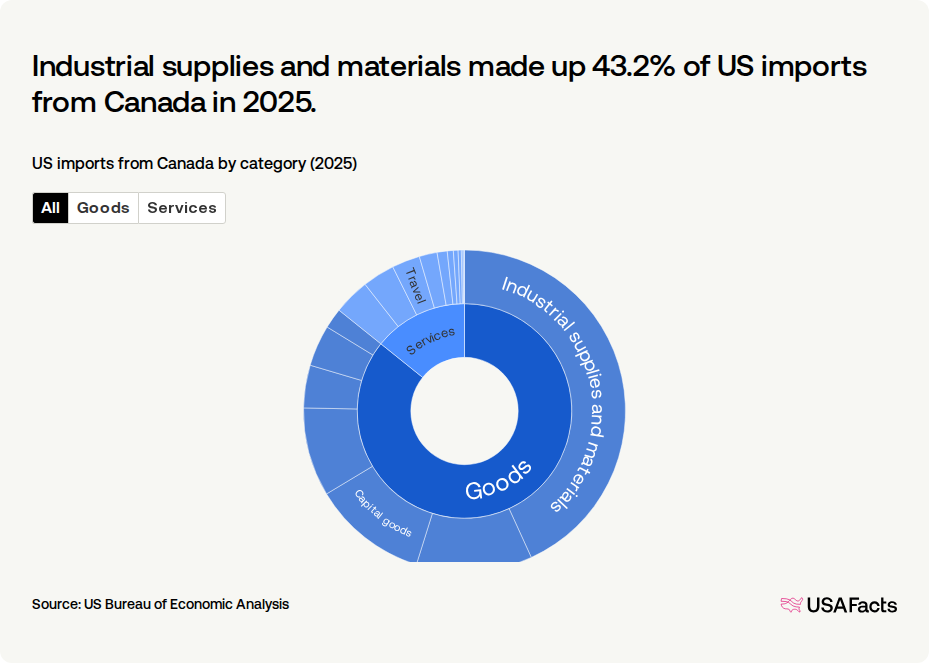
In 2025, 85.8% of US imports from Canada were goods. The largest category was industrial supplies and materials, which include oil, chemicals, plastics and other items used in the production processes. These imports totaled $195.9 billion.
The other two largest categories were automotive vehicles & parts and capital goods, such as machinery and equipment used in production. Together, these three categories accounted for $301.1 billion in total Canadian imports.
The remaining 14.2% of imports were services. Telecommunications and information services was the largest service category, accounting for $16.5 billion.
Industrial supplies and materials made up 43.2% of US imports from Canada in 2025.
US imports from Canada by category (2025)
What does the US export to Canada?
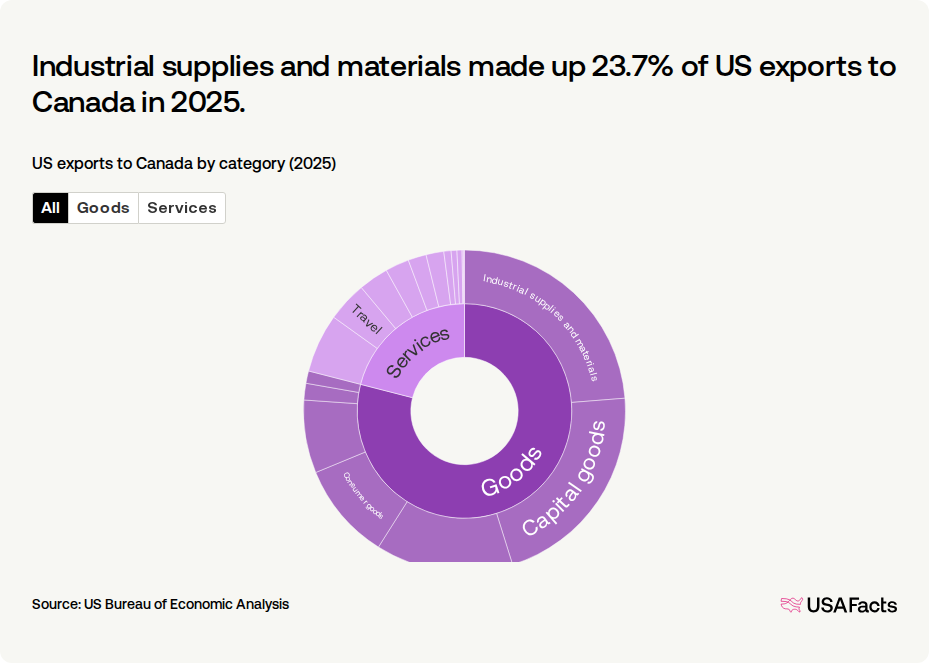
In 2025, 78.4% of US exports to Canada were goods. Most of these were industrial supplies and materials, accounting for $96.9 billion. The other top categories were capital goods and automotive vehicles & parts. Combined, all three categories accounted for $245.9 billion of exports to Canada.
The remaining 21.6% of exports were services, with business services as the largest category. Business services, which include research and development, consulting, and technology services, accounted for $26.6 billion.
Industrial supplies and materials made up 22.7% of US exports to Canada in 2025.
US exports to Canada by category (2025)
Do the US and Canada have a trade deal?
Yes. The US and Canada are part of the United States-Mexico-Canada Agreement (USMCA), which is a free trade agreement between the three countries that sets many tariffs between them at zero. The objective of free trade agreements are to:
- Reduce trade barriers like tariffs. This lowers the cost of imports, keeping prices lower, and giving consumers more purchase options.
- Protect intellectual property rights of domestic producers. Limiting competitive opportunities on proprietary products preserves access to international markets for domestic industries.
- Develop product and labor practice standards across markets. This protects consumers by ensuring that imported products are safe and meet the same kinds of standards as their domestic alternatives.
- Protect against exclusionary rules around investing or participating in financial markets.
In July 2026, the US declined to renew the agreement in its current form. However, that does not mean that the US has pulled out of the agreement; it means that the agreement will expire in 2036 unless all three countries agree to extend it (with or without changes to its terms).
The US trade deficit with Canada has decreased each year since 2022, falling to $27.3 billion in 2025.
What is a tariff, and who pays for it?
What is a tariff? Tariffs, sometimes called duties or customs duties, are taxes on goods traded between nations. When goods cross the US border, Customs and Border Protection collect tariffs based on the type of goods, their quantity, and their country of origin.
Who issues tariffs? Article 1 of the Constitution gives Congress the power to impose tariffs on imports and regulate foreign commerce.
The Trump administration used the International Emergency Economic Powers Act (IEEPA) to impose a series of tariffs against Canada, Mexico, and China in 2025. The Supreme Court struck down these tariffs in February 2026, stating that IEEPA does not give the president authority to impose such tariffs.
President Trump has said he has issued these most recent tariffs using powers in Section 338 of the Tariff Act of 1930 (19 U.S.C. § 1338) which gives the president the power to penalize foreign countries that treat American commerce unfairly.
Who pays for tariffs? Formally, a tariff is a tax on the US-based company or individual bringing the goods into the country. That importer pays the tariff to Customs and Border Protection, generally within 10 days of the goods crossing the border. When tariffs rise, American importers, not foreign exporters, owe the additional payment. It is not a tax on the foreign exporter or the foreign government.
Economically, though, importers don’t shoulder all these costs. Bureau of Labor Statistics research shows tariff costs are often passed through the supply chain, raising domestic prices and shifting at least part of the burden onto US consumers.
Why do countries use tariffs? Countries use tariffs as a tool to influence international trade. By raising the cost of imported goods, tariffs can push buyers toward domestic alternatives, which can support local industries. Tariffs are also used for political leverage: governments may raise or lower them to pressure rivals or respond to other countries’ tariffs and sanctions. While tariffs do generate government revenue, developed economies such as that of the United States typically use them more as a foreign-policy tool than as a primary revenue source.
How much revenue does the US generate from tariffs?
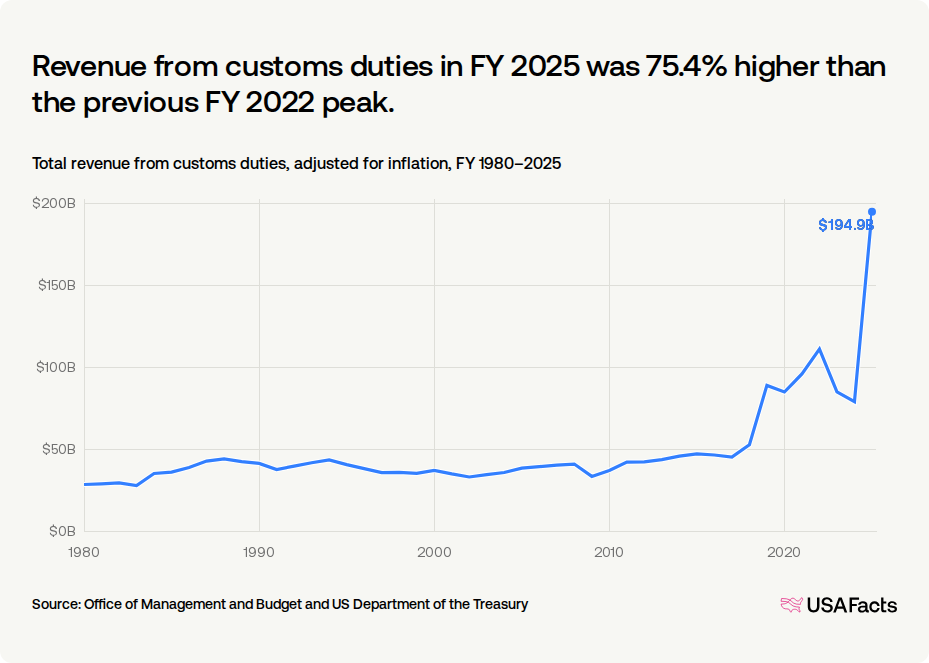
In FY 2025, the federal government collected $194.9 billion in revenue from tariffs. So far in FY 2026 (through July), the federal government has collected $154.4 billion.
In 2025, the Trump administration announced new or increased tariffs on imports from certain countries, contributing to higher customs duties collected by the federal government. These tariffs were on a broad range of imported goods, including those from China, Canada, Mexico, and the European Union.
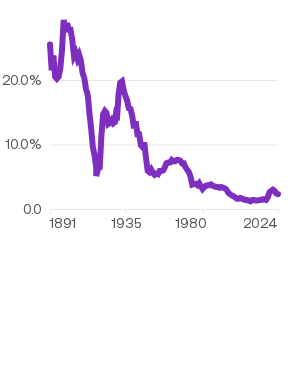
Customs duties were 3.7% of federal revenue in FY 2025.
Revenue from customs duties in FY 2025 was 75.4% higher than the previous FY 2022 peak.
Total revenue from customs duties, adjusted for inflation, FY 1980–2025
Where does this data come from?
Where does this data come from?
The trade data in this article comes from the Bureau of Economic Analysis, specifically Table 1.5, "US International Trade in Goods and Services by Area and Country." The Bureau of Economic Analysis's international economic accounts provide information on US exports and imports, foreign direct investment in the US, and the value of US international assets and liabilities.
Data related to tariffs and customs duties is from the Office of Management and Budget and the Department of the Treasury. The Office of Management and Budget (OMB) releases the President's budget annually. It outlines the executive branch's budget proposal and historical revenue, spending, deficit, and surplus data. The Department of the Treasury provides timely estimates of the financial activities of the federal government through the Monthly Treasury Statement. USAFacts recategorizes some of the OMB and Treasury Department data to align with net expenditures accounting practices and to group federal spending according to its purpose.
Get the latest trade data delivered to your inbox weekly by signing up for our newsletter.

Keep exploring
- What are tariffs and how do they work? - Tariffs are taxes paid by firms importing goods internationally. They are used as a tool to control global trade.
- What is the average US tariff rate overall?
- What are free trade agreements and how do they affect trade? - The US has 14 agreements covering trade with 20 countries.
- What are the top US exports to China? - Soybeans were the nation’s top export to China in 2022, making up 11.6% of overall export value.

