Of the 116 people who have served on the US Supreme Court, none were elected.
Justices are nominated by a president, confirmed by the Senate, and can serve for life. Lifetime tenure was written into the Constitution to insulate justices from the political pressures that shape the Legislative and Executive branches. There’s no periodic reconfirmation and no mechanism for voters to remove a justice, so they can rule impartially.
But the people who nominate and confirm them are elected officials, with their own political party affiliations. And while a president might never get the chance to nominate a justice, another might make enough nominations to shape the court for decades.
Nearly 70% of Supreme Court justices confirmed in the past 50 years were nominated by a Republican president. That hasn't always been the case.
Tenure of Supreme Court justices from confirmation date to departure, by party of the nominating president
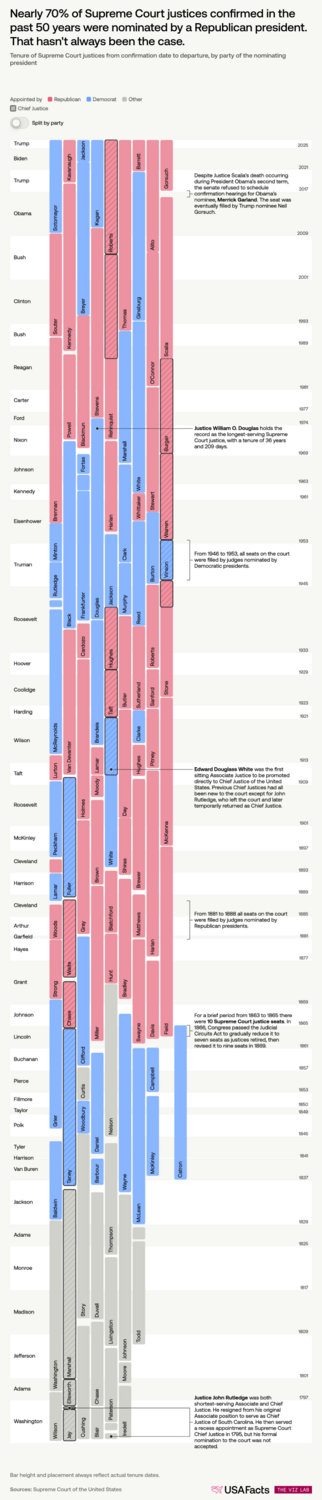
The balance of the Supreme Court has shifted throughout history
The Supreme Court has had nine seats since 1869, enough to guarantee a majority on any decision and never enough for a tie.
Republican-appointed justices made up a majority of the Supreme Court for around eight of every ten years since reaching its current size
Justice distribution by party composition of nominating president, 1869–2026
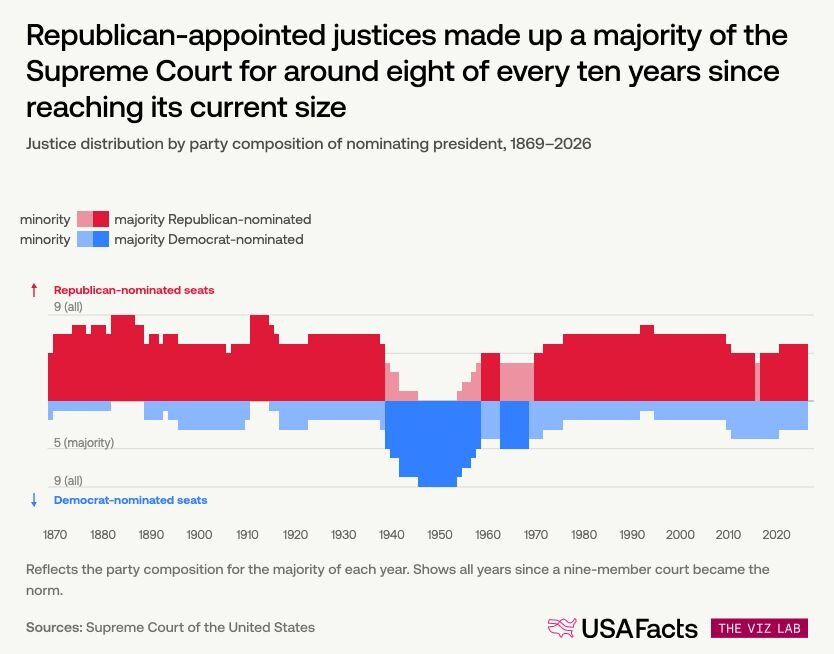
The split between Republican- and Democratic-nominated justices has never stayed fixed for long. Franklin Roosevelt appointed nine justices over his 12 years in office, and by the end of World War II every seat had been filled with a nominee by a Democratic president.
Democratic dominance eroded through the Eisenhower years, and from Nixon through George W. Bush, Republican presidents filled eleven of thirteen vacancies. Since Justice Amy Coney Barrett's 2020 confirmation, Republican-nominated judges have held six of the nine seats.
Some presidents have shaped the Supreme Court more than others
A president's influence on the Supreme Court depends less on how long they serve than on how many vacancies open during their time in office. Justices don't retire on a schedule and vacancies are unpredictable. Some presidents wait years to nominate a justice; others get to nominate several in a single term.
After a nomination, the candidate must be approved by the Senate. Since 1869, presidents have nominated 99 candidates for the Court. Around eight in ten were confirmed and served on the court, but the Senate has denied seven outright, and others were withdrawn or left without a hearing.
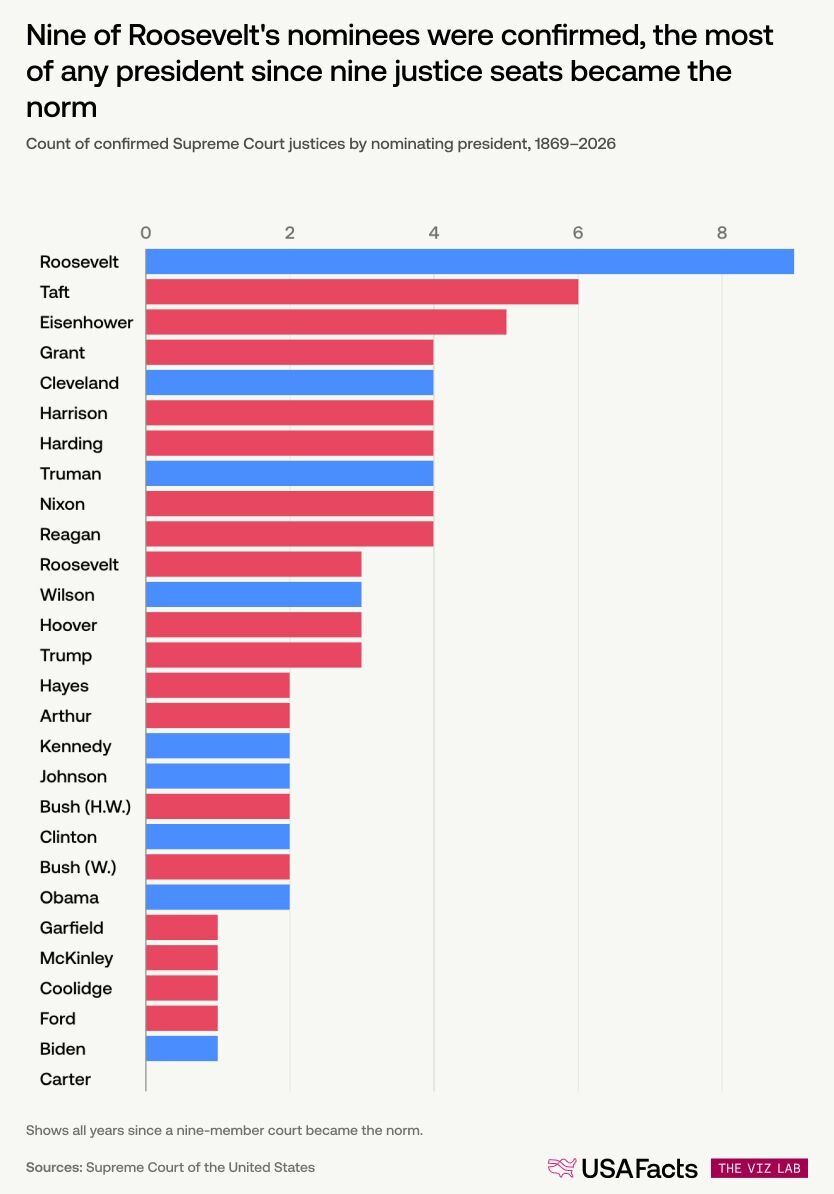
Franklin Roosevelt nominated eight new justices and elevated a ninth — Harlan Fiske Stone — to Chief Justice in a separate nomination and Senate confirmation to install the Supreme Court's presiding member. No president since George Washington has shaped the bench more.
Jimmy Carter served a full four-year term without a single vacancy, the only president with zero nomination opportunities since Zachary Taylor died in office in 1850.

