How much is spent on personal healthcare in the US?
National spending on personal healthcare per person has increased 1,306% since 1980 — over three times faster than inflation. More than $4.5 trillion total was spent in 2024.
Between the money spent by private insurance, Medicare and Medicaid, and people making out-of-pocket payments, America spent a total of $4.5 trillion on personal healthcare in 2024, according to the Centers for Medicare and Medicaid Services (CMS).
Private insurance was the largest funding source for personal healthcare in 2024.
Share of personal healthcare expenditures by source of funds, 2024

The Centers for Disease Control and Prevention (CDC) defines “personal healthcare” as the goods and services for patients — think prescription drugs, dentistry, and hospital care. The CDC calculates expenditures by adding national health spending from all sources and then subtracting the cost of investment (in research and equipment, for example), health insurance administration, and public health programs.
What’s the per-person cost of personal healthcare?
In 2020, per capita personal healthcare spending varied widely by age: overall per-person spending for people 65 and up was $22,356, five times higher than spending for a child ($4,217) and more than double that for under-65 adults ($9,154).
How has personal healthcare spending increased over the years?
Personal healthcare spending went from $943 per person in 1980 to $13,265 in 2024 – a 1,306% increase. By comparison, consumer prices in general went up 281% during this period. Even after adjusting $943 for inflation ($3,590 in 2024 dollars), per-person spending more than tripled by 2024.
This shows that general inflation does not fully explain the increase in healthcare spending. There are specific trends that could contribute to healthcare spending to increase faster than inflation, including:
- Advances in medical technology
- Demographic changes (particularly an aging population)
- Changes in how people use and access healthcare
- Price increases for healthcare-related goods and services
Inflation-adjusted per person healthcare spending was 3.7x higher in 2024 vs. 1980.
Per capita personal healthcare spending, 1980–2024

Where are most healthcare dollars spent?
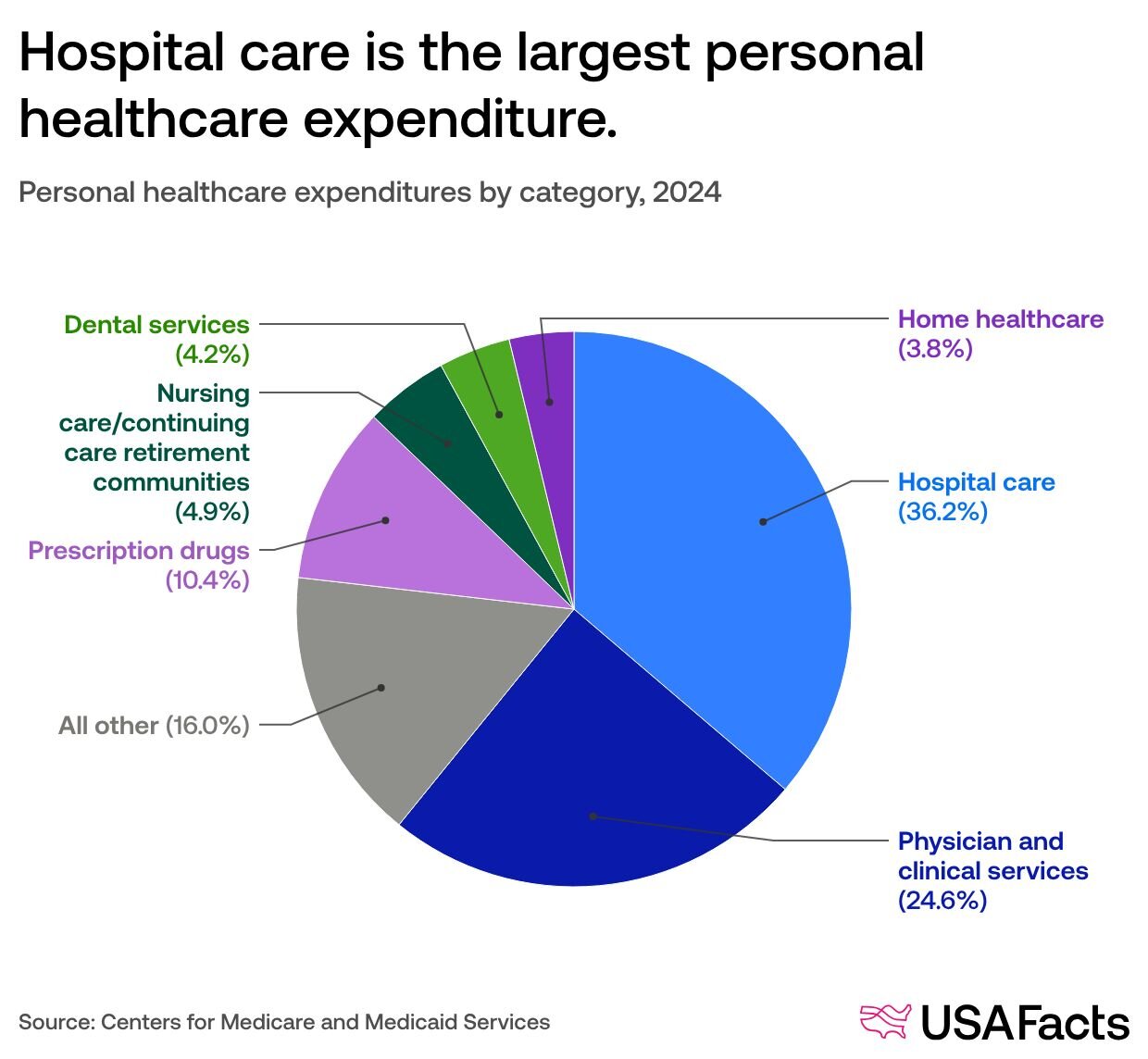
Hospital care has been the largest category of personal healthcare spending since CMS began collecting this data in 1960. In 2024, it totaled $1.6 trillion, or 36.2% of all personal healthcare spending, which was a consistent share of spending compared with the 2010s.
Hospital care is the largest personal healthcare expenditure.
Personal healthcare expenditures by category, 2024
Which category’s spending has increased the most over time? The least?
Home healthcare had the biggest increase between 1980 and 2024. Spending rose more than 1,771%, from $9.1 billion (adjusted for inflation) to $169.4 billion. Dental services increased the least, growing 273% from $50.7 billion to $189.2 billion.
When accounting for both population change and inflation, home healthcare spending still grew 1,150% and dental services 149.2%.
169.4B
Includes in‑home services such as injections, education for patients and caregivers, and surgical wound care.
$189.2B
Covers services provided in facilities run by licensed dental doctors (D.M.D., D.D.S., or D.D.Sc.).
$1.63T
Includes all services that hospitals provide to patients.
$1.11T
Covers services provided by doctors in outpatient centers, laboratories, and clinics.
Dig into data on ACA subsidies, which states have the highest cancer rates, and get the data directly in your inbox by signing up for our email newsletter.

Keep exploring
- How will the One Big Beautiful Bill Act impact Medicaid? - Work requirements and changes to state funding mechanisms are expected to impact federal Medicaid spending the most.
- Which states spend the most on healthcare? - On average, states spent $10,191 per person on goods and services directly related to patient care in 2020. New York, Alaska, and Massachusetts spent the most.
- Who has health insurance? Are rates going up? - Young adults ages 19 to 25 are the most likely to be uninsured of any age group: 14.3% of them were uninsured in 2024.
- Does access to healthcare differ by race and ethnicity? - Adults in four groups — American Indian and Alaska Native, Black, Native Hawaiian or other Pacific Islander, and Hispanic — report higher rates of fair or poor health than the national average.
