Discretionary spending definition
Discretionary spending funds federal agency operations and programs, with Congress setting funding levels each year through appropriations.
Discretionary spending is the part of the federal budget that pays for government operations and the programs agencies run. It is roughly one-quarter of all federal spending, and it funds programs and activities such as national defense, veterans' health care, and national parks. Congress sets those amounts each year in appropriation acts, the laws that give agencies money to spend.
Discretionary funding usually covers a single fiscal year, which runs from October 1 to September 30.
What is the difference between mandatory and discretionary spending?
Mandatory spending levels are determined by congressional rules. A law sets who qualifies for a benefit and how much they get, and the government pays everyone who meets those rules. Congress never votes on a total. Social Security, Medicare, and Medicaid work this way.
Discretionary spending levels are determined by an annual vote in Congress. Congress writes a specific dollar amount into an appropriation act, and the agency cannot spend more than that.
To change mandatory spending, Congress has to change the law behind the benefit. To change discretionary spending, it writes a different number as part of the annual budget process.
How does Congress set discretionary spending?
The process starts with the president, who is obligated to send Congress a budget request the first Monday in February. From there, the House and Senate Appropriations Committees write the legislation that actually provides the money, splitting the work across 12 parallel subcommittees. Each subcommittee handles one of the 12 regular appropriations bills Congress passes each year.
Congress rarely passes all 12 bills on time. Since fiscal year 1977, every regular appropriations act has been enacted before the fiscal year began only four times, most recently for fiscal year 1997. When the bills are late, Congress can pass a continuing resolution, which funds agencies temporarily, often at the previous year's levels.
If neither a regular appropriations act nor a continuing resolution is in place, a funding gap occurs. Federal law then bars agencies from spending money that has not been appropriated, so they must stop most operations until Congress acts.
How much of federal spending is discretionary?
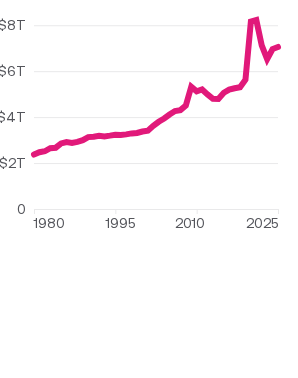
Discretionary spending accounted for $1.9 trillion of the $7.0 trillion in total federal spending for fiscal year 2025. Defense accounted for $893 billion of that, and nondefense programs for $980 billion. Almost all defense spending is discretionary.
As a share of all federal outlays, discretionary spending has decreased from 60% in the early 1970s to about 30% in recent years.

Keep exploring
- How does the government budget process work? - Congress hasn't passed a full budget on time since 1997. How is the government getting funded?
- What are congressional appropriations (spending) bills and how are they approved? - Appropriation bills are proposed laws, put forth by 12 subcommittees, that authorize different government agencies to spend money.
- How much does the US federal government spend?
- How much of the federal budget is mandatory spending? - In fiscal year 2023, around 60% of federal spending was mandatory spending.

