Is the US population growing or shrinking?
Refreshed annually
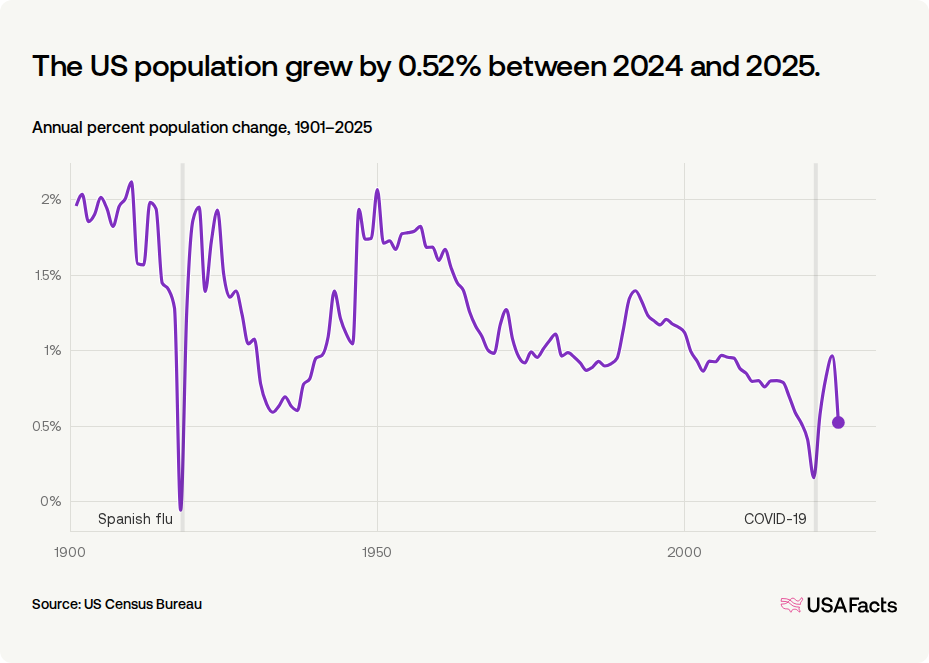
It grew by 1.78 million people between 2024 and 2025, a 0.52% increase. That’s more than the population of Phoenix, Arizona. Between 2015 and 2025, it grew by 6.2%. Changes in population reflect things like shifting birth and death rates, immigration patterns, and even the overall health of the economy. The recent 0.52% increase was primarily driven by immigration to the US.
+1.78M
population change (2024 to 2025)
+0.52%
percent change in population (2024 to 2025)
The US population has grown every year since 1900 except one. Between 1917 and 1918, a spate of Spanish flu deaths led to a 60,000-person drop.
Get weekly insights
Subscribe for data-driven insights. No spin, just the facts.
The recent 1.78 million-person increase has been the 22nd largest population increase of the 21st century and was 3.4 times larger than the population change during the COVID-19 pandemic, when the population grew by 522,000 between 2020 and 2021.
The US population gained 1.78 million people between 2024 and 2025, the 22nd largest population increase in the 21st century.
Annual population change, 1901–2025
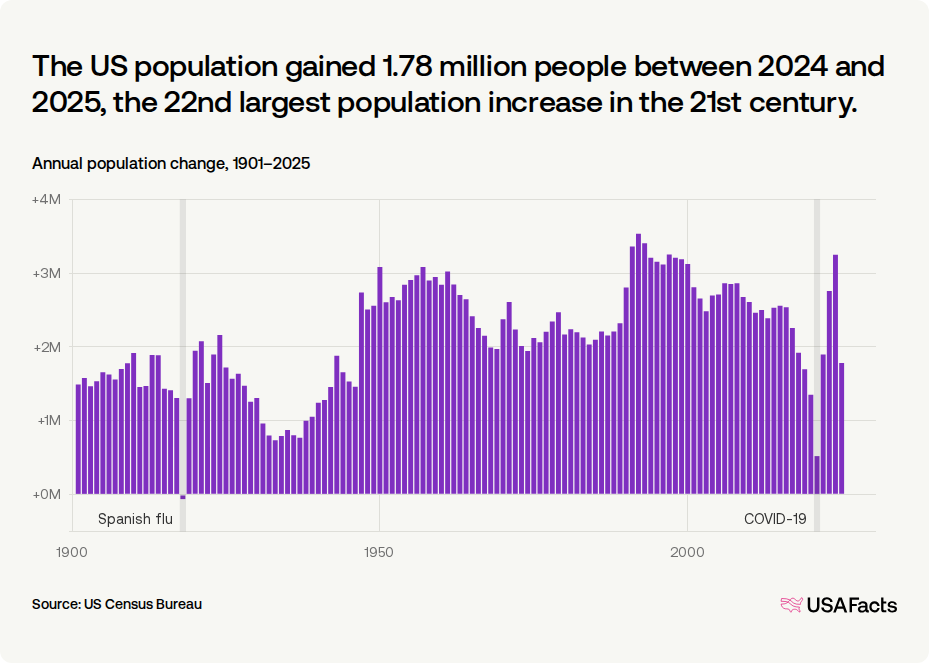
Since 2000, the US population has grown 21.1 percent, an average increase of 0.85 percent per year. The 2000-2001 change was the highest annual increase during those years.
The US population grew by 0.52% between 2024 and 2025.
Annual percent population change, 1901–2025
What factors contribute to population growth?
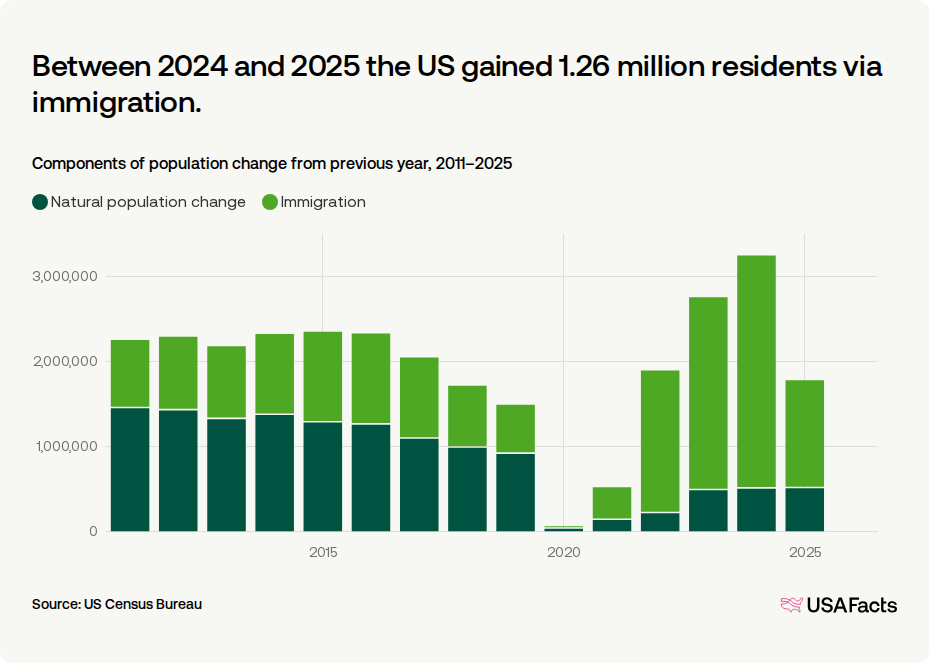
The US population is influenced by two factors:- Natural population change: If births outnumber deaths in a given year, natural population growth is positive. If deaths exceed births, it’s negative. Between 2024 and 2025, births exceeded deaths in the US by 518,900.
- Immigration: If more people move to the US than move out, population change from immigration is positive. If more people move out than in, it’s negative. Between 2024 and 2025, 1.26 million more people moved into the US than out.
Prior to the COVID-19 pandemic, natural population change drove most of the nation’s growth. Since 2020, immigration has been the primary driver of population growth.
Between 2024 and 2025 the US gained 1.26 million residents via immigration.
Components of population change from previous year, 2011–2025
Which states have the highest population growth?
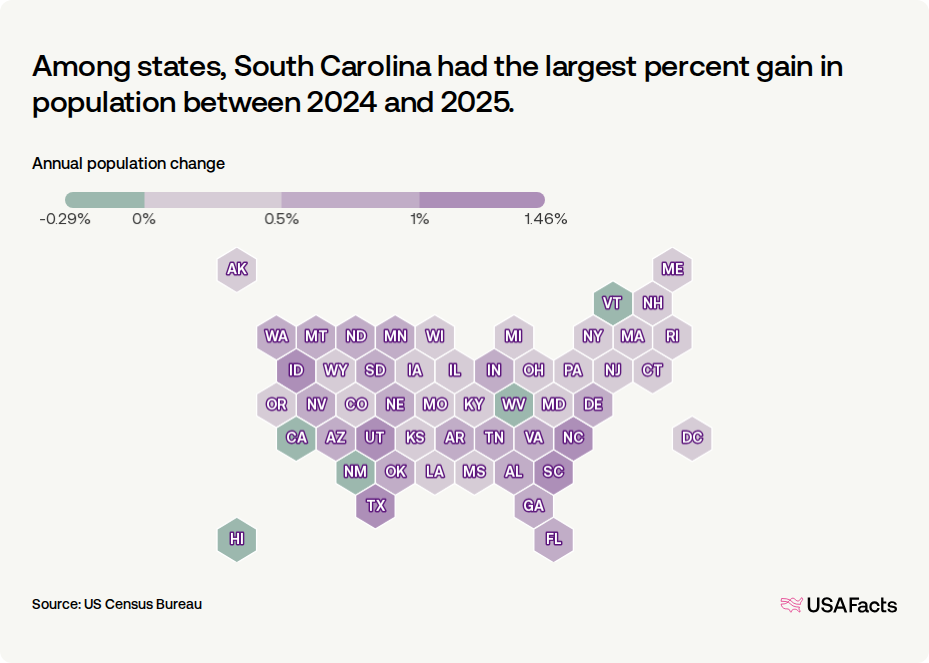
Unlike the nation as a whole, state populations can change three ways: births and deaths, international immigration, and domestic state-to-state migration.From 2024 to 2025 South Carolina had the largest percent gain and 1.5%. Vermont ranked last, with a 0.29% decline.
In terms of overall numbers, Texas gained the most residents with 391,200 followed by Florida with 196,700 and North Carolina with 145,900. Five states — West Virginia, New Mexico, Vermont, Hawaii, and California — lost population. California’s loss of 9,500 residents was the most of any state.
Among states, South Carolina had the largest percent gain in population between 2024 and 2025.
Annual population change
Between 2015 and 2025, the US population has increased by 6.2%. According to the US Census Bureau’s International Database, the world’s global population grew by 10.1% over that same period.
Population change between 2024 and 2025, by state
| State | Population change rate | |
|---|---|---|
| 1. | South Carolina | 1.5% |
| 2. | Idaho | 1.4% |
| 3. | North Carolina | 1.3% |
| 4. | Texas | 1.2% |
| 5. | Utah | 1% |
| 6. | Delaware | 0.94% |
| 7. | Washington state | 0.92% |
| 8. | Arizona | 0.89% |
| 9. | Nevada | 0.88% |
| 10. | Tennessee | 0.88% |
How is the US population changing?
Keep exploring

Methodology
USAFacts standardizes data, in areas such as time and demographics, to make it easier to understand and compare.
Page sources
USAFacts endeavors to share the most up-to-date information available. We sourced the data on this page directly from government agencies; however, the intervals at which agencies publish updated data vary.
