How many people are laid off in the each month?

Updated May. 12, 2026Refreshed monthly
About 1.87 million in March 2026. This includes all terminations of employment by an employer — called layoffs and discharges — such as permanent layoffs, temporary layoffs, and terminations because of mergers, downsizing, closings, or employee performance.

1.87M

people were laid off or discharged in March 2026

5.24M

layoffs and discharges in 2026 so far
Layoffs are a constant in the US labor market — from 2001 to 2019, there were more than 20 million a year. Increases in layoffs often reflect recessions or other economic disruption. For example, March and April 2020 saw record-setting layoffs and discharges because of COVID-19. So far in 2026 (January through March), layoffs and discharges total 5.24 million, which is 0.79% higher than the same period in 2025.

Layoffs were 0.79% higher by March 2026 than by March 2025.

Cumulative monthly layoffs and discharges, seasonally adjusted

Ask the data
Beta

We use AI to summarize the data, charts, and analysis we have on USAFacts

What is the layoff and discharge rate?

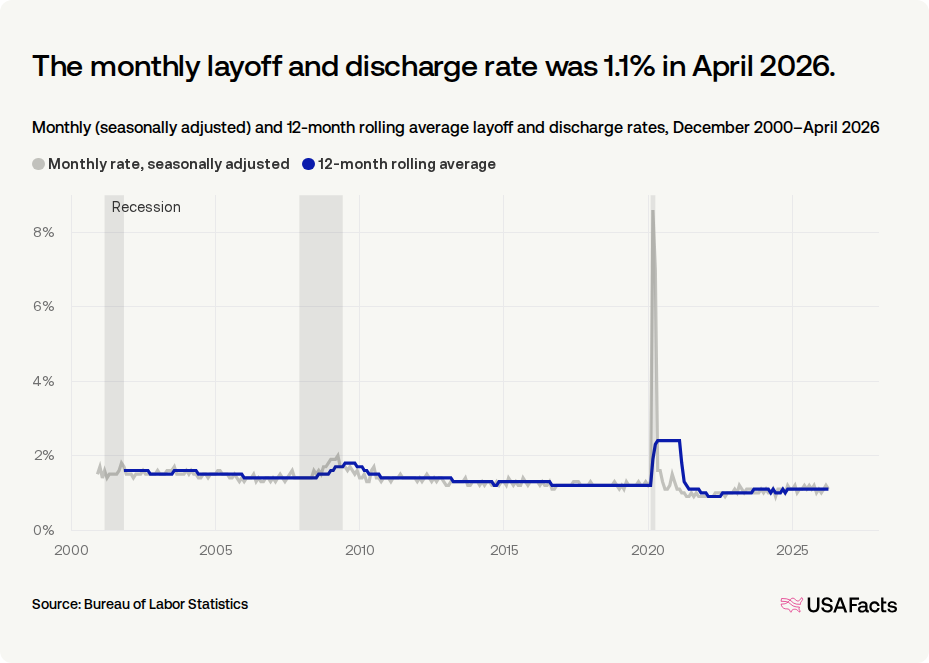
Another way to consider this data is to look at the layoff and discharge rate. This puts layoffs in the context of the total number of people working and shows the percentage of employed people laid off during the given time period. This rate allows for better comparisons across time, industries, and places by adjusting for differences in the size of the working population.
In March 2026, 1.2% of employed people were laid off or discharged. This was higher than the average over the previous 12 months (1.1%).

The monthly layoff and discharge rate was 1.2% in March 2026.

Monthly (seasonally adjusted) and 12-month rolling average layoff and discharge rates, December 2000–March 2026

A 12-month rolling average smooths out short-term fluctuations and clarifies long-term trends. Aside from a recession-related uptick in 2008 and 2009, the 12-month rolling average layoff rate trended downward from 1.6% in 2001 to 1.2% immediately prior to the COVID-19 pandemic. It reached a record high of 2.4% in 2020 from pandemic-related layoffs before falling to a record low 0.9% in 2021 and 2022. The rate was 1.1% for January–December 2025.

What industries have the highest and lowest layoff rates?

The layoff and discharge rate varies across industries, which experience different economic pressures and are dependent on different types of workers or technologies. In March 2026, the rate was highest in the information industry (2.4%) and was lowest in government (0.3%).

The layoff and discharge rate was highest in the information and professional services industry in March 2026.

March 2026 (seasonally adjusted) and March 2023–February 2026 average average layoff and discharge rates, by industry
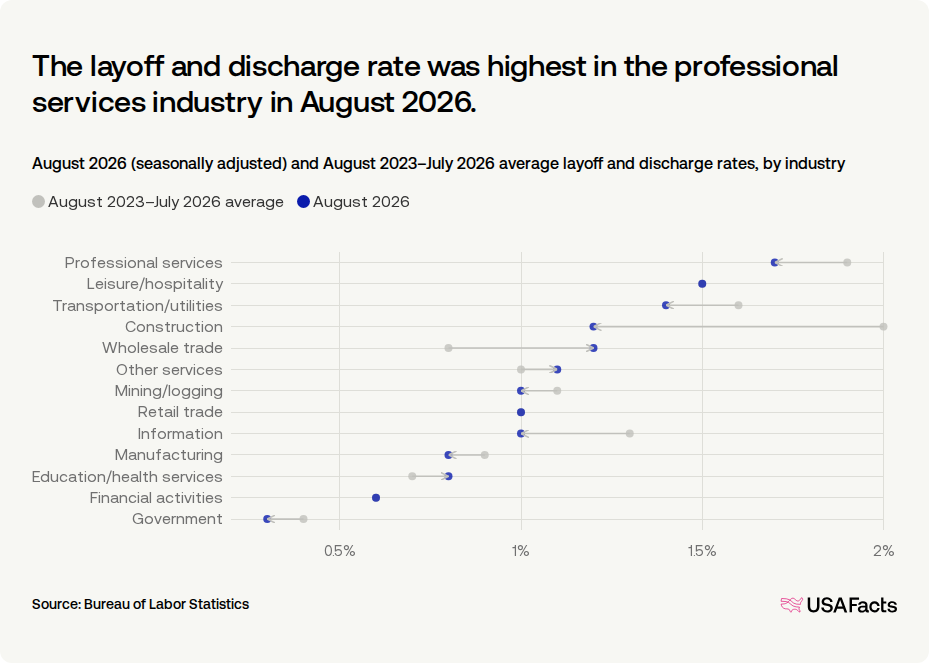
The March 2026 layoff and discharge rates in construction; financial activities; government; manufacturing; and mining and logging were all lower than the three-year average (March 2023–February 2026) in each. Rates exceeded the 3-year average in the information; leisure and hospitality; other services; professional and business services; retail trade; transportation, warehousing, and utilities; and wholesale trade industries.

What states have the highest and lowest layoff rates?

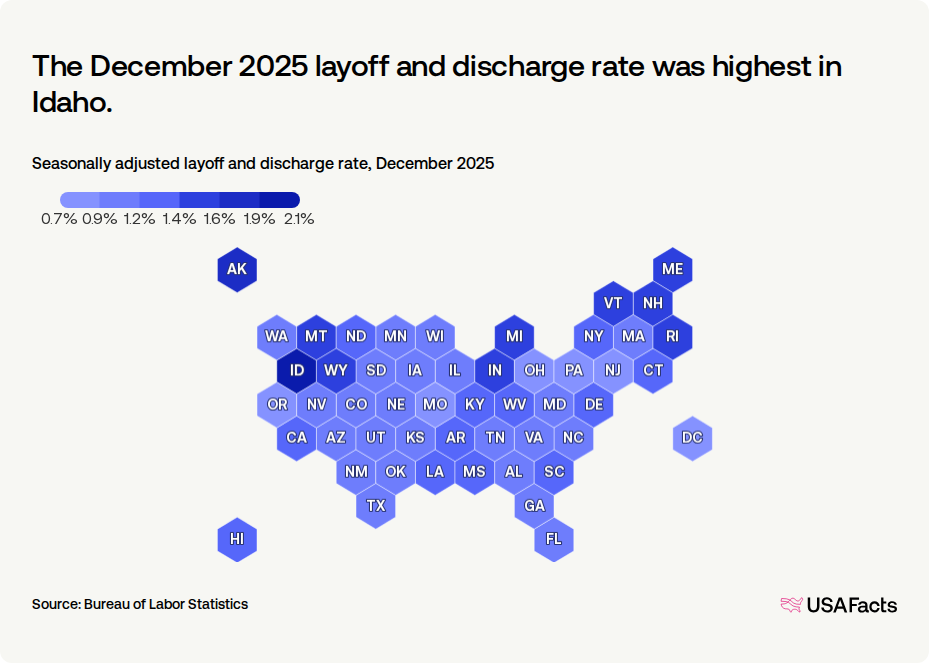
Layoffs and discharges also differ across states for many reasons, including the economic vitality and the industry profile of the region. In December 2025, rates ranged from 0.7% in Washington, DC to 2.1% in Idaho. Layoffs and discharges data for states were released monthly through February 2026. At that time, BLS released December 2025 data and stated that state-level data would shift to annual release, to be published in July of each year.

The December 2025 layoff and discharge rate was highest in Idaho.

Seasonally adjusted layoff and discharge rate, December 2025

Layoff and discharge rate, by state (December 2025)

Layoff and discharge rate, by state (December 2025)
1.

Idaho 

2.1%
2.

Alaska 

1.8%
3.

Indiana 

1.6%
4.

New Hampshire

1.6%
5.

Vermont 

1.6%
6.

Montana 

1.5%
7.

Maine 

1.4%
8.

Michigan 

1.4%
9.

Rhode Island

1.4%
10.

Wyoming 

1.4%

Keep exploring

Methodology

USAFacts standardizes data, in areas such as time and demographics, to make it easier to understand and compare.

The analysis was generated with the help of AI and reviewed by USAFacts for accuracy.

Page sources

USAFacts endeavors to share the most up-to-date information available. We sourced the data on this page directly from government agencies; however, the intervals at which agencies publish updated data vary.