In September 2026, about 29,000 jobs were gained. That's below the monthly average of 187,900 new jobs of the previous five years. This data comes from the Bureau of Labor Statistics' monthly Employment Situation Report, aka the “jobs report,” a closely watched economic indicator. These figures are often revised in later months as more complete data rolls in.
+29K
month to month change in number of jobs (September 2026)
+188K
average monthly change in number of jobs during the previous five years (October 2021–September 2026)
The monthly jobs number grabs attention but doesn’t tell the whole story; job growth might be strong overall yet uneven across industries or regions. The real changes show up in the detail.
Which parts of the economy had the best job growth in September 2026?
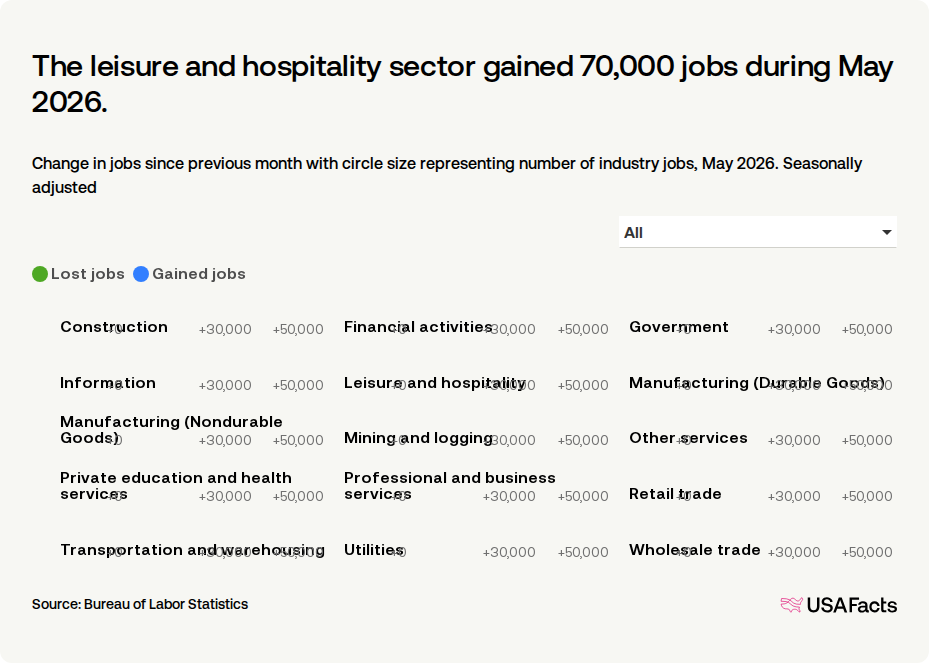
The three supersectors with the highest job growth in September 2026 were private education and health services, trade, transportation, and utilities, and construction. Private education and health services gained 20,000 jobs, while trade, transportation, and utilities added 18,000 and construction added 11,000. The remaining supersectors either posted smaller gains or lost jobs during the month.
The three lowest-performing supersectors were government, information, and professional and business services. In September 2026, government lost 17,000 jobs, while information lost 10,000 jobs and professional and business services lost 9,000 jobs.
The private education and health services sector gained 20,000 jobs during September 2026.
Change in jobs since previous month with circle size representing number of industry jobs, September 2026. Seasonally adjusted
Which states had the best and worst job growth in August 2026?
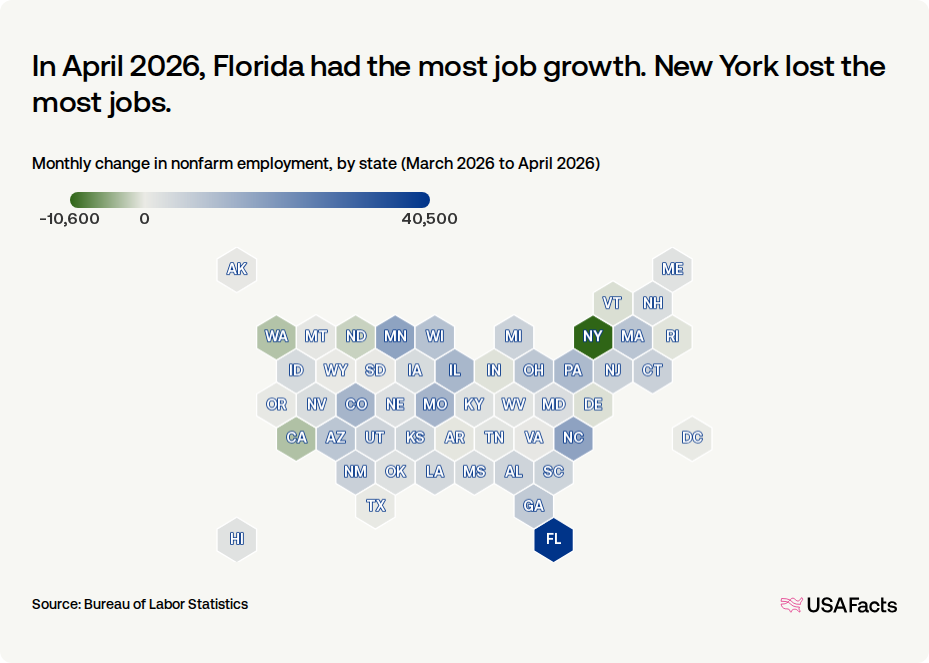
California led all states, gaining 39,400 in August 2026. New York had 23,500 fewer jobs, the largest decline of any state.
Thirty-five states experienced job growth in August 2026.
In August 2026, California had the most job growth. New York lost the most jobs.
Monthly change in nonfarm employment, by state (July 2026 to August 2026)
Among 393 metro areas — urban groupings geographically and economically integrated with one another — the Los Angeles, CA area gained the most jobs in August 2026 with an increase of 18,700. The New York, NY area had the worst job growth, losing 26,000 jobs.
Get weekly insights
Subscribe for data-driven insights. No spin, just the facts.
How does job growth in September 2026 compare to recent months?
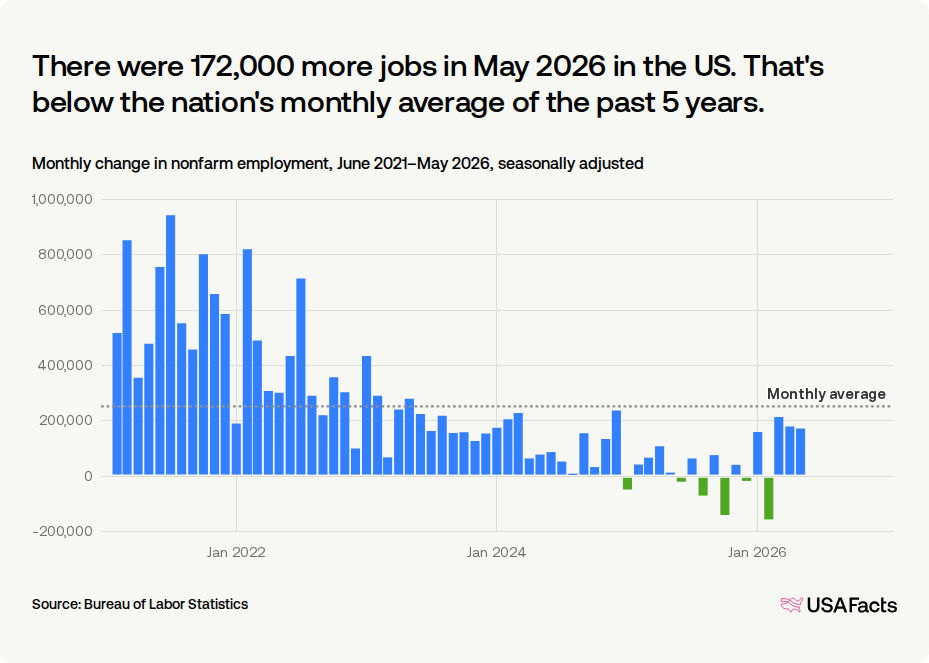
Job growth in September 2026 was below the average number of jobs gained in the last 5 years. Between October 2021 and September 2026 average monthly job gains were 187,900.
During the latest five-year period (October 2021 to September 2026), the US gained jobs in 53 out of 60 months. The most gains came in February 2022 (+819,000) while job growth was weakest in February 2026 (-156,000).
In 2020, at the start of the COVID-19 pandemic, monthly job changes ranged from 20.5 million lost in April to 4.6 million gained in June. Pre-pandemic, the single month of highest job growth was September 1983 (+1.1 million). The month with the worst loss was September 1945 (-2 million).
There were 29,000 more jobs in September 2026 in the US. That's below the nation's monthly average of the past 5 years.
Monthly change in nonfarm employment, October 2021–September 2026, seasonally adjusted
How does job growth in the past year compare to previous years?
Between October 2025 and September 2026 the US has gained an average of 41,300 jobs every month. That's lower than the increase of 53,000 per month in the 12 months preceding (October 2024 to September 2025).
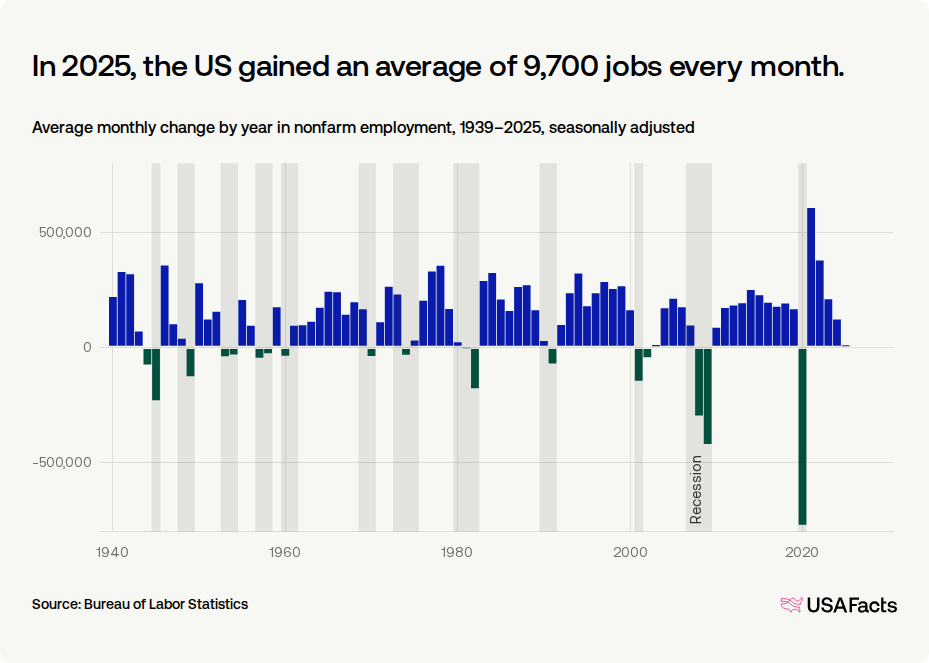
The monthly jobs report data goes back to 1939. The US usually added jobs each year, though the pace varies widely across economic cycles. Job growth slowed or turned negative during recessions (the early 1980s, the Great Recession, and the COVID-19 pandemic) then rebounded during the recoveries.
In 2025, the US gained an average of 9,700 jobs every month.
Average monthly change by year in nonfarm employment, 1940–2025, seasonally adjusted
USAFacts standardizes data, in areas such as time and demographics, to make it easier to understand and compare.
Page sources
USAFacts endeavors to share the most up-to-date information available. We sourced the data on this page directly from government agencies; however, the intervals at which agencies publish updated data vary.