How are public schools in Washington, DC funded?
Refreshed annually
Washington, DC public schools are funded primarily from local governments. In the 2023–2024 school year, the most recent year of available data, about 87.8% of Washington, DC public school funding came from local sources like property taxes. The federal government provided the remaining 12.2%. Altogether, public schools in Washington, DC received $3.39 billion in funding, or $36,700 per student.
$3.39B
of funding went to public schools in Washington, DC (2023–2024 school year)
$36.7K
per student went to public schools in Washington, DC (2023–2024 school year)
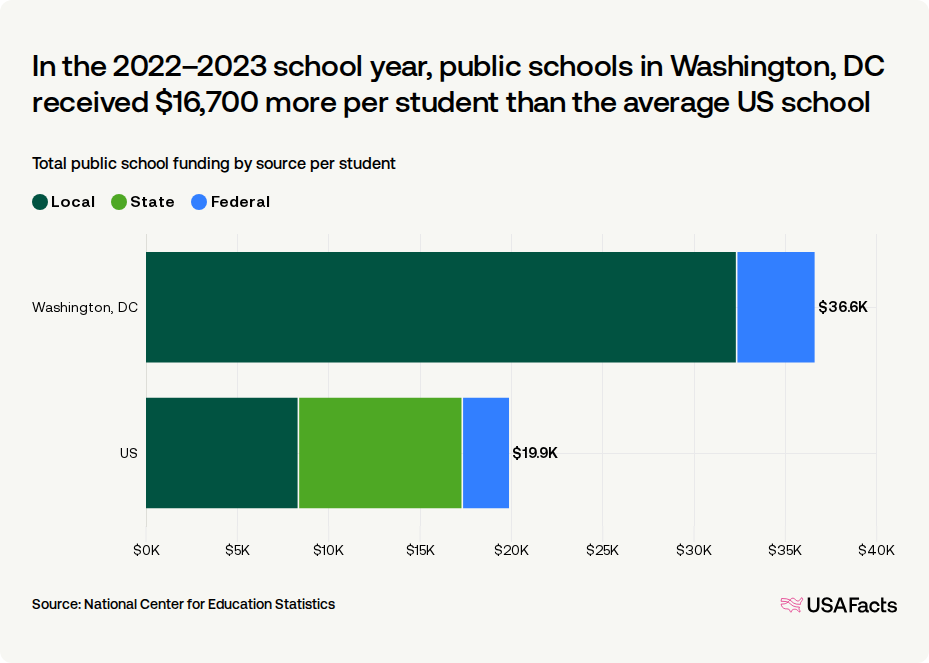
All American public schools are funded with a mix of local, state, and federal money, but the share attributable to each source — and the total amount of funding per student — differs by state. Washington, DC public schools received about $36,700 per student in 2023, roughly $15,600 more than the national average. Unlike other states, Washington, DC doesn’t receive state-level education funding. Instead, its local government covers both city and state responsibilities. As a result, most of DC’s school funding is reported as coming from local sources, totaling around $32,200 per student, compared to $9,000 from local sources nationally.
In the 2023–2024 school year, public schools in Washington, DC received $15,600 more per student than the average US school
Total public school funding by source per student
Where do local, state, and federal funds come from?
Public school districts receive funding from a combination of local, state, and federal sources.
- Local funding often comes from property taxes but can also come from fees or programs like parent-teacher associations.
- State funding is generated through a wide variety of sources that vary from state-to-state, often through personal and corporate income and retail sales taxes. Depending on the state, funding may also come from taxes on tobacco products and alcoholic beverages and from lotteries.
- Federal funding often comes to school districts through a series of targeted grants, like Title I, which supports schools serving low-income communities, or the Individuals with Disabilities Education Act (IDEA), which funds special education services. Much of this funding goes to the state, which is then allocated to individual school districts.
Get weekly insights
Subscribe for data-driven insights. No spin, just the facts.
In the 2023–2024 school year, local, state, and federal funds amounted to $36,700 per student in Washington, DC
Total public school funding by source per student

Which school districts in Washington, DC have the most funding per student? Which districts have the least?
Keep exploring

Methodology
USAFacts standardizes data, in areas such as time and demographics, to make it easier to understand and compare.
Page sources
USAFacts endeavors to share the most up-to-date information available. We sourced the data on this page directly from government agencies; however, the intervals at which agencies publish updated data vary.
